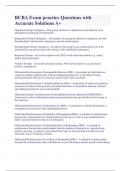
BCBA Exam practice Questions with Accurate Solutions A+
BCBA Exam practice Questions with Accurate Solutions A+ Dependent Group Contingency - The group's reinforcer is dependent on the behavior of an individual or small group of individuals. Independent Group Contingency - All members of a group are offered a contingency, but only the individual's who meet the contingency earn the reinforcement. Interdependent Group Contingency - In order for the group to earn reinforcement, all of the individuals in a group must meet the criterion of the established contingency. Response Prompts - Act on the response itself, NOT on the antecedent stimuli (e.g. verbal, model, physical prompt). Stimulus Prompts - Act on the antecedent stimuli, NOT on the response (e.g. movement, position, redundancy). Differential Reinforcement of Incompatible Behavior (DRI) - A procedure in which behavior cannot be emitted simultaneously with the challenging behavior (e.g. the behavior being reinforced and the behavior on extinction cannot occur at the same time). Differential Reinforcement of Alternate Behavior (DRA) - A procedure in which one reinforces occurrence of behavior that provides a desirable alternative to the problem behavior; alternate and challenging behavior are not incompatible. Differential Negative Reinforcement of Incompatible/Alternate Behavior (DNRI/DNRA) - Terms used to refer to differential reinforcement procedures that specifically involve escape as the reinforcer. Differential Reinforcement of Other Behavior (DRO) - A procedure in which reinforcement is contingent on the absence of the challenging behavior. Differential Reinforcement of High Rates of Responding (DRH) - A schedule of reinforcement that provides reinforcement for emitting behaviors that are at or above a pre-established rate; helps to increase behaviors that are too infrequent. Differential Reinforcement of Diminishing Rates of Responding (DRD) - A schedule of reinforcement that provides reinforcement when the number of responses in a specified time period is less than, or equal to, a prescribed limit; helps to decrease behaviors that occur too frequently, but not eliminate it entirely. Differential Reinforcement of Low Rates of Responding (DRL) - A schedule of reinforcement that provides reinforcement only if the behavior occurs following a specific period of time during which it did not occur or since the last time it occurred; by increasing IRT, you are lowering rate of responding. 7 dimensions of ABA- Behavioral - Observable events. 7 dimensions of ABA- Applied - Improves socially significant behaviors. 7 dimensions of ABA- Technological - Defines procedures clearly and in detail so they are replicable. 7 dimensions of ABA- Conceptually Systematic - All procedures used should be tied to the basic principles of behavior analysis from which they were derived. 7 dimensions of ABA- Analytic - A functional relationship is demonstrated. 7 dimensions of ABA- Generality - Extends behavior change across time, settings, or other behaviors. 7 dimensions of ABA- Effective - Improves behavior in a practical manner, not simply making a change that is statistically significant. Mentalism - Approach to explaining behavior that assumes an inner dimension exists and causes behavior (Freud) Hypothetical Constructs - Presumed, but unobserved, entities (e.g. free will) Explanatory Fictions - Fictitious variables that are another name for the observed behavior; contribute nothing to an understanding of the variables responsible for maintaining behavior (e.g. "knows", "wants"). Circular Responding - The cause and effect are both inferred from the same information (e.g. he cried because he felt sad). Behaviorism - The philosophy of the science of behavior; environmental (not mentalistic) explanation of behavior. 4 branches of behavior analysis - 1. Conceptual analysis of behavior (behaviorism): examines philosophical, theoretical, historical, and methodological issues. 2. ABA: technology for improving behavior. 3. Behavior service delivery: professional practice, consultation, etc. 4. Experimental analysis of behavior: research on basic processes and principles; labs. Respondent Behavior - Elicited by stimuli that immediately precede them; involuntary; reflex. Respondent Conditioning - When new stimuli acquire the ability to elicit respondents Operant Behavior - Any behavior whose probability of occurrence is determined by its history of consequences; voluntary action; function. Ontogenic - Learning that results from an organism's interaction with his environment (operant behavior is due to ------ history). Contiguity - When 2 stimuli occur close together in time, resulting in an association of those 2 stimuli (e.g. how superstition is developed) Stimulus Equivalence- Reflexivity - Simple non-symbolic match to sample (A=A). Stimulus Equivalence- Symmetry - Occurs with reversibility of the sample stimulus and the comparison stimulus (A=B). Stimulus Equivalence- Transitivity - Requires demonstration of 3 untrained stimulus-stimulus sequences (A=B, B=C, A=C). Surrogate MO - A stimulus that has acquired its effectiveness by accompanying some other MO and has come to have the same value-altering and behavior-altering effect as the MO that is has accompanied; pairing process required. Example: clock and food deprivation. Reflexive MO - Conditions or objects that acquire their effectiveness as MO's by preceding a situation that either is worsening or improving (e.g. signal that aversive events coming soon) Transitive MO - An environmental variable that establishes (or abolishes) the reinforcing effectiveness of another stimulus and thereby evokes (or abates) the behavior that has been reinforced by that other stimulus; establishes the reinforcing value of a second stimulus change (e.g. getting the right tool or the correct amount of money). Response Class - Group of behaviors that comprise an operant (have the same function). Stimulus Class - Group of antecedent stimuli that have a common effect on an operant class. Stimulus Generalization - Individual responds to something in the same way that resembles the original thing from which they learned (e.g. seeing an animal with a tail and saying, "kitty"). Response Generalization - The effects of intervention are expanded from a target response to a similar non-targeted behavior; the form of the response/behavior changes. 7 strategies to promote generalization- Common Stimuli - Programming common stimuli by ensuring that same sDs exist in both the instructional and generalization setting. 7 strategies to promote generalization- Loosely Train - Noncritical elements of the teaching setting are altered in arbitrary ways (e.g. therapy in different settings). 7 strategies to promote generalization- Multiple Exemplars - Providing opportunities to correctly respond to multiple examples of antecedent stimuli. 7 strategies to promote generalization- Mediation - instruct others who will help maintain and generalize new behaviors. 7 strategies to promote generalization- Indiscriminable Contingencies - The learner is unable to discriminate when his/her responses will be reinforced. 7 strategies to promote generalization- Negative Teaching Examples - Teaching settings/times/conditions when it is not appropriate to display a certain behavior. 7 strategies to promote generalization- General Case Analysis - Teaching all the different stimulus variations and response variations the individual may encounter in the post-intervention environment. Matching Law - Given 2 concurrently available reinforcers, he will choose to engage in the behavior that has the highest rate of reinforcement. Habilitation - Assesses meaningfulness of change. It occurs when a persons repertoire has been changed such that short & long term reinforcers are maximized & short & long term punishers are minimized. Generative Learning - Enhancing comprehension of new material due to previous learning; ensuring fluency. Stimulus Preference Assessment - Identifies stimuli that are likely to function as reinforcers; preference value (high vs. low). Reinforcer Assessment - Used to determine the relative effects of a given stimulus as reinforcement under different and changing conditions; assess the comparative effectiveness of multiple stimuli as reinforcers for a particular behavior under certain conditions. Experimental Control - When a predictable change in behavior (DV) can be reliably produced by the systematic manipulation of some aspect of the individuals environment (IV). 6 components of experiments in ABA - 1. At least one subject 2. At least one behavior (DV) 3. At least one setting 4. At least one treatment (IV) 5. A measurement system and ongoing analysis of behavior 6. An experimental design Internal Validity - The extent that an experiment shows that changes in behavior are a function of the IV and not the result of uncontrolled variables; high ------ designs showing strong experimental control.
Written for
- Institution
- BCBA
- Module
- BCBA
Document information
- Uploaded on
- December 9, 2023
- Number of pages
- 11
- Written in
- 2023/2024
- Type
- Exam (elaborations)
- Contains
- Questions & answers
Subjects
-
response prompts
-
bcba exam practice questions with accurate solutio
-
independent group contingency

Also available in package deal