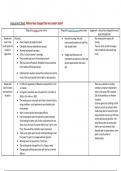
Assessment Sheet: Whose lives changed the most under Stalin?
Things that changed under Stalin Things that stayed the same under Stalin Judgement – whose lives changed the most?
Brief EXPLANATION
People who Peasants; ● Peasants housing: they had - Not many positive aspects for
lived in the ● A vast majority of people lost land one-roomed wooden huts and they farmers
countryside and ● Collective chairman ordered them around had outside toilets - They loss land, earned low wages,
worked in ● Received extremely low wages had no freedom and worked long
agriculture ● (20% of a factory worker’s earnings) ● Villages had miniscule new hours
● They worked long hours of hard physical work. investments so had none of the new
● They had a lack of freedom, forbidden to leave collective leisure opportunities that towns
farms without official permission. did.
● Collective-farm workers received free medical care but for
most of the Soviet period had no right to state pensions.
People who ● In 1936, the population of Moscow increased from 2.2 to - There was a decline in working
lived in towns 4.1 million conditions, however employment
and worked in ● Leningrad’s population also increased from 1.6 million in levels in the early 1930’s reached
factories 1926 to 3.4 million in 1939. 25% of the workforce in Western
● The working class and people who lived in towns had tiny Countries
living conditions: small apartments were divided up for - Factories gave basic clothing to their
more people. workers and set up canteens which
● Work in towns became increasingly difficult. made cheap but hot meals for them
- Larger factories also set up child care
● Internal passports were introduced to prevent workers
centres and laundry facilities - this
from looking for better jobs. Police could demand to see
eased the burden on women who
them at any time and if a worker didn’t have “right” to be
had to carry out domestic tasks
there, they would be arrested or even imprisoned - Rewards and increased rations were
● Trade union rights were heavily restricted. Managers had given to shock workers /
the power to sack or cut wages without approval. Stakhanovites
● Working hours increased from 7 to 8 hours.
● The working week changed from 5 to 6 days a week
● Changing jobs without permission will now be a criminal
offence
Things that changed under Stalin Things that stayed the same under Stalin Judgement – whose lives changed the most?
Brief EXPLANATION
People who Peasants; ● Peasants housing: they had - Not many positive aspects for
lived in the ● A vast majority of people lost land one-roomed wooden huts and they farmers
countryside and ● Collective chairman ordered them around had outside toilets - They loss land, earned low wages,
worked in ● Received extremely low wages had no freedom and worked long
agriculture ● (20% of a factory worker’s earnings) ● Villages had miniscule new hours
● They worked long hours of hard physical work. investments so had none of the new
● They had a lack of freedom, forbidden to leave collective leisure opportunities that towns
farms without official permission. did.
● Collective-farm workers received free medical care but for
most of the Soviet period had no right to state pensions.
People who ● In 1936, the population of Moscow increased from 2.2 to - There was a decline in working
lived in towns 4.1 million conditions, however employment
and worked in ● Leningrad’s population also increased from 1.6 million in levels in the early 1930’s reached
factories 1926 to 3.4 million in 1939. 25% of the workforce in Western
● The working class and people who lived in towns had tiny Countries
living conditions: small apartments were divided up for - Factories gave basic clothing to their
more people. workers and set up canteens which
● Work in towns became increasingly difficult. made cheap but hot meals for them
- Larger factories also set up child care
● Internal passports were introduced to prevent workers
centres and laundry facilities - this
from looking for better jobs. Police could demand to see
eased the burden on women who
them at any time and if a worker didn’t have “right” to be
had to carry out domestic tasks
there, they would be arrested or even imprisoned - Rewards and increased rations were
● Trade union rights were heavily restricted. Managers had given to shock workers /
the power to sack or cut wages without approval. Stakhanovites
● Working hours increased from 7 to 8 hours.
● The working week changed from 5 to 6 days a week
● Changing jobs without permission will now be a criminal
offence