AP US History Chapter 1 Summaries
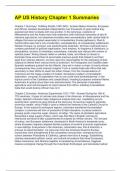
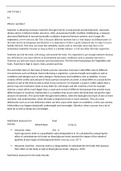
Chapter 1 Summary: Colliding Worlds - Answer-Native American, European, and African societies developed independently over thousands of years before they experienced direct contacts with one another. In the Americas, residents of Mesoamerica and the Andes were fully sedentary (with individual ownership of land & intensive agriculture), but elsewhere societies were semisedentary (with central fields & villages that were occupied seasonally) or nonsedentary (hunter-gatherers). West & Central Africa also had a mix of sedentary, semisedentary, & nonsedentary settlements. Western Europe, by contrast, was predominantly sedentary. All three continents had a complex patchwork of political organization, from empires, to kingdoms & chiefdoms, to principalities, duchies, & ministates; everywhere, rulership was imbued with notions of spiritual power. Ruling classes relied on warfare, trade, and tribute (or taxes) to dominate those around them & accumulate precious goods that helped to set them apart from ordinary laborers, but they also bore responsibility for the well-being of their subjects & offered them various forms of protection. As Portuguese and Castilian (later Spanish) seafarers pushed into the Atlantic, they set in motion a chain of events whose consequences they could scarcely imagine. From a coastal trade with Africa that was secondary to their efforts to reach the Indian Ocean, from the miscalculations of Columbus and the happy accident of Cabral, developed a pattern of transatlantic exploration, conquest, & exploitation that no one could have foretold/planned. In the tropical zones of the Caribbean and coastal Brazil, invading Europeans enslaved Native Americans & quickly drove them into extinction/exile. The demands of plantation agriculture soon led Europeans to import slaves from Africa, initiating a transatlantic trade that would destroy African lives on b Chapter 2 Summary: American Experiments - Answer-During the 16th & 17th centuries, 3 types of colonies took shape in the Americas. In Mesoamerica and the Andes, Spanish colonists made indigenous empires their own, capitalizing on pre-existing labor systems & using tribute & the discovery of precious metals to generate enormous wealth, which Phillip II used to defend the interests of the Catholic Church in Europe. In the tropical & subtropical regions, colonizers transferred the plantation complex: a centuries-old form of production & labor discipline, to places suited to growing exotic crops like sugar, tobacco, & indigo. The rigors of plantation agriculture demanded a large supply of labor, which was first filled in English colonies by indentured servitude & later supplemented & eclipsed by African slavery. The 3rd type of colony, neo-European settlement, developed in North America's temperate zone, where European migrants adapted familiar systems of social & economic organization in new settings. Everywhere in the Americas, colonization was, first & foremost, a process of experimentation. As resources from the Americas flowed to Europe, monarchies were strengthened & the competition among them, sharpened by the schism between Protestants & Catholics, gained new force & energy. Establishing colonies demanded political, social, and cultural innovations that threw Europeans, Native Americans, and Africans together in bewildering circumstances, triggered massive ecological change through the Columbian Exchanged, and demanded radical
Written for
- Institution
- Ap US History
- Module
- Ap US History
Document information
- Uploaded on
- February 19, 2024
- Number of pages
- 15
- Written in
- 2023/2024
- Type
- Exam (elaborations)
- Contains
- Questions & answers
Subjects
-
ap us history chapter 1 summaries
-
chapter 1 summary colliding worlds an

Also available in package deal