Bio 252 Exam 1 (Questions + Answers) Solved
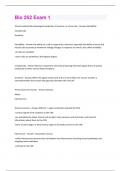
Three fundamental physiological properties of neurons, or nerve cells - Answer-Excitability Conductivity Secretion Excitability - Answer-the ability of a cell to respond to a stimulus, especially the ability of nerve and muscle cells to produce membrane voltage changes in response to stimuli; also called irritability -all cells are excitable -nerve cells are excitable to the highest degree Conductivity - Answer-Neurons respond to stimuli by producing electrical signals that are quickly conducted to other cells at distant locations Secretion - Answer-When the signal reaches the end of a nerve fiber, the neuron secretes a neurotransmitter that crosses the gap and stimulates the next cell Three classes of neurons - Answer-Sensory Motor Interneurons Sensory neurons - Answer-Afferent = signal conduction towards the CNS -conduct signals from receptors to the CNS -are specialized to detect stimuli such as light, heat, pressure, and chemicals, and transmit information about them to the CNS -these neurons begin in almost every organ in the body and end in the CNS Interneuron - Answer--Association neuron -called interneurons because they lie between and interconnect incoming sensory pathways and outgoing motor pathways -confined to the CNS-receive signals from many other neurons and carry out the integrative function of the nervous system = they process, story, and receive information and "make decisions" that determine how the body responds to a stimuli -90% of our neurons are interneurons - Motor - Answer--Efferent = signifies conduction away from CNS -conduct signals from the CNS to effectors such as muscles and glands -called motor cause most lead to muscle cells - Soma - Answer--control center of a neuron -neurosoma or cell body -contains a centrally located nucleus with a large nucleolus -cytoplasm contains mitochondria, lysosomes, a golgi complex, numerous inclusions, and extensive rough ER and cytoskeleton =cytoskeleton = consists of a dense mesh of microtubules and neurofibrils (bundles of actin filaments) which compartmentalize the rough ER into dark-staining regions called Nissl bodies
Written for
- Institution
- Bio 252
- Module
- Bio 252
Document information
- Uploaded on
- March 6, 2024
- Number of pages
- 4
- Written in
- 2023/2024
- Type
- Exam (elaborations)
- Contains
- Questions & answers
Subjects
-
bio 252

Also available in package deal