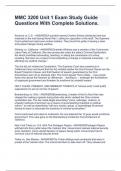
MMC 3200 Unit 1 Exam Study Guide Questions With Complete Solutions.
Schenck vs. U.S. - ANSWERSA socialist named Charles Scheck distributed anti-war materials in the mail during World War I, calling for opposition of the draft. The Supreme Court upheld and ruled over context matters. They found him guilty of posing a clear and present danger during wartime. Whitney vs. California - ANSWERSCharlotte Whitney was a member of the Communist Labor Party of California. She was prosecuted under the state's Criminal Syndicalism Act which prohibited advocating, teaching, or aiding the commission of a crime, including "terrorism as a means of accomplishing a change in industrial ownership. . .or effecting any political change." The Act did not violate the Constitution. The Supreme Court was unanimous in California's favor and found that the Act violated neither the Due Process Clause nor the Equal Protection Clause, and that freedom of speech guaranteed by the First Amendment was not an absolute right. The Court argued "that a State. . .may punish those who abuse this freedom by utterances. . .tending to. . .endanger the foundations of organized government and threaten its overthrow by unlawful means" ONLY CLEAR, PRESENT, AND IMMINENT THREATS of "serious evils" could justify suppression (to put an end to) of speech. Brandenburg vs. Ohio - ANSWERSBrandenburg, a leader of the Ku Klux Klan was charged for making a speech during their rally which violated the Ohio criminal syndicalism law. The law made illegal advocating "crime, sabotage, violence, or unlawful methods of terrorism as a means of accomplishing industrial or political reform," as well as assembling "with any society, group, or assemblage of persons formed to teach or advocate the doctrines of criminal syndicalism." Court overturned and ruled on incitement. No one believed the 12 guys would overthrow government. This case gave us the Brandenburg Incitement Test (incitement of violence). New York Times vs. U.S. AKA The Pentagon Papers - ANSWERSPentagon Papers withheld info from public about the Vietnam War. Government claimed national security (prior restraint). Court upheld decision of papers being public. Government had to convince court of national security threat. Tinker vs. Des Moines - ANSWERSThe Tinker siblings wore armbands that were in protest of the Vietnam War. The school told them to take them off. They refused and were suspended. The Supreme Court ruled the arm bands were a form of freedom of protest and expression (1st Amendment). The arm bands did not disrupt the class,
Written for
- Institution
- MMC 3200
- Module
- MMC 3200
Document information
- Uploaded on
- April 4, 2024
- Number of pages
- 9
- Written in
- 2023/2024
- Type
- Exam (elaborations)
- Contains
- Questions & answers
Subjects
-
mmc 3200 unit 1 exam study guide questions with co
-
mmc 3200 unit 1 exam study guide stuvia
-
schenck vs us answersa socialist named charl
-
whitney vs california answerscharlotte whitney

Also available in package deal