Edexcel IGCSE Physics Exam Question And Correct Answers.
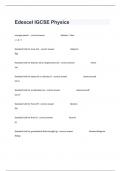
average speed = - correct answer distance / time v = d / t Standard Unit for mass (m) - correct answer kilogram (kg) Standard Unit for distance (d) or displacement (s) - correct answer metre (m) Standard Unit for speed (s) or velocity (v) - correct answer metre/second (m/s) Standard Unit for acceleration (a) - correct answer metre/second² (m/s²) Standard Unit for Force (F) - correct answer Newton (N) Standard Unit for time (t) - correct answer Second (s) Standard Unit for gravitational field strength (g) - correct answer Newton/kilogram (N/kg) Standard Unit for moment (Paper 2 Only) - correct answer Newton metre (Nm) Standard Unit for momentum (p) (Paper 2 Only) - correct answer kilogram metre/second (kg m/s) What does the gradient of a distance-time graph represent? - correct answer Gradient or the slope gives the speed. Flat line means stationary, straight line means constant speed, curved line means accelerating Describe how to investigate the motion of a toy car - correct answer - Set a ramp up so that the top of it is a certain height, h, above the desk, and the other end is fixed in place on the desk. - Measure the distance the toy car will travel down the ramp using a metre ruler. - Measure the time taken for the toy car to roll down the ramp using a stop watch. - As it is difficult to start and stop the watch at exactly the right time, the experiment is repeated five times so an average time can be calculated. - Divide the distance by the average time to calculate the average speed of the car. - To improve the accuracy of the experiment, light gates connected to electronic timers could be used as human reaction times will no longer affect the results. We still take multiple readings as the car may not have been released in exactly the same way each time. - An electronic timer that reads to more decimal places will give the answer to a greater level of precision. Acceleration = - correct answer Change in velocity/time taken a = (v-u) / t What does the gradient of a velocity-time graph represent? What does the area underneath the line represent? - correct answer gradient = acceleration flat line = constant velocity straight lines = constant acceleration (changing velocity) area under graph = distance travelled (final speed)² = - correct answer (initial speed)² + (2 x acceleration x distance) v² = u² + (2 x a x s) (This equation is given to you) A force can change an objects.... - correct answer - speed - shape - direction Types of force.... - correct answer Gravitational (Weight) Electrostatic Magnetic Friction Air Resistance (Drag) Upthrust (from fluids) Reaction (from solids) Engine force (and more...) What is Scalar? Give some examples - correct answer A measurement with just magnitude. Time, distance, temperature, mass, energy, charge, area, volume, frequency etc. What is a Vector? Give some examples - correct answer A measurement with magnitude and direction. Velocity, acceleration, force, weight, momentum, etc. There is an unbalanced force - correct answer when 2 or more forces acting on an object are uneven Resultant Force is..... - correct answer The combination of all forces acting on an object. Newton's 2nd Law: Force = - correct answer mass x acceleration F = m x a Newton's 2nd Law: Acceleration - correct answer force / mass a = F / m Newton's 2nd law: Mass - correct answer force / acceleration m = F / a Weight = - correct answer mass x gravitational field strength W = m x g Friction and Air Resistance act in what direction? - correct answer The direction that opposes motion (e.g. if an object is falling then air resistance is acting upwards) Stopping Distance = - correct answer Thinking Distance + Braking Distance. It is the total distance for the car to come to a complete stop What is Thinking Distance? What factors affect it? - correct answer The distance taken for the driver to react and apply the brakes. - Tiredness, Alcohol or drugs, Distractions, Age, Poor Visibility (e.g. fog), Reaction Time What is Braking Distance? What factors affect it? - correct answer The distance traveled while the braking force stops the car. - Speed, Condition of the tires and brakes, Condition of the road surface (including weather conditions such as ice or water on the road), Mass of the vehicle What is Terminal Velocity? What is the Resultant force on an object traveling at Terminal Velocity? What forces are acting on an object falling at Terminal Velocity? - correct answer Where an object reaches a maximum constant velocity. The forces on the object are balanced and so the resultant force is Zero Newtons. As an object falls, its weight causes it to accelerate. As it gets faster, the air resistance increases until it balances the weight of the object. At this point the forces are balanced and it no longer accelerates. Describe how to investigate how the extension of an object, such as a spring, varies with applied force. - correct answer - Clamp a spring onto a stand, such that it is hanging vertically down. - Measure the spring's original length. - Place a known weight (100g = 1N) on to the end of the spring and measure how far it has extended. A pointer attached to the spring (fiducial marker) can help to reduce parallax errors. - Repeat the process by adding one weight at a time and measuring the extended length each time. - Calculate the extension for each weight (Extension = extended length - original length) - Plot a graph of force against extension - Draw a line of best fit. It should be a straight line through the origin. If it is, then the extension is proportional to the applied force, and the spring is said to obey Hooke's law. - The Spring Constant can be calculated by dividing the change in Force by the extension. Hooke's law says... - correct answer the extension of a spring (or other material) is proportional to the force applied to it What is elastic behaviour? - correct answer The ability of a material to recover its original shape after the forces causing deformation have been removed. What is the Conservation of Momentum? (Paper 2 only) - correct answer The total momentum of objects before a collision is equal to the total momentum of objects after the collision. Momentum =
Written for
- Institution
- EDECEL
- Module
- EDECEL
Document information
- Uploaded on
- April 6, 2024
- Number of pages
- 38
- Written in
- 2023/2024
- Type
- Exam (elaborations)
- Contains
- Questions & answers
Subjects
-
edexcel igcse physics

Also available in package deal