OCR a level PE Practice Exam With Complete Answers.
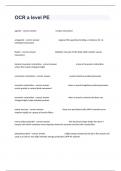
agonist - correct answer creates movement antagonist - correct answer opposed the agonist providing a resistance for co-ordinated movement fixator - correct answer stabilises one part of the body while another causes movement Isotonic muscular contraction - correct answer a type of muscular contraction where the muscle changes length concentric contraction - correct answer muscle shortens producing tension eccentric contraction - correct answer when a muscle lengthens producing tension, resists gravity to control joint movement isometric contraction - correct answer when a muscle contracts but does not change length, helps maintain posture motor neurons - correct answer these are specialised cells which transmit nerve impulse rapidly to a group of muscle fibres nerve action potential - correct answer the electrical charge inside the nerve + muscle cells which conducts nerve impulses down the neurone and into the muscle fibre phosphocreatine - correct answer a high energy compound stored in the muscle cell used as a fuel for very high intensity energy production (ATP-PC system) mitochondria - correct answer a structure in the cytoplasm thats responsible for aerobic energy production myoglobin - correct answer a protein in the muscle responsible for transporting oxygen to the mitochondria small motor units - correct answer these units stimulate few and small muscle fibres, this creates a motor unit which produces a slow and small amount of force but can resist fatigue large motor units - correct answer stimulate many large muscle fibres and creates a large force rapidly but fatigues quickly pulmonary circuit - correct answer circulation of blood through pulmonary artery to the lungs and pulmonary vein back to the heart systemic circuit - correct answer circulation of blood through aorta to the body and vena cava back to the heart myogenic - correct answer muscle tissue that has the capacity to generate its own electrical impulse that passes through muscular walls, forcing them to contract SA (Sino-atrial) node - correct answer located in the right partial wall, it generates electrical impulse and forces walls to contract AV (atrio-ventricular) node - correct answer it collects the impulse and delays it for 0.1 seconds to allow the atria to finish contracting. Bundle of His - correct answer located in the septum of the heart, it splits the impulse in two, so its ready to be distributed through each separate ventricle bundle branches - correct answer it carries impulse to base of each ventricle purkyne fibres - correct answer these distribute impulse through ventricle walls, causing them to contract cardiac dystole - correct answer the relaxation phase of the cardiac cycle cardiac systole - correct answer the contraction phase of the cardiac cycle diastole - correct answer As the atria then ventricles relax, they expand; drawing blood into the atria The pressure in the atria increase, opening av valves Blood passively enters the ventricles SL valves close to prevent blood leaving the heart atrial systole - correct answer the atria contract, forcing remaining blood into ventricles ventricular systole - correct answer the ventricles contract, increase pressure closing AV valves to prevent back flow into atria SL valves and forced open as blood is ejected from ventricles into the aorta and pulmonary artery AV valves - correct answer bicuspid and tricuspid valves SL valves - correct answer semilunar valves (in arteries leaving the heart) heart rate - correct answer number of times the heart beats per minute stroke volume - correct answer the volume of blood ejected from the left ventricle per beat cardiac output - correct answer the volume of blood ejected from the left ventricle per minute Q = HR x SV
Written for
- Institution
- OCR-A
- Module
- OCR-A
Document information
- Uploaded on
- April 10, 2024
- Number of pages
- 8
- Written in
- 2023/2024
- Type
- Exam (elaborations)
- Contains
- Questions & answers
Subjects
-
ocr a level pe

Also available in package deal