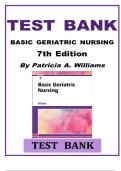
TEST BANK BASIC GERIATRIC NURSING 7th Edition By Patricia A. Williams
TEST BANK BASIC GERIATRIC NURSING 7th Edition By Patricia A. Williams Test Bank: Basic Geriatric Nursing, 7th Edition by Patricia A. Williams TEST BANK: Basic Geriatric Nursing, 7th Edition by Patricia A. Williams Contents Unit One: Overview of Aging Chapter 1. Trends and Issues Chapter 2. Theories of Aging Chapter 3.Physiologic Changes Unit Two: Basic Skills for Gerontologic Nursing Chapter 4. Health Promotion, Health Maintenance, and Home Health Considerations Chapter 5. Communicating with Older Adults Chapter 6. Maintaining Fluid Balance and Meeting Nutrition Needs Chapter 7. Medications and Older Adults Chapter 8. Health Assessment for Older Adults Chapter 9. Meeting Safety Needs of Older Adults Unit Three: Psychosocial Care of the Elderly Chapter 10. Cognition and Perception Chapter 11.Self-Perception and Self-Concept Chapter 12. Roles and Relationships Chapter 13. Coping and Stress Chapter 14. Values and Beliefs Chapter 15. End-of-Life Care Chapter 16. Sexuality and Aging Unit Four: Physical Care of the Elderly Chapter 17. Care of Aging Skin and Mucous Membranes Chapter 18. Elimination Chapter 19. Activity and Exercise Chapter 20. Sleep and Rest Chapter 01: Trends and Issues Williams: Basic Geriatric Nursing, 7th Edition MULTIPLE CHOICE 1) What fact explains the shift of health care focus toward the older adult in the late 1960s? a. Disability was viewed as unavoidable. b. Complications from disease increased mortality. c. Older adults’ needs are similar to those of all adults. d. Preventive health care practices increased longevity. ANS: D 2) The daughter of a patient who has been diagnosed with terminal cancer asks which documents are required to allow her to make health care decisions for her parent. Which response would provide the most accurate information to the daughter? a. Advance directives indicate the degree of intervention desired by the patient. b. A ‘Do Not Resuscitate’ document signed by the patient transfers authority to the next of kin. c. A durable power of attorney for health care transfers decision-making authority for health care to a designated person. d. A living will transfers authority to the physician. ANS: C 3) “Baby boomers” is a term used to classify which of the following persons? a. Those who entered school in 1945 b. Those who served in the military in World War II c. Those who were born between 1946 and 1964 d. Those who were eligible for Social Security benefits in 2000 ANS: C 4) What type of abuse is demonstrated by restraining an older adult in a recliner? a. Physical abuse b. Neglect c. Emotional abuse d. Self-neglect ANS: A 5) Which type of elder abuse is demonstrated by the nonprovision of medical care? a. Physical abuse b. Neglect c. Emotional abuse d. Self-neglect ANS: B 6) Which type of elder abuse is demonstrated by a health care worker telling a nursing home resident she will be left without a call light if she continues to use it excessively. a. Physical abuse b. Neglect c. Emotional abuse d. Self-neglect ANS: C 7) The daughter of a resident in a long-term care facility is frustrated with her 80-year-old mother’s refusal to eat. Which response would be the most appropriate? a. The refusal to eat is an effort to maintain a portion of independence and self-direction. b. The refusal to eat is an indication of approaching Alzheimer disease. c. The refusal to eat is an effort to gain attention. d. The refusal to eat is an indication of the dislike of the institutional food. ANS: A 8) When do the conditions of a living will go into effect? a. When the patient declares that desire in writing b. When a family member indicates the desire for curative therapy to cease c. When two physicians agree in writing that the criteria in the living will have been met d. When the physician and a family member agree that the criteria in the living will have been met ANS: C 9) In the 1980s, Medicare initiated a program of diagnosis-related groups (DRGs) to reduce hospital costs. How did the DRGs reduce hospital costs? a. By classifying various diagnoses as ineligible for hospitalization b. By allotting a set amount of hospital days and prospective payment on the basis of the admitting diagnosis c. By specifying particular physicians to treat specified diagnoses d. By using frequency of a particular diagnosis to set a payment schedule ANS: B 10) To what age group does the term “aged” apply? a. 55–64 years of age b. 65–74 years of age c. 75–84 years of age d. 85 and older ANS: C 11) Which is true of ageism? a. It is discrimination against persons solely on the basis of age. b. It causes a person to fear aging. c. It involves the use of cultural sensitivity to address concerns of aging. d. It focuses on resources for the older adult ANS: A
Written for
- Institution
- BASIC GERIATRIC NURSING 7th Edition
- Module
- BASIC GERIATRIC NURSING 7th Edition
Document information
- Uploaded on
- April 11, 2024
- Number of pages
- 116
- Written in
- 2023/2024
- Type
- Exam (elaborations)
- Contains
- Questions & answers
Subjects
-
basic geriatric nursing
-
test bank basic geriatric nursing 7th edition
-
basic geriatric nursing 7th edition
-
test bank basic geriatric nursing
Also available in package deal