test-bank-understanding-statistics-in-the-behavioral-sciences-10th-edition
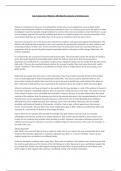
test-bank-understanding-statistics-in-the-behavioral-sciences-10th-editionCHAPTER 1 STATISTICS AND SCIENTIFIC METHOD LEARNING OBJECTIVES After completing Chapter 1, students should be able to: 1. Describe the four methods of establishing truth, 2. Contrast observational and experimental research 3 Contrast descriptive and inferential statistics. 4. Define the following terms: population, sample, variable, independent variable, dependent variable, constant, data, statistic, and parameter. 5. Identify the population, sample, independent and dependent variable, data, statistic and parameter from the description of a research study 6. Specify the difference between a statistic and a parameter. 7. Give two reasons why random sampling is important. 8. Understand the illustrative example, do the practice problem and understand the solution. DETAILED CHAPTER SUMMARY I. Methods of Acquiring Knowledge A. Authority. One accepts information as being true because someone who is supposed to know tells you something is true. B. Rationalism. This method uses reason alone to arrive at knowledge. One analyzes a situation and draws logical conclusions based on the information at hand. The conclusion is not tested empirically to determine if it is correct. Downloaded by DANIEL NDAMBIRI () lOMoARcPSD| Agradestuvia 46 Part 2: Chapter 1 C. Intuition. This is a sudden insight that springs into consciousness all at once as a whole. D. Scientific method. This method uses reasoning and intuition as a means of formulating an idea of what is true but then relies on objective assessment to verify or deny the validity of the idea. 1. Idea formed and hypothesis made. 2. Experiment designed. 3 Data collected and analyzed using statistics. 4. Hypothesis confirmed, denied or modified. II. Scientific Research A. Observational studies. In this research there is no direct experimental manipulation of variables. This technique employs naturalistic observation of events in their real world environment 1. Correlation. A type of observation where the relationship between two variables is studied. 2. Parameter estimation. This is when an investigator tries to determine the actual characteristics of the population, based on measuring a subset of the population. B. True experiments. The investigator attempts to determine if changes in one variable produce changes in another. In both observational studies and true experiments, statistical analysis is usually employed. C. Statistical analysis. 1. Descriptive statistics. Analysis is conducted to describe the obtained data. 2. Inferential statistics. Analysis is conducted to make inferences about a population using data obtained from the sample. TEACHING SUGGESTIONS AND COMMENTS Since this is your first lecture on content, before you plunge into the content of Chapter 1, I suggest that you first say some things about the web material and the To The Student section that follows the preface in the textbook. 1. Online Resources. It is a good idea for you to call the attention of your students to the Online Study Resources material shown at the end of the chapter, pointout the options and discuss them briefly. In fact, if your classroom allows access to the internet and has monitors that students can view, I suggest you complete document is available on Downloaded by DANIEL NDAMBIRI () lOMoARcPSD| Agradestuvia Part two: Chapter 1 47 spend a few minutes going through some of the options on the Online Study Resources website. The options that I recommend you demonstrate in this order are Know and BeAble to Do, Flashcards, Tutorial Quiz, and Glossary. As I discussed in the general teaching advice, these are all chapter specific and I believe very helpful to students in mastering the material of each chapter. A word or two is in order regarding the option, Know and Be Able to Do. This option presents a listing of what I believe students should know and be able to do to successfully complete each chapter. However, my list may not agree with yours. If so, then by all means change the list so that it is yours. Of course, be sure to inform students of the list you want them to use also think it a good idea to periodically reinforce web use by briefly asking students how they are doing regarding the web material and at least once more suggesting how valuable using them can be. (Of course, this assumes you like the web material. If not, then the above paragraph is moot). 2. SPSS. If you want your students to learn and use SPSS, since there is no instruction on SPSS in Chapter 1, I suggest you defer discussing SPSS in any detail until you begin lecturing on Chapter 2. 3. Aplia. If you are using Aplia, I suggest you go over its operation including the following: a. How to display the relevant chapter. b. How to display the relevant problems. Be sure to show students how to change the data for any problem to get additional practice with new numbers. c. How to have the computer score the student answers. d. How to access the detailed explanation of answers. e. How to access and use the tutorials. f. It may also be necessary to demonstrate to the students how to use the graphic tools supplied by Aplia. g. Show students how to access Aplia’s help section. In addition, in assigning homework problems, I recommend you chose among the textbook end-of-chapter problems and the additional Aplia created problems. Of course, I like the textbook problems since I wrote them, but Aplia has added good problems too. I think a mix of problems from both sources is probably the best choice for any chapter. 4. To the student. The first lecture is also a good time to mention the section titled, To The Student. Among other information, this section contains important studying advice. You can either just call their attention to this section, or go over it in detail. I’m not sure which is best, but I favor going over the entire list. Next, I’d like to make some comments about Chapter 1 itself. Downloaded by DANIEL NDAMBIRI (ndambiridan
Written for
- Institution
- Understanding-statistics-in-the-behavior
- Module
- Understanding-statistics-in-the-behavior
Document information
- Uploaded on
- April 12, 2024
- Number of pages
- 23
- Written in
- 2023/2024
- Type
- Exam (elaborations)
- Contains
- Questions & answers
Subjects
-
test bank understanding statistics in the behavior
-
chapter 1 statistics and scientific method learnin