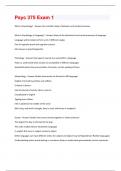
Psyc 375 Exam 1! Questions & Answers Graded A+
What is Psychology? - Answer-the scientific study of behavior and mental processes What is Psychology of Language? - Answer-Study of the behavioral and mental processes of language Language will be looked at from a lot of different angles Part of cognitive psych and cognitive science Also known as psycholinguistics Phonology - Answer-How speech sounds are used within a language Helps us understand what sounds are acceptable in different languages Specifically about the pronunciation of sounds, not the spelling of them Morphology - Answer-Studies how words are formed in diff languages English is formed by prefixes and suffixes Ex Books is Book-s Like the plurals of words, africa-n poli-sh Complicated in english Tagalog uses inflixes Infix is added to the middle of the word Bali is buy, and binili is bought, basa is read, and binasa is readpast) Syntax - Answer-Studies how we put words together to make sentences The dog bit the boy vs the boy bit the dog The order matters!(more declarative language) In english first noun is subject second is object Other languages can have different order, the subject and object may be flipped(more flexible languages) Understanding where words belong in a sentence helps us understand grammatically correct sentencesWe know "I ate the pizza is right" Not "Pizza ate I the" Semantics - Answer-Study of meaning Ex: metaphor, things like "time flies", Connected with world experience When asked to name a fruit, most likely to say something common like apple, so fruit doesn't have the same meaning necessarily Influences by associations/typically Also multiple definitions for one word Clock means hit/time We talk about face of the clock, that sorta stuff Lose track of time when we get hit in the face Definitions get extended, like japanese trees Metaphorical language Like "I gave you that idea" Pragmatics - Answer-Study of meaning in social contacts How diff people in different situations under stand meaning Ex: lets get out of here may be different to different people depending on the situation, Intentions in using language Assertions to convey information Ask questions to get into Order to make people behave in certain ways Also look at structure of rules of conversations We see issues in problems within conversations, like when we say something we expect people to respond about the same subject Nature vs nurture Language innate, or learned? - Answer-We are driven to form close bonds with others, could language come from this?Could concepts like learning about mathematics and other subjects be helpful in survival, could language also be created to help our survival? Learning language early can help with the survival of our species, but people could also learn it simply from interacting with their environments Domain specific vs domain general - Answer-Domain specific: It would be independent of anythings else, like learning music/math/other skills Damage to brain that affects language would not affect other skills Domain general: language/other abilities are learned using same mechanism, if language breaks down, so would other skills Communication vs. language - Answer-language represents words whether it is writing or speaking as it's also a method of communication. On the other hand, communication is all about message. Hockett's design features - Answer-things a language has to have to be considered a language Hockett's design features: List them - Answer-Semanticity, Arbitrariness, Discreteness, Productivity, Displacement, Traditional transmission, Duality of patterning Duality of patterning in Hockett's design features - Answer-refers to the ability of human language, both signed and spoken, to form discrete meaningful units (morphemes; cf. "Rules of word formation (morphology)") from discrete non-meaningful segments (phonemes; Semanticity in Hockett's design features - Answer-Signal has meaning Showing meaning through smell, like cats rubbing on objects to communicate Arbitrariness in Hockett's design features - Answer-Words do not resemble meaning, like how cat does not look like a catDiscreteness in Hockett's design features - Answer-Can break up a word into smaller parts, like how reunited is made up of 3 parts, but re- and -ed are used in other places We can say I ate an apple, and use "ate" in "they ate the apple",, we can combine words in different ways in different texts Productivity in Hockett's design features - Answer-Ability to invent new sentences New combos of words/finding new ways to explain concepts Few animal systems can actually express meaning in unique ways Displacement in Hockett's design features - Answer-Ability to talk about things in the past and future Also seen in the wild, like a mother bird pretending to have a broken wing in order to fend off predators Traditional transmission in Hockett's design features - Answer-Parents teaching communication to next generation Birds must hear bird song in order to sing, but some species also do not require traditional transmission to speech Communication example using Hockett's design features: Bee Communication - Answer-Baby bees can communicate without ever seeing an adult bee Does not show traditional transmission Completely instinctual Show semanticity, shows discreteness(more components to the dance), no productivity, can't talk about past/future so no displacement, and no traditional transmission Communication example using Hockett's design features: Vervet Monkey alarm calls - Answer-Make predator specific alarm calls Monkeys would recognize a leopard alarm call and go into tree, and if they saw an eagle they would give a different call and hid ina bush Language? Seemed like a call designated something in the environment Phonetics - Answer-Study of how speech sounds are producedThings like the anatomy and acoustics of our speech sounds Like the human vocal tracts Sounds like "pa" and "ba" Languages use only a subset of the sounds we can make bilabial(lips and teeth) Different in different languages,
Written for
- Institution
- Psyc 375
- Module
- Psyc 375
Document information
- Uploaded on
- April 17, 2024
- Number of pages
- 25
- Written in
- 2023/2024
- Type
- Exam (elaborations)
- Contains
- Questions & answers
Subjects
-
psyc 375

Also available in package deal