NCLEX archer Fluid and electrolytes Exam Q&A proven A Score
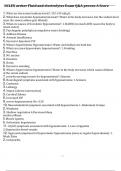
NCLEX archer Fluid and electrolytes Exam Q&A proven A Score 1. What are the normal sodium levels?: 135-145 mEq/L 2. What does euvolemic hyponatremia mean?: Water in the body increases, but the sodium level stays the same (sodium gets diluted) 3. What are causes of Euvolemic hyponatremia?: 1. SIADH (too much ADH causes the body to retain water) 2. Psychogenic polydipisa (compulsive water drinking) 3. Addison Disease 4. Adrenal Insufficiency 5. Excessive hypotonic IVF 4. What is hypovlolemic Hyponatremia?: Water and Sodium are both lost 5. What can cause hypovolemic hyponatremia?: 1. Vomiting 2. Diarrhea 3. NG suction 4. Diuretics 5. Burns 6. Excessive sweating 6. What is hypervolemic hyponatremia?: Water in the body increases which causes dilution of the serum sodium 7. priority nursing concern for hyponatremia?: Seizures 8. Neurological symptoms associated with hyponatremia: 1. Seizures 2. Confusion 3. Lethargy 4. Stupor (almost unconscious) 5. Cerebral Edema 6. Increased ICP 9. severe hyponatremia: Na <120 10. Musculoskeletal symptoms associated with hyponatremia: 1. Abdominal Cramps 2. Weakness 3. Shallow respiration 4.Decreased deep tendon reflexes 5. Muscle spasms 6. Orthostatic hypotension 11. GI/GU symptoms associated with hyponatremia: 1. Loss of appetite 2. Hyperactive bowel sounds 12. Signs and symptoms for Hypovolemic hyponatremia (same as regular hypovolemia): 1. Weak Pulse 2. tachycardia 3. Hypotension 4. Dizziness 13. Signs and Symptoms for Hypervolemic Hyponatremia (same as Hyperv- olemia): 1. Bounding Pulses 2. Hypertension 14. What is the treatment for Hypovolemic Hyponatremia?: 1. Restore Volume and sodium 2. Mild: 0.9% NS (isotonic) 3. Severe: 3% NS (hypertonic) 15. treatment for hypervolemic hyponatremia: 1. Restrict free water intake (water causes it to dilute) 2. Osmotic Diuretics 3. Avoid High salt foods (will pull even more water) 16. What is the treatment for euvolemic hyponatremia: 1. Restrict free water 2. Sodium tablets 3. Encourage high salt foods 17. What occurs when sodium is replaced too quickly?: 1. Cerebral Edema 2. Central Pontine Myelinolysis (CPM) (rapid infusion of sodium pulls water from our brain cells) 18. Sodium should be replaced at a rate of?: 0.5 mEq/hr 19. Is sodium replaced slowly or quickly and why?: Slowly because it can cause fluids shifts (especially in the brain) 20. What is important to monitor for CPM (water pulled out of brain cells for infusing Na+ too quickly): Numbness and weakness in the feet 21. What are nursing interventions for low sodium?: 1. Encourage intake of oral sodium (Euvolemic Hyponatremia) 2. Monitor lithium levels if applicable 3. Monitor NEURO STATUS 22. What is the priority nursing intervention for a patient who is Hyponatrem- ic?: MONITOR NEURO STATUS (SEIZURES) 23. What is sever Hyponatremia?: Sodium below 125 24. What are musculoskeletal signs and symptoms of Hyponatremia?: 1. Ab- dominal cramps 2. Weakness 3. Shallow respirations 4. Decreased DTR 4. Muscle spasms 5. Orthostatic hypotension 25. What are GI/GU S&S for hyponatremia?: 1. Decreased UOP (urine output) 2. Loss of appetite 3. Hyperactive bowel sounds 26. Hypervolemic hypernatremia: Sodium gains > Water gains 27. Hypovolemic Hypernatremia: Water deficit > Sodium deficit 28. Euvolemic Hypernatremia Etiology: When total water loss is equal from all parts of the body, not just from the intravascular space 29. Why is hypernatremia seen with DI: Tons of fluid loss from DI leads to a relative high amount of Na (sodium stay same but since water is lost it makes it increase more in the body) 30. Neuro findings seen with hypernatremia: 1. Restless 2. Agitated 3. Lethargic 4. Drowsy 5. Stupor 6. Coma 31. Musculoskeletal Findings seen with hypernatremia: 1. Twitching 2. Cramps 3. Weakness 32. CV findings with hypernatremia: 1. Fever 2. Edema 3. +/- BP (decreased BP for hypovolemia and increased for hypervolemia) 4. Weak (Hypovolemic), bounding pulses (hypervolemic) 33. What is the treatment for hypervolemic hypernatremia? (Sodium intake is greater than fluid intake): 1. Find causative agent (3% administration, aldosterone excess (increase sodium reabsorption in the kidneys)) 2. Loop diuretics (inhibits the resp take of sodium chloride in the kidneys) 3. Free water administration 34. What is the treatment option for Hypovolemic hypernatremia: 1. Isotonic Fluid administration 35. Treatment for euvolemic hypernatremia: 1. Free water administration 2. PO intake better than IV because patient is euvolemic (intake of water) 36. What is the normal range for potassium?: 3.5-5.0 mEq/L 37. What role does potassium play in acid base balance?: Increased potassium can cause the body to become acidotic. 38. Causes for hyperkalemia (too much potassium moves from in the cell to outside of the cell): 1. Burns (increase in intracellular fluid moves to extra cellular space) 2. Adrenal insufficiency (adrenal glands can't produce enough aldosterone which leads to retention of potassium in the body because it cant be excreted through the urine.) 3. Renal Failure 4. Dehydration 5. Excessive K+ intake 6. Acidosis 7. Diabetic ketoacidosis 8. ACE inhibitors 9. NSAIDs 10. Potassium sparing diuretics 39. Assessment findings for Hyperkalemia: 1. EKG CHANGES 2. Muscle weakness and twitching 3. Numbness 3. Cramping
Written for
- Institution
- NCLEX archer Fluid and electrolytes
- Module
- NCLEX archer Fluid and electrolytes
Document information
- Uploaded on
- April 27, 2024
- Number of pages
- 14
- Written in
- 2023/2024
- Type
- Exam (elaborations)
- Contains
- Questions & answers
Subjects
-
nclex archer fluid and electrolytes exam qa prove
-
1what are the normal sodium levels 135 145 meq
-
2psychogenic polydipisa compulsive water drinki
-
4what is hypovlolemic hyponatremia water and s

Also available in package deal