JOMC 486 Quizzes with 100% Complete Solutions
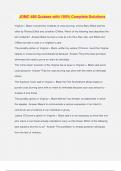
JOMC 486 Quizzes with 100% Complete Solutions Virginia v. Black involved two incidents of cross burning, one by Barry Black and the other by Richard Elliott and Jonathan O'Mara. Which of the following best describes the two incidents? -Answer-Black burned a cross at a Ku Klux Klan rally, and Elliott and O'Mara burned a cross in a neighbor's yard. The plurality opinion in Virginia v. Black, written by Justice O'Connor, found the Virginia statute on cross burning unconstitutional because -Answer-The prima facie provision eliminates the need to prove an intent to intimidate. The "prima facie" provision of the Virginia law at issue in Virgnian v. Black said jurors could presume -Answer-That the cross burning was done with the intent to intimidate others. The Supreme Court said in Virginia v. Black the First Amendment allows states to punish cross burning done with an intent to intimidate because such acts amount to - Answer-A true threat. The plurality opinion in Virginia v. Black defined "true threats" as statements in which the speaker -Answer-Means to communicate a serious expression of an intent to commit an act of violence on an individual or group. Justice O'Connor's opinion in Virginia v. Black said it is not necessary to show that one who utters a true threat actually intended to carry out the threat. Which of the following best explains why this is so? -Answer-The prohibition on threats protects individuals from the fear of violence. Justice O'Connor in Virginia v. Black gave examples of when cross burning may be done without an intent to intimidate. Which of the following is NOT an instance of cross burning without an intent to intimidate? -Answer-Cross burning on a neighbor's lawn. Justice Thomas dissented in Virginia v. Black. He argued that the Virginia statute was enacted to restrict the activities of the Ku Klux Klan and therefore was directed only at _______________. -Answer-Conduct Justice Scalia argued the prima facie provision in the statute at issue in Virginia v. Black was constitutional because it still allowed the defendant to -Answer-Offer rebuttal evidence. Justice Souter concurred in the majority's decision in Virginia v. Black in part because he believed evidence of an official intent to suppress ideas was afoot could be found in - Answer-The prima facie provision of the statute. When might it be legal for the government to exercise prior restraint over a newspaper, according to Justice William Brennan's opinion in The New York Times v. United States.? -Answer-If the publication would inevitably, directly, and immediately lead to a grave harm. A major complaint the three dissenting justices in the Pentagon Papers case advanced was that -Answer-The Supreme Court had rushed to a conclusion. Justice Byron White's concurring opinion in New York Times v. United States expressed the view that the Espionage Act of 1917 -Answer-Could be used to prosecute the Times and the Post for publishing the Pentagon Papers. What was the US government seeking to do in the case of The New York Times v. United States? -Answer-Prevent the newspapers from publishing classified documents. The government's request for a prior restraint on The New York Times and The Washington Post to prevent publication of the Pentagon Papers was based on the claim the president had _____________ to seek such a restraint. -Answer-Inherent power In the New York Times v. United States case, Justices Byron White and Thurgood Marshall said they were reluctant to impose a prior restraint on a newspaper in the absence of -Answer-A statute passed by Congress authorizing the government to seek a prior restraint. The Pentagon Papers, which were at issue in the New York Times v. United States Supreme Court decision, were -Answer-A top secret study of how the nation became embroiled in the Vietnam War. When Scottie Pippen sued NBC Universal for libel, he was suing over a publication that falsely reported Pippen -Answer-Had filed for bankruptcy
Written for
- Institution
- JOMC 486
- Module
- JOMC 486
Document information
- Uploaded on
- May 6, 2024
- Number of pages
- 14
- Written in
- 2023/2024
- Type
- Exam (elaborations)
- Contains
- Questions & answers
Subjects
-
jomc 486 quizzes with 100 complete solutions

Also available in package deal