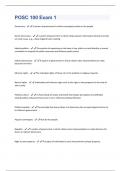
POSC 100 Exam 1 Questions And Answers Graded A+
Democracy - A system of government in which sovereignty resides in the people Direct democracy - A system of government in which citizens govern themselves directly and vote on most issues; e.g., a New England town meeting. Identity politics - The practice of organizing on the basis of sex, ethnic or racial identity, or sexual orientation to compete for public resources and influence public policy. Indirect democracy - A system of government in which citizens elect representatives to make decisions for them. Minority rights - The individual rights of those not in the political or religious majority Natural rights - Inalienable and inherent rights such as the right to own property (in the view of John Locke). Political culture - A shared body of values and beliefs that shapes perceptions and attitudes toward politics and government and, in turn, influences political behavior Political equality - The principle that every citizen of a democracy has an equal opportunity to try to influence government. Popular sovereignty - Rule by the people. Republic - A system of government in which citizens elect representatives to make decisions for them; an indirect democracy. Right to own property - The rights of individuals to own and work their private property.United States Census - A census is a count, and a census of all U.S. inhabitants is done every ten years in years divisible by ten. "Mischiefs of factions" - A phrase used by James Madison in the Federalist Papers to refer to the threat to the nation's stability that factions could pose. McColloch v. Maryland - An 1819 U.S. Supreme Court decision that broadly interpreted Congress's powers under the implied powers clause. Separation between state and federal Anti-Federalists - Those who opposed the ratification of the U.S. Constitution. Articles of Confederation - The first constitution of the United States; in effect from 1781 to 1789. Bill of Rights - The first ten amendments to the U.S. Constitution. Checks and balances - The principle of government that holds that the powers of the various branches should overlap to avoid power becoming overly concentrated in one branch. Constitutional Convention - The gathering in Philadelphia in 1787 that wrote the U.S. Constitution; met initially to revise the Articles of Confederation but produced a new national constitution instead. Direct democracy - A system of government in which citizens govern themselves directly and vote on most issues; e.g., a New England town meeting Divided government - The situation in which one political party controls the presidency and the other party controls one or both houses of Congress. Emancipation Proclamation - Abraham Lincoln's 1863 proclamation that the slaves "shall be . . . forever free." At the time, it applied only in the Confederate states and so had little practical impact because the Union did not control them. However, it had an immense political impact, making clear that the Civil War was not just to preserve the Union but also to abolish slaver
Written for
- Institution
- POSC 100
- Module
- POSC 100
Document information
- Uploaded on
- May 20, 2024
- Number of pages
- 6
- Written in
- 2023/2024
- Type
- Exam (elaborations)
- Contains
- Questions & answers
Subjects
-
posc 100

Also available in package deal