100% satisfaction guarantee Immediately available after payment Both online and in PDF No strings attached 4.6 TrustPilot
logo-home
Exam (elaborations)

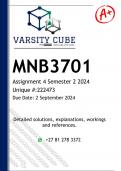
EST1501 Assignment 2 (COMPLETE ANSWERS) 2024 (202804) - DUE 31 May 2024

Rating
4.0
(1)
Sold
7
Pages
20
Grade
A+
Uploaded on
24-05-2024
Written in
2023/2024

EST1501 Assignment 2 (COMPLETE ANSWERS) 2024 (202804) - DUE 31 May 2024 ;100 % TRUSTED workings, explanations and solutions. For assistance call or W.h.a.t.s.a.p.p us on ...(.+.2.5.4.7.7.9.5.4.0.1.3.2)........... QUESTION 1: ENGLISH GRAMMAR AND LANGUAGE [10] Read the sentences below and fix the grammar and language errors that appear: 1.1 The boys runs fast through the park every morning. 1.2 I wanted to go to the store I needed some groceries but I didn't have time to get there before it closed. 1.3 When we were growing up, my brother grumbled (frequently, frequent) about house chores. 1.4 The weather was beautiful we decided to have a picnic in the park however we forgot to bring any food with us. 1.5 She enjoy playing the netball and the cricket. 1.6 On the way to the mall. 1.7 This assignment is due in a month’s time. 1.8 Although I was feeling tired. 1.9 These shoes do not fit anymore. 1.10 When the police were not looking, the suspect (quick, quickly) jumped out of the van and ran. QUESTION 2: ENGLISH GRAMMAR [20] Punctuate the paragraph below: Human societies use a variety of semiotic modes for meaning construction The ubiquity of images in todays world alone or in combination with other modes makes competence with images or visual literacy a prerequisite of competence in life Now identified as an essential literacy skill for 21st century learners in the digital age visual literacy has been introduced into contemporary english curricula in a number of countries around the world in china the skill of viewing is added as one important component of language competence in national english curriculum standards for high school issued in 2017 thereby making the cultivation of visual literacy vital to secondary EFL education This paper aims to present and discuss the current situation of visual literacy in secondary EFL education in China It first provides an analysis of the ways of visual-verbal interplay for meaning construction in textbooks and finds an uneven distribution of image-text relations in the current EFL textbooks with a majority of images playing a supportive or illustrative role Then it explicates the bi-dimensional three-level construct of visual literacy that is specified in the EFL curriculum with which the subskills of visual literacy assessed in the latest large-scale EFL tests are compared with a view to finding out the degree of correspondence between the subskills measured in the tests and the subskills expected in the curriculum the result shows that only one dimension of reading visual texts is assessed, and the other dimension of writing visual texts is not evidenced finally suggestions are made for varied visual inputs an expanded construct of visual literacy and improvement of the washback effect of tests. (Wang, H. Visual literacy in secondary EFL education in China: A semiotic perspective. Language and Semiotic Studies 7(4): 26-47) QUESTION 3: READING TECHNIQUES [25] 3.1 Scan through the speech by Deputy President Mashatile below and identify two main topics or themes discussed in the speech. (2) 3.2 Scan through the speech and list three notable individuals or groups mentioned in the speech. (3) 3.3 Read critically the contents of the speech, create a topical map that categorises the key themes and ideas discussed by the speaker. (10) 3.4 Use the topical map above (in 3.3) to provide a brief summary of the main arguments or key points presented in the speech. The summary should comprise one paragraph of 150 words. (10) Deputy President Paul Mashatile: Ninth BRICS Parliamentary Forum 27 Sep 2023 Remarks by Deputy President Paul Mashatile on the occasion of the 9th BRICS Parliamentary Forum, Emperors Palace, Johannesburg, South Africa Programme Director, Secretary to Parliament, Mr Xolile George; Your Excellency, Mme Nosiviwe Maphisa Nqakula, Speaker of the National Assembly; Your Excellency, Ntate Lechesa Tsenoli, Deputy Speaker of the National Assembly; The Chairperson of the NCOP, Ntate Amos Masondo; The Deputy Chairperson of the NCOP, Mme Sylvia Lucas; Your Excellency, Kgalema Petrus Motlanthe, former President of the Republic of South Africa; Your Excellency, Mme Baleka Mbete, former Deputy President of the Republic of South Africa; Your Excellency, Mr Sostenes Cavalcante, Vice President of the Chamber of Deputies, Federal Republic of Brazil; Your Excellency, Mr Harivanash Narayan Singh, Deputy Chairman of the Rajya Sabha Republic of India; Your Excellency, Mr Peng Qinghua, Vice Chairman of the Standing Committee of the National People’s Congress, of the Peoples Republic of China; Your Excellency, Dr Hanafy Ali Gebaly, Speaker of the Egyptian House of Representatives Your Excellency, Mr Mohammad-Bagher Ghalibaf, President of Majles Shoraye Eslaimi of the Islamic Republic of Iran; Your Excellencies, the Speakers and Honourable Peoples tribunes from fellow BRICS member-states; Ambassadors; Business leaders; Esteemed guests; Ladies and Gentlemen, I would like to welcome you to the 9th BRICS Parliamentary Forum (PF). It has been a long, challenging and exciting road since the historic inaugural meeting held in the Russian Federation in June 2015. Since then, this Forum has grown from strength to strength, reflecting both the hard work of the collective leadership of the BRICS member states and, without doubt, the overwhelming desire amongst the peoples of the world to evolve a just world order, which serves not just a few, but also and especially the wretched of the earth. Congratulations to our new partners: the Argentine Republic; the Arab Republic of Egypt; the Federal Democratic Republic of Ethiopia; the Islamic Republic of Iran; the Kingdom of Saudi Arabia; and the United Arab Emirates. We trust that you will invigorate this promising intergovernmental organisation. From 2015 to date, the BRICS Parliamentary Forum has identified many issues which require continuous discussion, refinement and programmatic plans of action, the better to better serve the wretched of the earth. The issues range from: the sacrosanct role of the United Nations in international affairs and the consolidation of multilateral structures; the reform of the Security Council; and the fairness of the international legal system; the transition to a multipolar world and deepening economic globalisation, exploring new trade and investment prospects; the promotion of international peace and security, shared economic growth, cooperation and mutually beneficial interaction amongst the peoples of the world, undergirded by a continuous dialogue among and between the world’s cultures and civilisations for the cross-pollination of knowledge and perspectives for the benefit of humanity; deepening cooperation in a multiplicity of fields, including the promotion of cooperation in research, education, healthcare, environmental protection and sport, with a focus on the youth; coordinating our macroeconomic policies, the reform of the international monetary system and the promotion of growth; intensifying South-South and North-South dialogue; to the creation of a permanent contact group within the BRICS Parliamentary Forum, which helps, among other things, to identify and guide our association on key evolving issues of international political economy and to develop a long-term strategy for the Forum. These and many additional matters that have served on the agenda of this Forum since the inaugural session in Moscow are about moving the world towards greater social justice — in short, making sure that the wretched of the earth become, “Somebody!” So goes the as the African American parlance. We recall that the inaugural BRICS Parliamentary Forum took place, to the hour, on the 70th anniversary of the end of World War II and the founding of the world’s premier intergovernmental organisation, the United Nations – our United Nations! The solemnity of the occasion was a stark reminder of the importance of history. Some of our colleagues rightly appealed that we draw appropriate lessons from history. The quest to be Somebody is innate to every people. This is true for the developing South inasmuch as it is the case for the developed North. For the African continent, as with part of the developing world, the quest to be Somebody has been an act of resistance and defiance, since at least the advent of the Atlantic Slave Trade. In addition to the heroic anti-colonial and apartheid struggles, this led to the 1955 Bandung Conference and the formation of the Non-Aligned Movement (NAM) in 1961. A consistent thread in the NAM’s work has been the promotion of the political and economic cooperation of developing countries. This is how President Julius Nyerere of Tanzania put the matter when he addressed the opening of the preparatory meeting of the NAM, in Dar es Salaam, on April 13, 1970: “The fact is that our political independence depends upon the degree of our economic independence, as well as the nature of our economic development depending upon our political independence. These things are interlinked in the modern world; and because of that interdependence, our economic relationships with one another, and individually with the great powers of the world, are matters with which the Non-Aligned conference must be concerned.” This underscores the importance of BRICS and the cooperation it has sought to promote since its founding. BRICS is one of the institutions that holds the possibility of taking forward much of the objectives of the NAM and the South Commission which President Nyerere ably led after his voluntary retirement from public office in 1985. There is no need to regale you with statistics about the global reach of the BRICS in terms of its economy, the combined population of its member states relative to the rest of the world and other interesting information, which you know. This Forum has the possibility to exert change on a global and unprecedented scale. For starters, BRICS has focused the imagination of the world’s population beyond the citizens of its member states. In and of itself, this is a good thing. However, we should not be surprised when this success factor attracts negative responses from some actors in the world despite the fact that BRICS is not opposed to any state parties or groups. Instead, we seek a peaceful and just world of equitable resource distribution. The single most powerful instrument parliamentarians have at their disposal is their command of law-making. Through coordinated efforts, you can impact positively on more than a quarter of the world’s population by introducing far-reaching progressive legislation and repealing laws that do not improve the lives of the people. Some lessons from history in this regard might be useful. The 13th-century Egyptian Chief Justice, Ibn Khaldun, insisted that law should be based on what he called “social solidarity”, which was a statement on the supremacy he placed on social cohesion. Kwame Nkrumah, on the other hand, was adamant that the “teaching of law is totally incomplete if it is not accompanied by a background of economic, social and political science and even politics, science and technology”. He envisioned a law that is an “expression of the political, economic and social conditions of the people and of their aims for progress”, as opposed to one that is based on “a formalistic yardstick which completely disregards the material content of the law and measures justice or injustice solely by procedural rules”. As BRICS parliamentarians, who seek to change the world for the better, you have the possibility to usher in the social solidarity and development that Chief Justice Khaldun and President Nkrumah strove to achieve. However, legislative changes alone are neither enough nor sufficient to effect change. You require a capable, civic-minded, and ethical bureaucracy, which has the capacity and commitment to drive the existing legislative framework to achieve its ends. The effervescence of the parliamentary vocation attests to the sociological truism that all societies are heterogeneous theatres, in which differently disposed social actors’ battle to shape public affairs in their own image. To the extent that such intercourse will, from time to time, impact upon the institution of BRICS as national, regional and other interests, this Forum should gird its intellectual and political loins for their constructive management and resolution. Sometimes, these may be interests from outside ourselves intent on exhausting us in meaningless, but tiresome distractions or, otherwise, pit us against each other; thus, to take us completely off the rails so that we are unable to achieve our strategic objective. Fortunately, the collective of BRICS members possess the wisdom to rise above such machinations. Equally fortunate is that BRICS member states have come together in this rising intergovernmental institution on a shared perspective of development, to which the current global political and economic order continues to respond inadequately. Whatever difficulties we face in the future, President Nyerere may provide a useful guide. “Development,” he said in August 1988, “involves decisions about national and international political priorities and structures. It includes social questions and matters related to education, health human dignity, and security both personal and national. And it means adequate food clothing and shelter for the individual person. All these matters are inextricably mixed and are all encompassed in any definition of development, which is meaningful to the human beings who are now suffering from lack of it.” Every country faces these considerations and challenges in its resource allocation and decision-making processes. Undoubtedly, this will find expression in your discussions, especially as it concerns the four broad thematic areas on your agenda, namely climate change; energy security and just transition of coal to hydrogen energy; multilateralism; peace and security. In July 2014, BRICS established the New Development Bank and the BRICS Contingent Reserve Arrangement. It is increasingly clear that there are varying levels of capacity for project planning and development among member states. As with the executive, parliamentarians are challenged to interrogate how this can be overcome. One way of addressing this is by identifying the broad range of skills that are required to address effect development at the scale and the pace required to accelerate the impact of BRICS in all the member states. This speaks to the technocratic capacity to which I referred earlier, and we should, in this regard and in keeping with the tradition of cooperation amongst us, adopt the slogan of the progressive trade union movement: “An injury to one is an injury to all.” One suggestion you may want to ponder over is that we should immediately conduct a skills audit relative to the development imperatives of each member state and bring together institutions of higher learning amongst us to respond to the skills challenge. I would like to commend the BRICS Women's Business Alliance and their efforts in organising the BRICS-Africa WBA Trade Conference. Malibongwe! Africa is moving towards a single African market. All 54 countries have signed the African Continental Free Trade Area (AfCFTA) agreement. We are well on our way to creating the world's largest single-free trade area, with 1.3 billion people and a gross domestic product of $3.4 trillion. The implementation of the African Continental Free Trade Area will improve intra-African trade, the continent’s share and participation in global trade, stimulate and improve the economy as well as contribute to lifting millions of people out of poverty. The continent's transport networks are largely unsatisfactory. Few roads connect the continent's five regions, and those that do, are often in poor condition and under-maintained. As a continent, we look forward to engaging with our BRICS partners to realise the implementation of the African Continental Free Trade Area and, thus, create a win-win solution for all. Let us seize this opportunity to strengthen the BRICS-Africa partnership and promote a rules-based approach towards a just global order. Thank you. QUESTION 4: READING EFFECTIVELY (CATEGORISING PARAGRAPHS) [20] Read the section in your study guide on “Classifying paragraphs according to type”, and use the skills learnt from the study guide to classify the paragraphs below according to the features advanced by Samone (1991). Identify each kind of paragraph and substantiate your choice by citing some information from the paragraph. What does indigenous knowledge mean? A compilation of attributes What does indigenous knowledge (IK) mean? That’s a big question because “there are approximately 370 million indigenous people in the world, belonging to 5 000 different groups, in 90 countries worldwide. Indigenous people live in every region of the world...” At this point, there isn’t a hard-and-fast definition accepted and recognised by all; it can mean different things to different societies and cultures. The United Nations Educational, Scientific, and Cultural Organisation (UNESCO) uses this definition: Local and indigenous knowledge refers to the understandings, skills and philosophies developed by societies with long histories of interaction with their natural surroundings. For rural and indigenous peoples, local knowledge informs decision making about fundamental aspects of day-to-day life. This knowledge is integral to a cultural complex that also encompasses language, systems of classification, resource use practices, social interactions, ritual and spirituality. These unique ways of knowing are important facets of the world’s cultural diversity, and provide a foundation for locally appropriate sustainable development. Why should non-indigenous people take the time to learn about indigenous knowledge? Because Western science is increasingly recognising the value of IK and is collaborating with communities to incorporate their knowledge in related research projects. • The rise of indigenous traditional knowledge in environmental assessments We wanted to put some flesh on the bones of the UNESCO definition, so did some research [3] and have developed a compilation that we hope encompasses the primary tenets of indigenous knowledge. Interspersed with the tenets are some quotes, expressions and proverbs from indigenous leaders. Indigenous knowledge is: Adaptive: It is based on historical experiences, but adapts to social, economic, environmental, spiritual and political changes. Adaptation is the key to survival. Cumulative: It is a body of knowledge and skills, developed from centuries of living in close proximity to nature. Dynamic: It is not rooted in a particular point in history, but has developed, adapted, and grown over millennia; it is not static. Holistic: All aspects of life are interconnected - are not considered in isolation, but as a part of the whole. The world is believed to be an integral whole. Indigenous knowledge incorporates all aspects of life - spirituality, history, cultural practices, social interactions, language, healing. Humble: Indigenous knowledge does not dictate how to control nature, but how to live in harmony with the gifts of the Creator. Intergenerational: The collective memory is passed on orally within a community, from one generation to the next, through language, stories, songs, ceremonies, legends, and proverbs. Invaluable: It has been argued that indigenous knowledge, not capital, is the key to sustainable social and economic development. There is a growing recognition and respect for IK and a desire to collaborate with indigenous communities on environmental monitoring projects. Irreplaceable: There is nothing Western science can do to replace or replicate indigenous knowledge. An aspect of indigenous knowledge that is sometimes overlooked by scientists, and others, is the critical connection between IK and language. Indigenous languages are in decline and, as languages die, so does the indigenous knowledge that is part of that language and the collective memory of the speakers of that language. Moral: There is a morality in indigenous knowledge – a right and wrong way to interact with nature; there is a responsibility given from the Creator to respect the natural world. Non-linear: Time, patterns, migrations and movements of animals are cyclical.

Show more Read less
Institution
Module


Whoops! We can’t load your doc right now. Try again or contact support.

Connected book

Written for

Institution
Module

Document information

Uploaded on
May 24, 2024
Number of pages
20
Written in
2023/2024
Type
Exam (elaborations)
Contains
Questions & answers

Subjects

Content preview

EST1501
ASSIGNMENT 2 2024

, lOMoARcPSD|21997160


Department Language Education, Arts and Culture


Module name and code: EST1501 Assessment number: 2

Due date: Total marks: 100

Unique number:

Instructions:

This assignment is compulsory and must be completed and submitted by the due date.

The assignment questions are based on learning units from your study guide.

Have your study guide at hand while completing this assignment, as you will need it to answer the
assignment questions.

Please make use of academic writing and proofread your assignment before submitting it.

Please complete the attached honesty declaration and submit it with your assignment.

, lOMoARcPSD|21997160


HONESTY DECLARATION FOR THE DEPARTMENT OF LANGUAGE EDUCATION, ARTS AND CULTURE

Module Code:……………………. Assessment Date………………. 20….


1. I know that plagiarism means taking and using the ideas, writings, works or inventions of another as if
they were one’s own. I know that plagiarism not only includes verbatim copying, but also the extensive
use of another person’s ideas without proper acknowledgement (which includes the proper use of
quotation marks) or any attempt to cheat the plagiarism checking system. I know that plagiarism covers
the use of material found in textual sources and from the Internet.


2. I acknowledge and understand that plagiarism is wrong.


3. I understand that my assignment/exam answers must be accurately referenced.


4. This assignment/exam file/portfolio is my own work. I acknowledge that copying someone else’s work,
or part of it, is wrong, and that submitting identical work to others constitutes a form of plagiarism.


5. I have not allowed, nor will I in the future allow, anyone to copy my work with the intention of
passing it off as their own work.


6. I understand that I can be awarded 0% if I have plagiarized.


7. I understand that my assignment/exam file/portfolio may be submitted automatically to Turnitin.


8. I confirm that I have read and understood the following UNISA policies:

8.1 Policy for Copyright and Plagiarism

8.2 Policy on Academic Integrity

8.3 Student Disciplinary Code


Name……………………………………………… Student No: ..............................


Signed ……………………………………………. Date …………………………….

Reviews from verified buyers

Showing all reviews
1 year ago

4.0

1 reviews

5
0
4
1
3
0
2
0
1
0
Trustworthy reviews on Stuvia

All reviews are made by real Stuvia users after verified purchases.

Get to know the seller

Seller avatar
Reputation scores are based on the amount of documents a seller has sold for a fee and the reviews they have received for those documents. There are three levels: Bronze, Silver and Gold. The better the reputation, the more your can rely on the quality of the sellers work.
LIBRARYpro University of South Africa (Unisa)
Follow You need to be logged in order to follow users or courses
Sold
10539
Member since
2 year
Number of followers
4904
Documents
4830
Last sold
1 day ago
LIBRARY

On this page, you find all documents, Package Deals, and Flashcards offered by seller LIBRARYpro (LIBRARY). Knowledge is Power. #You already got my attention!

3.7

1460 reviews

5
684
4
236
3
243
2
79
1
218

Recently viewed by you

Why students choose Stuvia

Created by fellow students, verified by reviews

Quality you can trust: written by students who passed their exams and reviewed by others who've used these revision notes.

Didn't get what you expected? Choose another document

No problem! You can straightaway pick a different document that better suits what you're after.

Pay as you like, start learning straight away

No subscription, no commitments. Pay the way you're used to via credit card and download your PDF document instantly.

Student with book image

“Bought, downloaded, and smashed it. It really can be that simple.”

Alisha Student

Frequently asked questions