BLAW Pleasant Exam 1 TTU Questions With Verified Answers
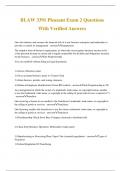
BLAW Pleasant Exam 1 TTU Questions With Verified Answers Primary Source of Law - answera document that *establishes the law* on a particular issue, such as constitution, a statute, an administrative rule, or a court decision. Constitutional Law (4 sources of law) - answerlaw based on documents setting forth for the general organizations, powers, and limits of the government. Executive Orders - answerLegally binding directive from the president. Treaties - answerwritten agreements by 2 or more countries. -becomes legally binding when approved by 2/3 of the senate. Statutory Law (4 sources of law) - answer-laws enacted by legislative bodies at any level of government, such as statutes passed by congress or by any state legislatures. Ordinance - answerlaw passed by a local government, such as city council. Administrative Law (4 sources of law) - answerthe body of rules, regulations and decisions created by administrative agencies. Uniform Commercial Code (UCC) - answer-Set of laws that govern various *commercial transactions* and are designed to bring *uniformity* to state law. -prepared in 1952 and took over 15 years and all 50 states have adopted it. Case Law (4 sources of law) - answer-the rules of law announced in court decisions. -interprets statutes, regulations, constitutional provisions, etc. -governs all areas not covered by statutory or administrative law and is part of our common law tradition. Common Law - answer-the body of law developed from custom or judicial decisions in English and U.S. courts, not attributable to legislature. Precedent - answera court decision that furnished an example or authority for deciding subsequent cases involving identical or similar legal principles or facts. Reporters - answercourt decisions are published in books and called ___________________. Citation - answerNames of parties, volume number, name of the reporter, beginning page number. Stare Decisis - answermeans "to stand on deciding cases" Binding Authority - answerany source of law that a court must follow when deciding a case. Federal Statute - answerapplies to all states State Statute - answerstatutes enacted by state legislatures Uniform Law - answera model law developed by the National Conference of Commissioners on Uniform State Laws for the states to consider enacting into statute. -state legislature has to adopt the uniform law to make it a law in that particular state. Plaintiff - answerthe party who *begins* a lawsuit by filing a complaint in the appropriate court. (*offense*) Defendant - answerthe party *against* whom a lawsuit is brought and from whom recovery is sought or who is *charged* with a violation of the law. (*defense*) Substantive Law - answerall laws that define, describe, regulate, and create legal rights and obligations. -ex: state law that provides employees the right to workers compensation for on the job injuries because it *creates legal rights* Procedural Law - answerall laws that establish the methods of enforcing the rights established by substantive law. -Ex: establishes the method by which an employee must notify the employer about an on-the-job injury, prove the injury, and periodically submit additional proof to continue receiving workers comp. Civil Law - answer-spells out the rights and duties that exist between individuals and between persons and their governments. -includes the law of property, contract, and torts. Criminal Law - answer-has to do with the wrongs committed against society and the regulation of criminal activity. -criminal defendants are prosecuted by public officials on behalf of the state, not by victims or other private parties. National Law - answerthe law of a particular nation International Law - answerapplies to more than one nation Difference between National and International Law? - answer-difference is that government authorities can enforce national law. Judicial Review - answerthe process by which a court decides on the constitutionality of legislative enactments and actions of the *executive branch*. Jurisdiction - answer-the authority of a court to hear and decide a case. -three different types. -"the power to speak the law" Original Court Jurisdiction - answer-the first court that can hear a case. -State System: County and District courts. -Federal System: District Courts Appellat Jurisdiction - answer-power to review previous decisions. -there are *NO* trials at this level.
Written for
- Institution
- BLAW 3391
- Module
- BLAW 3391
Document information
- Uploaded on
- May 26, 2024
- Number of pages
- 12
- Written in
- 2023/2024
- Type
- Exam (elaborations)
- Contains
- Questions & answers
Subjects
-
blaw pleasant exam 1 ttu questions with verified a

Also available in package deal