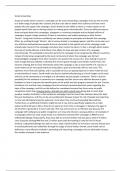
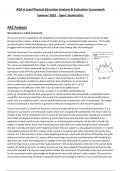
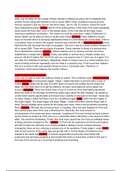
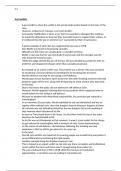
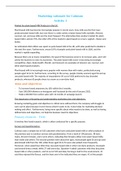
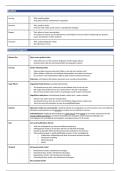
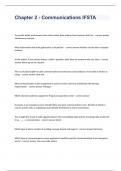
Concise Introduction to Logic 13th edition By Hurley Chapter 2 Exam Cognitive - answer✔✔terminology that gives you information or facts emotive - answer✔✔terminology that expresse s or evokes feelings; appeals to emotions. It enables the arguer to make value claims without providing evidence. value claim - answer✔✔a claim that something is good, bad, right, wrong, better, worse, more important, or less important than some other thin g. For example, a statement about the death penalty that asserts a claim that the death penalty is wrong or immoral would be this type of claim. vague expression - answer✔✔The meaning is hazy, obscure, and imprecise (creates a "blur" of meaning); There are different meanings depending on the context. It is hard to determine the exact meaning intended. For example, words such as "love," "happiness," "peace," "excessive," "fresh," "rich," "poor," "normal," "natural," "healthy," "conservative," and "polluted" ambiguous expression - answer✔✔An expression interpreted as having more than one clearly distinct meaning in a given context (mixes up otherwise clear meanings). For example, words such as "light," "proper," "critical," "stress," "mad," "inflate," "chest, " "bank," "sound," and "race." Thus, what is meant by a light beer? Does this mean that the beer is light in color, light in calories, or light in taste? term - answer✔✔any word or arrangement of words that may serve as the subject of a statement; consists of proper names, common names, and descriptive phrases such as: Proper names, (Napoleon) Common names (animal), Descriptive phrases (author of Hamlet) intensional meaning (intension) - answer✔✔consists of the qualities or ATTRIBUTES that the term CONNOTES extensional meaning (extension) - answer✔✔consists of the members of the CLASS that the term DENOTES connotation - answer✔✔the intensional meaning of a term denotation - answer✔✔the extensional meaning of a term conventional connotation - answer✔✔includes the attributes that the term commonly calls forth in the minds of competent speakers of the language. this helps to keep the interpretation the same from person to person. empty extension - answer✔✔a situation where the term denotes something that does no t exist; the "null" class. Examples include "unicorn," "leprechaun," "gnome," "elf," "griffin," and "current king of France". increasing intension - answer✔✔when each term in the series (except the first) connotes more attributes than the one preceding it (the more attributes, the more specific the term). decreasing intension - answer✔✔when each term in the series (except the first) connotes less attributes than the one preceding it (the attributes get less specific and the terms become more general) increasing extension - answer✔✔when each term in the series (except the first) denotes a class having more members than the class denoted by the term preceding it (the class size gets larger with each successive term) decreasing extension - answer✔✔When ea ch term in the series (except the first) denotes a class having less members than the class denoted by the term preceding it (the class size gets smaller with each successive term) definiendum - answer✔✔is the word or group of words that is supposed to be defined (ex: the word you look up in a dictionary) definition - answer✔✔a group of words that assigns a meaning to some word or group of words. Consists of two parts: a definiendum & the definiens. definiens - answer✔✔is the word or group of words that doe s the defining (the information that follows the word) stipulative definition - answer✔✔A definition that assigns a meaning to a word for the first time. For example, during World War II, "Tora! Tora! Tora!" was the Japanese code name that triggered the at tack on Pearl Harbor. Crossbreeding a lime with a kumquat produced a fruit that was called a "limequat," Sexting. lexical definition - answer✔✔is used to report the meaning that a word already has in a language. Dictionary definitions are all instances of these definitions. True definitions of a word. Light: 1.Something that makes things visible. 2.Electromagnetic radiation. 3.Of little weight. 4.Having fewer calories than the standard product.
Exam (elaborations)
Concise Introduction to Logic 13th edition By Hurley Chapter 2 Exam
Rating
Sold
-
Pages
5
Grade
A+
Uploaded on
27-05-2024
Written in
2023/2024
Concise Introduction to Logic 13th edition By Hurley Chapter 2 Exam Cognitive - answerterminology that gives you information or facts emotive - answerterminology that expresses or evokes feelings; appeals to emotions. It enables the arguer to make value claims without providing evidence. value claim - answera claim that something is good, bad, right, wrong, better, worse, more important, or less important than some other thing. For example, a statement about the death penalty that asserts a claim that the death penalty is wrong or immoral would be this type of claim. vague expression - answerThe meaning is hazy, obscure, and imprecise (creates a "blur" of meaning); There are different meanings depending on the context. It is hard to determine the exact meaning intended. For example, words such as "love," "happiness," "peace," "excessive," "fresh," "rich," "poor," "normal," "natural," "healthy," "conservative," and "polluted" ambiguous expression - answerAn expression interpreted as having more than one clearly distinct meaning in a given context (mixes up otherwise clear meanings). For example, words such as "light," "proper," "critical," "stress," "mad," "inflate," "chest," "bank," "sound," and "race." Thus, what is meant by a light beer? Does this mean that the beer is light in color, light in calories, or light in taste? term - answerany word or arrangement of words that may serve as the subject of a statement; consists of proper names, common names, and descriptive phrases such as: Proper names, (Napoleon) Common names (animal), Descriptive phrases (author of Hamlet) intensional meaning (intension) - answerconsists of the qualities or ATTRIBUTES that the term CONNOTES extensional meaning (extension) - answerconsists of the members of the CLASS that the term DENOTES connotation - answerthe intensional meaning of a term denotation - answerthe extensional meaning of a term conventional connotation - answerincludes the attributes that the term commonly calls forth in the minds of competent speakers of the langu
Show more
Read less
Institution
LOGIC
Module
LOGIC
Content preview
Written for
- Institution
- LOGIC
- Module
- LOGIC
Document information
- Uploaded on
- May 27, 2024
- Number of pages
- 5
- Written in
- 2023/2024
- Type
- Exam (elaborations)
- Contains
- Questions & answers
Subjects
-
concise introduction to logic 13th edition by hurl
£8.51
Get access to the full document:
100% satisfaction guarantee
Immediately available after payment
Both online and in PDF
No strings attached