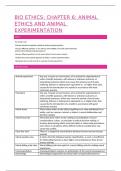
BIO ETHICS: CHAPTER 6: ANIMAL
ETHICS AND ANIMAL
EXPERIMENTATION
AIMS
DEFINITIONS
Animal experiment Any use, invasive or non-invasive, of an animal for experimental or
other scientific purposes, with known or unknown outcome, or
educational purposes which may cause the animal a level of pain,
suffering, distress or lasting harm equivalent to , or higher than, that ,
caused by the introduction of a needle in accordance with food
veterinary practice
Procedure Any use, invasive or non-invasive, of an animal for experimental or
other scientific purposes, with known or unknown outcome, or
educational purposes, which may cause the animal a level of pain,
suffering, distress or lasting harm equivalent to, or higher than, that
caused by the introduction of a needle in accordance with good
veterinary practice
Moral status Moral status refers to the ethical significance or value attributed to an
entity, such as a person, animal, or object, in moral deliberation and
decision-making
Moral hierarchy Moral hierarchy refers to the ranking or prioritization of moral
considerations, values, or principles in ethical decision-making. It
involves determining which moral principles or values take precedence
over others in situations where different ethical consideration may
come into conflict.
Clear-line view There is a categorical moral division between human and non-human
animals
Moral equality view It claims that the biological species classification, as such, is insufficient
for delineating humans as have higher moral importance than all non-
human animals
Moral sliding scale view Moral sliding scale view opts for a moral sliding scale for ranking moral
importance
Consequentialism Consequentialism requires an optimization of the overall consequences
Deontology Deontological approaches to animal ethics are generally based on
, rights, duties and personhood
Speciesism The (unwarranted) assignment of different values, rights or special
considerations to individuals based on their species membership,
without further motivation.
Animal rights Animal rights refer to the idea that non-human animals have inherent
rights, similar to those of humans, and that these rights should be
recognized and protected.
Sentience The capacity to feel pain and pleasure
Subjects-of-a-life Although animals may lack rationality, they possess futures, life goals,
and interests in survival, aspects that warrant respect, duties, and
rights. This perspective diverges from utilitarianism, as it emphasizes
inherent entitlements rather than outcomes, acknowledging animals as
inherently valuable.
Capacity to flourish Have interests/needs met
Cognitive capacity Eg self-consciousness, rational will, tool use, having moral symptoms,…
Sociability Relations with humans and other animals
Rationality Rationality refers to the capacity or ability of an individual to think,
reason, and make decisions based one careful considerations of
relevant information, logical principles, and goals or values
Replacement The substitution of conscious living higher animals with insentient
material (e.g. cell or tissue cultures, in-silico models)
Reduction The reduction in the nr of animals used to obtain information of given
amount and precision. This often requires statistical power analyses to
determine the minimal numbers of animals required to gain sufficient
power in the results.
Refinement Any decrease in the incidence of severity of inhumane procedures
applied to those animals which is used. This also includes decreases in
stress or harm experienced during procedures, breeding, housing,
transport, and handling through enrichment approaches
Abolitionist Refers to someone who advocates for the abolition or elimination of a
particular institution or practice, often on moral or ethical grounds
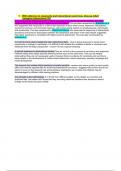
QUESTION 1: DISCUSS 3 POSITIONS ON THE MORAL STATUS OF NON-HUMAN ANIMALS.
FOR EACH POSITION, GIVE 1 EXAMPLE OF AN APPROACH TO ANIMAL EXPERIMENTATION
ETHICS ARGUING FROM THAT POSITION.
Considerations of humans using animals for research and testing, often begin with the moral
considerability of non-human animals: ‘Do non-human animals have moral status or moral
importance and how does it relate to the moral status of humans?’
Generally, there are 3 current positions in this question: the clear-line view, the moral equality view,
and moral sliding scale view
POSITION 1 : CLEAR-LINE VIEW
- Clear-line view: states that there is a categorical moral division between human and non-
human animals.
- Based on the assumption that there is some morally relevant, specific property which is
unique to, or possessed by humans, and which all non-human animals lack.
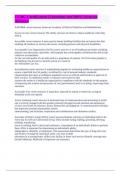
ETHICS AND ANIMAL
EXPERIMENTATION
AIMS
DEFINITIONS
Animal experiment Any use, invasive or non-invasive, of an animal for experimental or
other scientific purposes, with known or unknown outcome, or
educational purposes which may cause the animal a level of pain,
suffering, distress or lasting harm equivalent to , or higher than, that ,
caused by the introduction of a needle in accordance with food
veterinary practice
Procedure Any use, invasive or non-invasive, of an animal for experimental or
other scientific purposes, with known or unknown outcome, or
educational purposes, which may cause the animal a level of pain,
suffering, distress or lasting harm equivalent to, or higher than, that
caused by the introduction of a needle in accordance with good
veterinary practice
Moral status Moral status refers to the ethical significance or value attributed to an
entity, such as a person, animal, or object, in moral deliberation and
decision-making
Moral hierarchy Moral hierarchy refers to the ranking or prioritization of moral
considerations, values, or principles in ethical decision-making. It
involves determining which moral principles or values take precedence
over others in situations where different ethical consideration may
come into conflict.
Clear-line view There is a categorical moral division between human and non-human
animals
Moral equality view It claims that the biological species classification, as such, is insufficient
for delineating humans as have higher moral importance than all non-
human animals
Moral sliding scale view Moral sliding scale view opts for a moral sliding scale for ranking moral
importance
Consequentialism Consequentialism requires an optimization of the overall consequences
Deontology Deontological approaches to animal ethics are generally based on
, rights, duties and personhood
Speciesism The (unwarranted) assignment of different values, rights or special
considerations to individuals based on their species membership,
without further motivation.
Animal rights Animal rights refer to the idea that non-human animals have inherent
rights, similar to those of humans, and that these rights should be
recognized and protected.
Sentience The capacity to feel pain and pleasure
Subjects-of-a-life Although animals may lack rationality, they possess futures, life goals,
and interests in survival, aspects that warrant respect, duties, and
rights. This perspective diverges from utilitarianism, as it emphasizes
inherent entitlements rather than outcomes, acknowledging animals as
inherently valuable.
Capacity to flourish Have interests/needs met
Cognitive capacity Eg self-consciousness, rational will, tool use, having moral symptoms,…
Sociability Relations with humans and other animals
Rationality Rationality refers to the capacity or ability of an individual to think,
reason, and make decisions based one careful considerations of
relevant information, logical principles, and goals or values
Replacement The substitution of conscious living higher animals with insentient
material (e.g. cell or tissue cultures, in-silico models)
Reduction The reduction in the nr of animals used to obtain information of given
amount and precision. This often requires statistical power analyses to
determine the minimal numbers of animals required to gain sufficient
power in the results.
Refinement Any decrease in the incidence of severity of inhumane procedures
applied to those animals which is used. This also includes decreases in
stress or harm experienced during procedures, breeding, housing,
transport, and handling through enrichment approaches
Abolitionist Refers to someone who advocates for the abolition or elimination of a
particular institution or practice, often on moral or ethical grounds
QUESTION 1: DISCUSS 3 POSITIONS ON THE MORAL STATUS OF NON-HUMAN ANIMALS.
FOR EACH POSITION, GIVE 1 EXAMPLE OF AN APPROACH TO ANIMAL EXPERIMENTATION
ETHICS ARGUING FROM THAT POSITION.
Considerations of humans using animals for research and testing, often begin with the moral
considerability of non-human animals: ‘Do non-human animals have moral status or moral
importance and how does it relate to the moral status of humans?’
Generally, there are 3 current positions in this question: the clear-line view, the moral equality view,
and moral sliding scale view
POSITION 1 : CLEAR-LINE VIEW
- Clear-line view: states that there is a categorical moral division between human and non-
human animals.
- Based on the assumption that there is some morally relevant, specific property which is
unique to, or possessed by humans, and which all non-human animals lack.