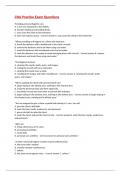
21. Hearsay Evidence Complete Assignment With Questions And Answer|2024.s
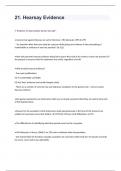
• "Evidence of what another person has said". • General rule against hearsay set out in Morrison v HM Advocate 1990 JC 299: - "an assertion other than one made by a person while giving oral evidence in the proceedings is inadmissible as evidence of any fact asserted" (at 312). • Rule only prevents hearsay evidence being led to prove the truth of its content. It does not prevent it if the purpose is to prove that the statement was made, regardless of truth. • Why exclude hearsay evidence? - Two main justifications (1) It is potentially unreliable (2) Not 'best' evidence (and could elongate trials) - There are a number of common law and statutory exceptions to the general rule - correct answer Hearsay evidence • Res gestae statements are statements which are so closely connected that they are said to form part of the disputed facts. • Reason for the exception is that statements made spontaneously in the heat of the moment are unlikely to have been concocted: Ratten v R [1972] AC 378, per Lord Wilberforce at 391 • The difficulty lies in identifying what time period counts as the res gestae • HM Advocate v Murray (1866) 5 Irv 232 took a relatively wide interpretation - Girl claimed that she had been sexually assaulted, she ran home which took her 10 minutes and told her mum, court said it was admissible. • Cinci v HM Advocate 2004 JC 103 took a far narrower view and this must now be regarded as the leading authority - Exchange students in the youth hostel. - Length of time accepted by the courts is now very narrow. • Can make distinction between res gestate and de recenti statements made shortly after the incident - correct answer (1) "Res gestae" statements • These (confessions or other incriminating admissions) are admissible as an exception to the hearsay rule on the bases that they are especially reliable. • Confessions are admissible as an exception to the hearsay rule because they are especially reliable • In the past there were special rules about the admissibility of mixed statements - those that are partly incriminating and partly exculpatory e.g. "I was there but it wasn't me who stabbed him" - McCutcheon v HM Advocate 2002 SLT 27 (Full Bench of nine judges!) • The Criminal Justice (Scotland) Act 2016 s.109 inserts s.261ZA into the 1995 Act which replaces complex rules with a simple rule: any statement made by accused in course of being questioned by police officers is admissible • (confirmed in McPhee v HM Advocate v HM Advocate [2019] HCJAC 8) - correct answer (2) Confessions • A witness can "adopt" a statement she made to police as her evidence in chief. This might be helpful if her memory of events has faded but she is confident she told the truth when she made the statement. • Follows Lord Coulsfield's recommendations made in Scottish Government's 2007 Review of the Law and Practice of Disclosure Report and also reflects Jamieson v HM Advocate 1994 J.C 251 • CPSA section 260(2): three conditions must be met: (a) the statement is contained in a document (but not a precognition i.e. statement taken by someone preparing the case for one of the parties, unless made on oath, because it would be considered partisan); (b) the witness in giving evidence indicates that he made the statement, and adopts it as his evidence; and (c) at the time it was made the maker would have been a competent witness. • See Croal v HM Advocate [2014] HCJAC 34 - correct answer (3) Adoption of prior statements • Under section 259(2) of the CPSA, hearsay evidence is admissible where the person who made the statement: (a) is dead, or is, by reason of his bodily or mental condition, unfit or unable to give evidence in any competent manner; (b) is named and otherwise sufficiently identified, but is outwith the UK, and it is not reasonably practicable to secure his attendance at the trial or to obtain his evidence in any other competent manner; (c) is named and otherwise sufficiently identified, but cannot be found (all reasonable steps having been taken); (d) has refused to give evidence (with the court's permission) on the basis that it might incriminate him (because the court needs all the evidence to determine the guilt or innocence of the accused); (e) has either refused to take the oath or has refused to give evidence. The witness must be in court and must have refused to take the oath or answer questions after specifical - correct answer (4) The statutory exceptions • In HM Advocate v Malloy [2012] HCJ 124 court made it clear that the statutory rules replace the previous common law - Didn't make the application therefore the evidence was inadmissible, court made it clear that the statutory rules replace the common law. • Where a party wishes to lead hearsay evidence under gateway (a) (b) or (c) he or she must make an application to the court in writing in advance: section 259(5) - correct answer (4) The statutory exceptions: interpretation • In Lees v HM Advocate [2016] HCJAC 16 the court confirmed that evidence admitted from a deceased person under s.259(2)(a) had the same value as spoken evidence & could offer corroboration by way of the Moorov doctrine • Meaning of incompetent, see HM Advocate v Patterson 2000 J.C 137, the court rejected alcoholism as rendering a witness incompetent under 259(2)(a) - correct answer (4) The statutory exceptions: interpretation (s.259(2)(A)) • In Aslam v HM Advocate 2000 J.C 325 the court upheld the decision by the Sheriff not to allow hearsay evidence after not being satisfied that the witness was abroad, as claimed. - correct answer (4) The statutory exceptions: interpretation (s.259(2)(B)) • In Macdonald v HM Advocate 1999 SLT 533 the court held that part (e) (the exception for a witness who refuses to take the oath or give evidence) is to be interpreted strictly - Court held that part (e) is to be interpreted strictly. - Young child giving evidence about a sexual assault but broke down in court and was too distressed to continue, prosecution had a statement from the child but the court said it was inadmissible because he had not actually refused to give the statement was simply unable. • Value for vulnerable/anxious witnesses? - correct answer (4) The statutory exceptions: interpretation (s.259(2)(E)) • Three questions arise when hearsay evidence is admitted from an absent witness: (1) Was there a good reason for the non-attendance of the witness? (2) If so, was the evidence "sole or decisive"? (3) If so, were there adequate counterbalancing measures? • Graham (Ryan) v HM Advocate [2018] HCJAC 69 - correct answer Test for the absent witness • Article 6(3)(d) of the ECHR might seem to prohibit hearsay evidence, as it explicitly provides that an accused must be able to "examine or have examined witnesses against him". • But the Scottish courts have held that, because other safeguards exist, Article 6(3)(d) is not breached: McKenna v HM Advocate 2000 JC 291 (objection to admission of evidence); 2003 SLT 769 (appeal against conviction) - These safeguards include the corroboration requirement and the trial judge's direction which must warn the jury about the limitations of hearsay evidence • The European Court of Human Rights took a similar view in Al-Khawaja and Tahery v United Kingdom (2012) 54 EHRR 23. • This does raise the question of what will happen if the corroboration requirement is abolished ... -
Written for
- Institution
- EVIDENCE LAW
- Module
- EVIDENCE LAW
Document information
- Uploaded on
- June 5, 2024
- Number of pages
- 5
- Written in
- 2023/2024
- Type
- Exam (elaborations)
- Contains
- Questions & answers
Subjects
-
21 hearsay evidence

Also available in package deal