Neuroscience, Sixth Edition Chapter 8 Synaptic Plasticity exam with complete solutions
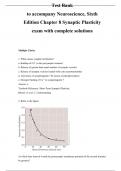
Multiple Choice 1. What causes synaptic facilitation? a. Buildup of Ca2+ in the presynaptic terminal b. Release of greater than usual number of synaptic vesicles c. Release of synaptic vesicles loaded with extra neurotransmitter d. Activation of synaptotagmin 7 by means of phosphorylation e. Stronger binding of Ca2+ to synaptotagmin 7 Answer: a Textbook Reference: Short-Term Synaptic Plasticity Bloom’s Level: 2. Understanding 2. Refer to the figure. At which time interval would the postsynaptic membrane potential of the second stimulus be greatest? a. 8 ms b. 15 ms c. 20 ms d. 30 ms e. 50 ms Answer: a Med C Textbook Reference: Short-Term Synaptic Plasticity Bloom’s Level: 4. Analyzing 3. Refer to the figure. Which statement describes the depicted phenomenon most accurately? a. Synaptic depression directly correlates with the concentration of extracellular Ca2+. b. Synaptic depression directly correlates with the amount of neurotransmitter released. c. Synaptic depression is inversely correlated with the amount of neurotransmitter released. d. Synaptic depression depends on the rate of neurotransmitter release. e. Synaptic depression depends on the concentration of neurotransmitter in synaptic vesicles. Answer: b Textbook Reference: Short-Term Synaptic Plasticity Bloom’s Level: 4. Analyzing 4. How would an increase in external Ca2+ concentration affect synaptic depression? a. It would increase the rate of depression. b. It would reduce the rate of depression. c. It would decrease the rate of neurotransmitter release and induce depression. d. It would increase the rate of neurotransmitter release and delay depression. e. It would have no effect on depression. Answer: a Textbook Reference: Short-Term Synaptic Plasticity Bloom’s Level: 3. Applying 5. Which type of short-term synaptic plasticity lasts the longest? a. Potentiation b. Augmentation Med C c. Depression d. Facilitation e. Post-tetanic potentiation Answer: e Textbook Reference: Short-Term Synaptic Plasticity Bloom’s Level: 1. Remembering 6. What characteristic(s) make(s) Aplysia californica a practical model organism for studying the nervous system? a. Its great magnitude and variety of neurons b. Its large neurons c. The random location of its neurons d. That it is aquatic e. All of the above Answer: b Textbook Reference: Long-Term Synaptic Plasticity and Behavioral Modification in Aplysia Bloom’s Level: 2. Understanding 7. Refer to the figure. In which form of plasticity is this neural circuit involved, and which component of the circuit makes this form of plasticity possible? a. Habituation; interneuron b. Habituation; modulatory interneuron c. Sensitization; interneuron d. Sensitization; modulatory interneuron e. Sensitization; motor neuron Answer: d Textbook Reference: Long-Term Synaptic Plasticity and Behavioral Modification in Aplysia Bloom’s Level: 4. Analyzing Med C 8. Refer to the figure. Repeated stimulation of the siphon results in habituation. Which synaptic change occurs during habituation? a. The synapse between the sensory and motor neurons is depressed. b. The synapse between the sensory and motor neurons is potentiated. c. The synapse between the sensory neuron and the interneuron is depressed. d. The synapse between the sensory neuron and the modulatory interneuron is depressed. e. The synapse between the interneuron and the motor neuron is depressed. Answer: a Textbook Reference: Long-Term Synaptic Plasticity and Behavioral Modification in Aplysia Bloom’s Level: 4. Analyzing 9. Refer to the figure. The function of which synapse is altered during sensitization? Med C a. The synapse between the sensory neuron of the siphon and the motor neuron b. The synapse between the sensory neuron of the tail and the modulatory interneuron c. The synapse between the sensory neuron of the siphon and the interneuron d. The synapse between the interneuron and the motor neuron e. The synapse between the modulatory interneuron and sensory neuron of the siphon Answer: a Textbook Reference: Long-Term Synaptic Plasticity and Behavioral Modification in Aplysia Bloom’s Level: 4. Analyzing 10. Complete the sequence of events that take place in the presynaptic enhancement underlying short-term behavioral sensitization: Serotonin is released from facilitatory interneuron; Ca2+ influx into the presynaptic terminal is enhanced; more neurotransmitter is released; synaptic transmission is enhanced a. IP3 signaling keeps postsynaptic K+ channels closed. b. IP3 signaling keeps presynaptic K+ channels closed. c. PKA signaling keeps presynaptic K+ channels closed. d. PKA signaling keeps presynaptic K+ channels open. e. cAMP signaling keeps presynaptic K+ channels open. Answer: c Textbook Reference: Long-Term Synaptic Plasticity and Behavioral Modification in Aplysia Bloom’s Level: 3. Applying 11. Which process differentiates long-term from short-term sensitization? a. Synaptic transmission between the facilitatory and sensory neurons b. Changes in gene expression c. PKA activation d. Production of cAMP e. Changes in the synapses between the sensory and motor neurons Answer: b Textbook Reference: Long-Term Synaptic Plasticity and Behavioral Modification in Aplysia Bloom’s Level: 2. Understanding 12. Which Drosophila melanogaster genotype is associated with the worst performance in an olfactory learning task? a. Wild type b. Dunce mutant c. Rutabaga mutant d. Dunce, rutabaga double mutant e. The performance of all phenotypes is comparable. Answer: d Textbook Reference: Box 8A: Genetics of Learning and Memory in the Fruit Fly Bloom’s Level: 1. Remembering Med C 13. Which characteristic of a living hippocampus slice is critically important to its suitability as an experimental system for studying learning? a. Its architecture: the hippocampus can be sectioned without destroying relevant circuits. b. The hippocampus contains few neurons, which makes it easy to study. c. The layer of the pyramidal neurons is divided into several regions. d. Long-term potentiation takes place in hippocampal synapses. e. The hippocampus is involved in learning. Answer: a Textbook Reference: Long-Term Potentiation at a Hippocampal Synapse Bloom’s Level: 2. Understanding 14. LTP represents a lasting increase in the size of EPSP a. following a high-frequency train of stimuli. b. following a low-frequency train of stimuli. c. following a single stimulus. d. that is restricted to the hippocampus. e. that is restricted to the cortex. Answer: a Textbook Reference: Long-Term Potentiation at a Hippocampal Synapse Bloom’s Level: 2. Understanding 15. Which property of LTP underlies Pavlovian conditioning? a. Requirement for coincident activation of pre- and postsynaptic neurons b. Specificity of input c. Associativity d. Complementarity e. Transience Answer: c Textbook Reference: Long-Term Potentiation at a Hippocampal Synapse Bloom’s Level: 2. Understanding 16. Which condition(s) must be met to induce LTP? a. Glutamate must be released from the presynaptic terminal. b. Glutamate must open the postsynaptic AMPA receptors. c. The postsynaptic membrane must be depolarized for a period of time. d. Mg2+ block must be expelled from NMDA receptors to allow Ca2+ influx. e. All of the above Answer: e Textbook Reference: Mechanisms Underlying Long-Term Potentiation Bloom’s Level: 2. Understanding 17. What is the immediate consequence of Mg2+ blockade removal from the NMDA receptors? a. Ca2+ influx into the presynaptic terminal b. Ca2+ influx into the postsynaptic terminal c. Na+ influx into the postsynaptic terminal Med C d. Postsynaptic EPSP e. Glutamate binding to its receptors Answer: b Textbook Reference: Mechanisms Underlying Long-Term Potentiation Bloom’s Level: 2. Understanding 18. What would happen if Mg2+ was not expelled from NMDA channels? a. Glutamate would not bind to NMDA receptors. b. Glutamate would not bind to AMPA receptors. c. The postsynaptic membrane would not depolarize. d. EPSP would not occur. e. LTP would not occur. Answer: e Textbook Reference: Mechanisms Underlying Long-Term Potentiation Bloom’s Level: 3. Applying 19. What is the mechanism of LTP expression? a. Increase in the number of postsynaptic NMDA receptors b. Increase in the number of postsynaptic AMPA receptors c. Increase in the number of presynaptic AMPA receptors d. Increase in the intracellular level of synaptotagmins e. Decrease in the level of glutamate released into the synaptic cleft Answer: b Textbook Reference: Mechanisms Underlying Long-Term Potentiation Bloom’s Level: 3. Applying 20. Which protein facilitates the late phase of LTP? a. Synaptotagmin b. CaMKII c. CREB d. PKC e. Clathrin Answer: c Textbook Reference: Mechanisms Underlying Long-Term Potentiation Bloom’s Level: 1. Remembering 21. Which process does not take place during LTD? a. Activation of protein kinases b. Activation of protein phosphatases c. Activation of PKC d. Activation of clathrin e. Activation of synaptotagmin Answer: a Textbook Reference: Mechanisms Underlying Long-Term Depression Bloom’s Level: 1. Remembering Med C 22. Which second messenger(s) is(are) involved in postsynaptic depression? a. Ca2+ only b. cAMP and Ca2+ only c. DAG and IP3 only d. Ca2+, DAG, and IP3 e. cAMP, Ca2+, DAG, and IP3 Answer: d Textbook Reference: Mechanisms Underlying Long-Term Depression Bloom’s Level: 1. Remembering 23. Which statement about silent synapses is true? a. They cannot be induced to transmit information. b. They transmit information at a resting membrane potential. c. They can produce postsynaptic responses as a result of LTP. d. They contain both NMDA and AMPA receptors. e. They represent mature glutamatergic synapses. Answer: b Textbook Reference: Mechanisms Underlying Long-Term Potentiation Bloom’s Level: 2. Understanding 24. Refer to the figure. Glutamate sensitivity (the amplitude of response to the application of glutamate) is color coded. The micrograph on the right was taken 120 minutes after the micrograph on the left. Which form of plasticity is shown in the figure? a. Habituation b. Sensitization c. Synaptic facilitation d. LTP e. LTD Answer: d Textbook Reference: Mechanisms Underlying Long-Term Potentiation Bloom’s Level: 4. Analyzing Med C 25. What triggers LTD? a. Ca2+ influx into the postsynaptic terminal b. Internalization of AMPA receptors c. High-frequency stimulation d. Low-frequency stimulation followed by small or slow increase in Ca2+ e. Low-frequency stimulation followed by sharp and dramatic increase in Ca2+ Answer: d Textbook Reference: Spike Timing-Dependent Plasticity Bloom’s Level: 2. Understanding 26. At which time interval between pre- and postsynaptic activity would STDP occur? a. 20 ms, but only if presynaptic activity occurs before postsynaptic activity b. 30 ms, but only if postsynaptic activity occurs before presynaptic activity c. 40 ms, regardless of whether pre- or postsynaptic activity occurs first d. 10–100 ms, regardless of whether pre- or postsynaptic activity occurs first e. 40–100 ms, regardless of whether pre- or postsynaptic activity occurs first Answer: c Textbook Reference: Spike Timing-Dependent Plasticity Bloom’s Level: 4. Analyzing 27. Which statement about kindling is true? a. Its effect is reversible. b. Its effect is long-lasting. c. It is based on use of a single, weak stimulus to change the excitability of the brain. d. It is used to treat epilepsy. e. It is used to diagnose epilepsy. Answer: b Textbook Reference: Spike Timing-Dependent Plasticity Bloom’s Level: 2. Understanding Short Answer 1. Define the term “synaptic plasticity.” Answer: It is the ability of synapses to change in strength. Textbook Reference: Overview Bloom’s Level: 1. Remembering 2. How do the short-term forms of synaptic plasticity contribute to learning and memory? Answer: They cause the transmission at chemical synapses to change dynamically as a consequence of the recent history of synaptic activity, that is, experience. Textbook Reference: Short-Term Synaptic Plasticity Bloom’s Level: 2. Understanding 3. What is the synaptic basis for short-term sensitization in Aplysia? Med C Answer: Modulatory interneurons strengthen synaptic transmission in the gill withdrawal circuit, that is, the synapses between the sensory and motor neurons of the siphon. Textbook Reference: Long-Term Synaptic Plasticity and Behavioral Modification in Aplysia Bloom’s Level: 2. Understanding 4. Define long-term potentiation (LTP). Draw a diagram that shows how LTP is obtained experimentally in CA1 of the hippocampus. Answer: Long-term potentiation represents a long-lasting increase in synaptic strength. Textbook Reference: Long-Term Potentiation at a Hippocampal Synapse Bloom’s Level: 3. Applying 5. What is needed for: a) the initial acquisition of LTP and b) the maintenance of long- lasting LTP? Answer: a) Increase in postsynaptic Ca2+ b) Increase in the number of postsynaptic AMPA receptors with subsequent changes in protein expression in the postsynaptic cell Textbook Reference: Mechanisms Underlying Long-Term Potentiation Bloom’s Level: 2. Understanding 6. What is long-term depression (LTD)? How is it produced experimentally? Answer: Long-term depression is a persistent, activity-dependent weakening of synaptic transmission. It can be produced in the lab by stimulating Schaffer collaterals at a low frequency/rate for a long period of time /10–15 minutes. Textbook Reference: Mechanisms Underlying Long-Term Depression Bloom’s Level: 3. Applying 7. Compare cellular mechanisms involved in LTP versus LTD. Answer: LTP is accompanied by an increase in the number of postsynaptic AMPA receptors, whereas LTD is accompanied by a decrease in the number of postsynaptic AMPA receptors. Textbook Reference: Mechanisms Underlying Long-Term Depression Med C Bloom’s Level: 3. Applying 8. How are silent synapses converted to active excitatory synapses? Answer: Silent synapses are turned “on” when (induced by LTP) AMPA receptors are added to postsynaptic membranes, and the postsynaptic cell becomes responsive to glutamate. Textbook Reference: Mechanisms Underlying Long-Term Potentiation Bloom’s Level: 2. Understanding 9. Why is it thought that Ca2+ levels might be involved in spike timing-dependent plasticity (STDP)? Answer: If postsynaptic Ca2+ levels are high (as they are when presynaptic activity precedes postsynaptic potential), LTP occurs. If postsynaptic Ca2+ levels are low (as they are when postsynaptic potential precedes presynaptic activity), LTD occurs. Textbook Reference: Spike Timing-Dependent Plasticity Bloom’s Level: 3. Applying 10. What might LTP and epilepsy have in common? Answer: Long-lasting or even permanent changes in neuronal circuitry underlie both LTP and epilepsy. Textbook Reference: Spike Timing-Dependent Plasticity Bloom’s Level: 2. Understanding Multiple Choice from Dashboard Quiz 1. Which statement about the plasticity of synapses in the mammalian CNS is false? a. The hallmark of both short-term and long-term synaptic plasticity is that they always increase the strength of synaptic connections. b. The efficacy of synapses can be adjusted by modulating the amount of neurotransmitter that is released. c. Calcium ions play a central role in at least some forms of synaptic plasticity. d. Changes in synaptic efficacy can occur over time scales ranging from milliseconds to years. e. A variety of molecular mechanisms are involved in the different forms of synaptic plasticity. Answer: a Textbook Reference: Overview Bloom’s Level: 2. Understanding 2. Firing an action potential in an axon initially causes a 10-mV depolarization (EPSP) in a postsynaptic neuron, but after applying a certain stimulus to the axon, firing it causes an 8-mV depolarization after each action potential. This phenomenon is called synaptic a. enhancement. b. depression. c. facilitation. Med C d. augmentation. e. potentiation. Answer: b Textbook Reference: Short-Term Synaptic Plasticity Bloom’s Level: 2. Understanding 3. After firing a short burst of action potentials in an axon, researchers observe a larger EPSP in the postsynaptic cell, and this effect seems to last a few tens of milliseconds. This is most likely due to the presynaptic terminal having a. extra calcium. b. lowered calcium. c. extra sodium. d. reduced sodium. e. extra magnesium. Answer: a Textbook Reference: Short-Term Synaptic Plasticity Bloom’s Level: 2. Understanding 4. Which mechanism would be a plausible explanation for synaptic depression? a. Inhibition of postsynaptic calcium channels b. Activation of presynaptic potassium channels c. Depletion of docked synaptic vesicles in the presynaptic terminal d. Faster replenishment of vesicles to the reserve pool e. Enhancement of presynaptic sodium currents Answer: c Textbook Reference: Short-Term Synaptic Plasticity Bloom’s Level: 3. Applying 5. Which statement about long-term synaptic plasticity is false? a. The efficacy of transmission at many synapses depends on their history of synaptic activity. b. The tracking of long-term changes in synaptic efficacy is difficult in mammalian systems because of the complexity of mammalian brains. c. The gill withdrawal reflex in Aplysia can be enhanced by pairing a noxious stimulus with a mild touch. d. Associative learning in the Aplysia gill withdrawal reflex is relatively independent of the timing or the order in which different stimuli are applied. e. Gill withdrawal behavior in Aplysia can be altered for days or weeks by means of repeated pairings of shocks and touches. Answer: d Textbook Reference: Long-Term Synaptic Plasticity and Behavioral Modification in Aplysia Bloom’s Level: 2. Understanding 6. Which mechanism contributes to the long-term enhancement of the gill withdrawal reflex in Aplysia but is not involved in the short-term enhancement of the reflex? Med C a. Activation of G-protein-coupled receptors by serotonin b. Phosphorylation of CREB c. Activation of adenylyl cyclase d. Activation of protein kinase A e. Decreased opening of potassium channels during presynaptic action potentials Answer: b Textbook Reference: Long-Term Synaptic Plasticity and Behavioral Modification in Aplysia Bloom’s Level: 2. Understanding 7. Learning and memory processes in the fruit fly Drosophila show striking molecular overlap with analogous processes in Aplysia, in terms of their using all of the following except a. phosphodiesterase. b. adenylyl cyclase. c. adenylyl cyclase activating pathways. d. allosteric modulation of GABA receptors. e. CREB gene regulation. Answer: d Textbook Reference: Box 8A: Genetics of Learning and Memory in the Fruit Fly Bloom’s Level: 2. Understanding 8. Which statement about LTP is false? a. LTP involves an enhancement in synaptic efficacy that can last for hours, days, weeks or even longer. b. If one synapse (A) is very strongly stimulated (sufficient to cause LTP), and another nearby synapse (B) on the same dendrite is weakly stimulated at the same time, then the second synapse (B) will also show LTP. c. If one synapse (A) is very strongly stimulated (sufficient to cause LTP), and a nearby synapse (B) on the same cell is weakly stimulated a few seconds later, then the second synapse (B) will also show LTP. d. The requirement for coincident pre- and postsynaptic activity was predicted by Donald Hebb in 1949. e. Hippocampal LTP was first reported by Bliss and Lomo about 1970. Answer: c Textbook Reference: Long-Term Potentiation at a Hippocampal Synapse Bloom’s Level: 2. Understanding 9. An electrode is used to stimulate a presynaptic nerve that synapses in the dentate gyrus (DG) of the hippocampus. Postsynaptic recordings are measured in the DG neurons. First a weak stimulus (stimulus A) is applied, and then a strong stimulus (stimulus B). If a second weak stimulus (stimulus C) is applied after the strong stimulus, which result would you expect? a. The postsynaptic response to the second weak stimulus (C) will be higher than the response to the strong stimulus (B). Med C b. The postsynaptic response to the second weak stimulus (C) will be lower than the response to the first weak stimulus (A). c. The postsynaptic response to the second weak stimulus (C) will be equal to the response to the first weak stimulus (A). d. The postsynaptic response to the second weak stimulus (C) will be equal to the response to the strong stimulus (B). e. The postsynaptic response to the second weak stimulus (C) will be higher than the response to the first weak stimulus (A). Answer: e Textbook Reference: Long-Term Potentiation at a Hippocampal Synapse Bloom’s Level: 4. Analyzing 10. A researcher is trying to study synaptic transmission in a glutamatergic hippocampal neuron. She is tasked with measuring calcium flow in the postsynaptic hippocampal neuron after either low or high intensity stimulation to the presynaptic neuron. During the experiment, she measures calcium influx after both low and high stimulation. Which statement best describes the error she made? a. She forgot to add magnesium to the extracellular solution b. She forgot to add calcium to the extracellular solution c. She forgot to add sodium to the extracellular solution d. She forgot to add potassium to the extracellular solution e. She completed all steps correctly. Answer: a Textbook Reference: Mechanisms Underlying Long-Term Potentiation Bloom’s Level: 4. Analyzing 11. You are examining long-term potentiation in two groups of hippocampal neurons: control and treated. You induce lasting LTP in the control cells after repetitive high- frequency stimulation. In the treated cell, however, the potentiation begins to decrease after 2 hours. What treatment was given? a. A drug that blocks sodium channels b. A drug that opens calcium channels c. A drug that binds magnesium d. A drug that inhibits protein synthesis e. A drug that blocks clathrin Answer: d Textbook Reference: Mechanisms Underlying Long-Term Potentiation Bloom’s Level: 4. Analyzing 12. The type of receptor that is critical for the induction of hippocampal LTP, admitting calcium into a dendritic spine, is called a(n) a. AMPA receptor. b. NMDA receptor. c. glycine receptor. d. cholinergic GPCR. e. noradrenergic GPCR. Med C Answer: b Textbook Reference: Mechanisms Underlying Long-Term Potentiation Bloom’s Level: 1 Remembering 13. The key aspect of receptor-gating in the associative induction of hippocampal LTP is that a. all glutamate receptors open automatically whenever glutamate is in the synaptic cleft. b. the NMDA receptor acts as a molecular coincidence detector. c. the AMPA receptor allows calcium into the cell only after the NMDA receptor is activated. d. both the NMDA and AMPA channels must be open in order for the cell to depolarize. e. The NMDA receptor allows the flow of magnesium into the cell. Answer: b Textbook Reference: Mechanisms Underlying Long-Term Potentiation Bloom’s Level: 2. Understanding 14. Which statement about the mechanisms underlying hippocampal LTP induction is false? a. An influx of calcium triggers two or more intracellular processes in the postsynaptic dendritic spine. b. Calcium may enhance transmitter release from the presynaptic terminal. c. Calcium may activate Ca2+/calmodulin-dependent protein kinase type II (CaMKII), which then autophosphorylates, leading to a long-term “on” state. d. Calcium may activate a signaling cascade that causes the insertion of glutamate receptors into the postsynaptic membrane. e. Calcium decreases a resting leak current of sodium so that the postsynaptic cell is closer to threshold and therefore fires more easily. Answer: e Textbook Reference: Mechanisms Underlying Long-Term Potentiation Bloom’s Level: 2. Understanding 15. Silent synapses are “silent” because they a. have no presynaptic terminal. b. have AMPA receptors but no NMDA receptors. c. have NMDA receptors but no AMPA receptors. d. lack voltage-gated sodium channels. e. are continuously inhibited and so cannot be activated. Answer: c Textbook Reference: Box 8B: Silent Synapses Bloom’s Level: 1. Remembering 16. Which mechanism used in hippocampal LTD is not part of the hippocampal LTP mechanism? a. History-dependent modification of synaptic efficacy b. NMDA receptor activation c. Calcium influx Med C d. Calcium-dependent activation of protein phosphatases e. Calcium-dependent activation of protein kinases. Answer: d Textbook Reference: Mechanisms Underlying Long-Term Depression Bloom’s Level: 2. Understanding 17. The targets of the phosphatases activated during hippocampal LTD are a. voltage-gated ion channels. b. ligand-gated ion channels. c. synaptic vesicle regulatory proteins. d. postsynaptic signaling pathways. e. unknown. Answer: e Textbook Reference: Mechanisms Underlying Long-Term Depression Bloom’s Level: 1. Remembering 18. Cerebellar LTD depends on a. synergistic actions of calcium and IP3 on internal calcium release channels. b. synergistic actions of sodium and IP3 on internal calcium release channels. c. activation of AMPA receptors by voltage-gated ion channels. d. binding of IP3 to clathrin to activate endocytosis. e. calcium-dependent insertion of GABA receptors into the postsynaptic membrane. Answer: a Textbook Reference: Mechanisms Underlying Long-Term Depression Bloom’s Level: 2. Understanding 19. Which observation would demonstrate the spike timing-dependent plasticity of synapses? a. Whether or not LTP occurs is dependent on the specific temporal pattern of action potentials. b. LTP occurs whenever an action potential precedes an EPSP. c. LTD occurs whenever an action potential follows an EPSP. d. Switching the relative timing of action potential and EPSP by as little as 20 ms can switch the response from LTD to LTP, or vice-versa. e. A rhythmic pattern of spike–EPSP–spike–EPSP, at 40 ms intervals, produces maximal LTP. Answer: d Textbook Reference: Spike Timing-Dependent Plasticity Bloom’s Level: 2. Understanding 20. In the context of neuropathological activity, the phenomenon of kindling refers to a. small burns made in cortex by an electrical stimulating electrode. b. the ability to induce LTP in the amygdala and other brain regions in live animals. c. the ability of daily administration of a weak, low-amplitude train of electrical pulses to gradually evoke larger and larger behavioral responses. Med C d. the phenomenon whereby a single, strong electrical pulse can evoke a full-blown seizure. e. chaotic patterns of neural activity resembling the flame of a candle. Answer: c Textbook Reference: Clinical Applications: Epilepsy: The Effect of Pathological Activity on Neural Circuitry Bloom’s Level: 1. Remembering
Written for
- Institution
- Neuroscience
- Module
- Neuroscience
Document information
- Uploaded on
- July 25, 2024
- Number of pages
- 33
- Written in
- 2023/2024
- Type
- Exam (elaborations)
- Contains
- Questions & answers
Subjects
-
neuroscience sixth edition chapter 8

Also available in package deal