100% satisfaction guarantee Immediately available after payment Both online and in PDF No strings attached 4.6 TrustPilot
logo-home
Exam (elaborations)

Module 1 Questions and Answers 100% correct

Rating
-
Sold
-
Pages
4
Grade
A+
Uploaded on
02-08-2024
Written in
2024/2025

Module 1 Questions and Answers 100% correct The Biofeedback Certification International Alliance defines EEG biofeedback (also called neurofeedback) as: "EEG Biofeedback is employed to monitor or modify the electrical activity of the CNS including: EEG, event related potentials, slow cortical potentials, and other electrical activity either of subcortical or cortical origin. Neurofeedback is a specialized application of biofeedback of brainwave data in an operant conditioning paradigm. The method is used to treat clinical conditions as well as to enhance performance" EEG Is a non-invasive way of measuring brain function. Brain activity changes with everything that you think, feel, or do when you can see that activity in real time. Event related potentials the measured (measurable) brain response that is the direct result of a specific sensory, cognitive, or motor event.[1] More formally, it is any stereotyped electrophysiological response to a stimulus. Slow Cortical Potentials Cortical Subcortical Operant Conditioning Paradigm Berger's Wave 10 Hz alpha that dominates when the eyes are closed in human EEG Neal Miller and Leo Decara Carried out a animal experiments in the 1960's, which demonstrated the possibility of operant conditioning with a variety of internal autonomically regulated physiologic processes, including: blood pressure, cardiac function, and intestinal activity. Prior to their research, physiologists generally assumed that organisms only had control over voluntary processes and not involuntary processes the Society for the Study of Neuronal Regulation which today is known as the ISNR or International Society for Neurofeedback and Research. Thomas Budzynski In the early 1970s, he developed the Twilight Learner in collaboration with John Picchiottino. The Twilight Learner was one of the first neurotherapy systems. He became the first person to use alpha training for systematic desensitization. Barry Sterman Department of Psychiatry at UCLA. conducting operant conditioning experiments with cats. He discovered that the cats produced a particular brainwave pattern in the motor strip when they were alert and motionless. He called this 12-15 cycle per second pattern, The Sensory Motor Rhythm, or SMR Slow wave paradigm Kamiya and Peniston /alpha theta training Fast wave paradigm Sterman, Lubar, and Ayers - which was widely developed and promoted by the Othmers in the 1990s Joel Lubar develop qEEG guided neurofeedback in parallel with Sterman and Kaiser as well as Robert Thatcher. Also used Stermans seizure training to treat ADHD Tom Collura and Robert Thatcher co-developed Z-Score Training which guides EEG thresholding automatically on 240 qEEG variables based on a dll library. Recently Collura developed sLORETA Z-Score training involving 19 channels of Z-Score training with live LORETA imaging. The Others Developed training of the subdelta dc components of the brain's electrical activity under the rubric of Infra-low training or ILF Mark Smith developed that paradigm as well only at slightly higher frequencies under the rubric of Infra-slow training ISF. Len Ochs led the development of EEG driven photic stimulation with the Flexyx EDS System and developed a training model known as LENS which quickly became popular as well. The LENS system works by stimulating the brain using a very weak high frequency signal to generate change. Nick Dorgis developed a combination of micro tesla pulsing and neurofeedback called Neurofield, which has been a very promising innovation. Using this system, Nick can inhibit local abnormal neuronal activity with brief pulses from the microtesla coils. Then he retrains the area with brief periods of neurofeedback. Margaret Ayers Assistant to Barry Sternman Neuropsychological Arousal Model This model proposes that brainwave frequency changes globally in a fairly stereotypical pattern as a consequence of function. As cognitive processes increase, alpha brainwaves decrease and beta, or desynchronized brainwaves, increase. As sensorimotor input to the brain decreases, SMR, or sensory motor rhythm, increases and attentiveness increases. As vigilance decreases, theta waves increase. Other ideas regarding the neuropsychological arousal model Overall this model appears to be fairly accurate, if not simplistic, even though exceptions occur. One such exception would be the observation by some researchers that a midline theta rhythm in the 5 Hz range occurs briefly during a full memory search. There is apparently healthy theta and unhealthy theta. Frank Duffy developed the Brain Electrical Mapping System (BEAM) in the 1980s. He developed the first topographic maps based on normative databases, but it appears that E. Roy John provided the first usable database. Jay Gunkelman Promotes use of databases and brain maps for protocol development Othmers Their early recognition of the role that asymmetry plays in proper neural functioning is particularly important. They have gone even further to suggest a "time binding" model of the brain based on modern network theories grounded in Hebbian models of neural action. This model is in contrast to more quantum models suggested by Karl Pribram and Valdeen Brown. Valdeen Brown Specializes in nonlinear dynamical and chaos theory. His perspective is also grounded in quantum physics and often resonates with Karl Pribram's theories. He has told me that he has a background in both neuropsychology and electrical engineering. His approach involves training both sides of the brain at the same time, over the motor strip, using multiple frequencies and reinforcement tones. There are three basic stages of training to his Period 3 techniques. He alters training frequencies at each stage. In recent years, he has gone beyond his Period 3 approach; and his focus is now on reducing abnormal variability in the EEG to enhance system integration and functioning. Slow cortical potential shifts in the electrical negative direction represent synaptic activities in the apical dendrites in those layers. Negative shifts represent increased probability of firing while positive shifts represent decreased probability or inhibition. Negative shifts are described as related to the utilization of resources for attention, memory, and other related cognitive mechanisms. Children and adults with ADHD display excessive positive shifts reflected in reduced contingent negative variation when ERPs are evaluated. training aims at regulation of cortical excitation thresholds considered to be impaired in children with ADHD. Elmer Green experimented extensively with theta wave training. Until recently, many practitioners found it disturbing as it was commonly related exclusively to dysregulation. Green's subjects began having experiences that he thought sounded similar to the profound experiences that individuals were describing in literature such as the yogic Aphorisms of Patanjali. Led to development of alpha-theta protocol. Nancy White (AT protocol) who had been learning the approach from Adam Crane, studied their research more closely and began conducting her own research and workshops on the method. Her workshops inspired many clinicians to adapt the technique. As she worked with people over the years at the clinical level, she refined the technique. Eventually she developed a theoretical perspective that can be found in her chapter in the first textbook on the topic. Les Femi Promotes alpha synchrony (open focus) Joel Lubar full cap training and LORETA guided neurofeedback to localize and train Regions of Interest Tom Collura developed a method to train amplitude, coherence, phase, and symmetry all at the same time using 2 channel and 4 channel equipment. With the help of a dll from Robert Thatcher's Neuroguide database, he was the first to provide a method to automatically control thresholds on all these dimensions at once with the database dll as a reference. Tom called this method Z-Score training. Adam Crane develop special equipment for alpha training and synchrony training, but he has a slightly different definition of terms than Les. Adam has coined the term "profound attention" which he defines as the outcome of both alpha training and The Process. He sees this form of attentional development as antidotal to many of the modern dilemmas that we encounter including mental disorders. He has drawn on the work of many investigators who have looked at modern stress as the source of the majority of modern health problems. Recent publications by the American Pediatrics Society on Toxic Stress (Shonkoff and Garner, 2011) continue to support this perspective. LENS Low Energy Neurofeedback System Len considers his method a form of disentrainment. It is based on a general model of brain reorganization somewhat similar to the Othmer's concept. Sessions are very short; sometimes treatments last only for seconds. The effects are supposed to be felt immediately.

Show more Read less
Institution
Bcia
Module
Bcia

Content preview

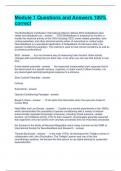
Module 1 Questions and Answers 100%
correct
The Biofeedback Certification International Alliance defines EEG biofeedback (also
called neurofeedback) as: - answer "EEG Biofeedback is employed to monitor or
modify the electrical activity of the CNS including: EEG, event related potentials, slow
cortical potentials, and other electrical activity either of subcortical or cortical origin.
Neurofeedback is a specialized application of biofeedback of brainwave data in an
operant conditioning paradigm. The method is used to treat clinical conditions as well as
to enhance performance"

EEG - answer Is a non-invasive way of measuring brain function. Brain activity
changes with everything that you think, feel, or do when you can see that activity in real
time.

Event related potentials - answer the measured (measurable) brain response that is
the direct result of a specific sensory, cognitive, or motor event.[1] More formally, it is
any stereotyped electrophysiological response to a stimulus.

Slow Cortical Potentials - answer

Cortical

Subcortical - answer

Operant Conditioning Paradigm - answer

Berger's Wave - answer 10 Hz alpha that dominates when the eyes are closed in
human EEG

Neal Miller and Leo Decara - answer Carried out a animal experiments in the 1960's,
which demonstrated the possibility of operant conditioning with a variety of internal
autonomically regulated physiologic processes, including: blood pressure, cardiac
function, and intestinal activity. Prior to their research, physiologists generally assumed
that organisms only had control over voluntary processes and not involuntary processes

the Society for the Study of Neuronal Regulation which today is known as the ISNR or
International Society for Neurofeedback and Research. - answer

Thomas Budzynski - answer In the early 1970s, he developed the Twilight Learner in
collaboration with John Picchiottino. The Twilight Learner was one of the first
neurotherapy systems. He became the first person to use alpha training for systematic
desensitization.

Written for

Institution
Bcia
Module
Bcia

Document information

Uploaded on
August 2, 2024
Number of pages
4
Written in
2024/2025
Type
Exam (elaborations)
Contains
Questions & answers

Subjects

£9.92
Get access to the full document:

100% satisfaction guarantee
Immediately available after payment
Both online and in PDF
No strings attached


Also available in package deal

Get to know the seller

Seller avatar
Reputation scores are based on the amount of documents a seller has sold for a fee and the reviews they have received for those documents. There are three levels: Bronze, Silver and Gold. The better the reputation, the more your can rely on the quality of the sellers work.
Pogba119 Harvard University
Follow You need to be logged in order to follow users or courses
Sold
51
Member since
1 year
Number of followers
2
Documents
5037
Last sold
3 days ago
NURSING TEST

BEST EDUCATIONAL RESOURCES FOR STUDENTS

3.8

11 reviews

5
4
4
3
3
3
2
0
1
1

Trending documents

Why students choose Stuvia

Created by fellow students, verified by reviews

Quality you can trust: written by students who passed their exams and reviewed by others who've used these revision notes.

Didn't get what you expected? Choose another document

No problem! You can straightaway pick a different document that better suits what you're after.

Pay as you like, start learning straight away

No subscription, no commitments. Pay the way you're used to via credit card and download your PDF document instantly.

Student with book image

“Bought, downloaded, and smashed it. It really can be that simple.”

Alisha Student

Frequently asked questions