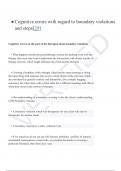
● Cognitive errors with regard to boundary violations
and steps[29]
Cognitive errors on the part of the therapist about boundary violations
D
• What happens outside the psychotherapy session has nothing to do with the
therapy (this error may lead to undermine the interactions with clients outside of
IE
therapy sessions, which might influence the client and the therapy)
• Crossing a boundary with a therapy client has the same meaning as doing
the same thing with someone who is not a client (Some of the activities which
IF
are considered as general courtesy and humanistic, [for example hugging
someone], but when done with a client often have different meanings and effects
when they occur in the context of therapy)
R
• Our understanding of a boundary crossing is also the client’s understanding
of the boundary crossing
VE
• A boundary violation which was therapeutic for one client will also be
therapeutic for another client
• A boundary crossing is a static, isolated event
• If we ourselves do not see any self-interest, problems, conflicts of interest,
unintended consequences, major risks, or potential downsides to crossing a
particular boundary, then there aren’t any
and steps[29]
Cognitive errors on the part of the therapist about boundary violations
D
• What happens outside the psychotherapy session has nothing to do with the
therapy (this error may lead to undermine the interactions with clients outside of
IE
therapy sessions, which might influence the client and the therapy)
• Crossing a boundary with a therapy client has the same meaning as doing
the same thing with someone who is not a client (Some of the activities which
IF
are considered as general courtesy and humanistic, [for example hugging
someone], but when done with a client often have different meanings and effects
when they occur in the context of therapy)
R
• Our understanding of a boundary crossing is also the client’s understanding
of the boundary crossing
VE
• A boundary violation which was therapeutic for one client will also be
therapeutic for another client
• A boundary crossing is a static, isolated event
• If we ourselves do not see any self-interest, problems, conflicts of interest,
unintended consequences, major risks, or potential downsides to crossing a
particular boundary, then there aren’t any