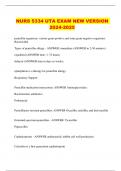
NURS 5334 UTA EXAM NEW VERSION
2024-2025
penicillin organisms: various gram-positive and some gram-negative organisms.
Bactericidal
Types of penicillin allergy - ANSWER: immediate (ANSWER in 2-30 minutes).
expedited (ANSWER time: 1–72 hours)
delayed (ANSWER time in days or weeks).
epinephrine is a therapy for penicillin allergy.
Respiratory Support
Penicillin medication interactions: ANSWER Aminoglycosides.
Bacteriostatic antibiotics
Probenecid
Penicillinase-resistant penicillins: ANSWER Oxacillin, nafcillin, and dicloxacillin
Extended-spectrum penicillins - ANSWER: Ticarcillin
Piperacillin
Cephalosporins - ANSWER antibacterial; inhibit cell wall production
Cefazolin is a first-generation cephalosporin
,Cephalexin
Cefadroxil
Second-generation cephalosporins include cefoxitin, cefaclor, cefuroxime,
cefotetan, and cefprozil.
Third-generation cephalosporins: cefotaxime, cefdinir, cefditoren, cefpodoxime,
ceftazidime, ceftibuten, ceftriaxone.
Cefepime and ceftolozane are fourth-generation cephalosporins.
Ceftaroline is a fifth-generation cephalosporin.
cephalosporin excretion: ANSWER renal
Cephalosporin medication interactions - ANSWER: Probenecid
Alcohol
Drugs that encourage bleeding
Calcium with Ceftriaxone
Cephalosporin Adverse Reactions: ANSWER allergy, bleeding, thrombophlebitis.
First-generation cephalosporins are commonly used for prophylaxis against
infection in surgical patients.
Cefuroxime, a second-generation cephalosporin, is used to treat pneumonia caused
by H. influenza, Klebsiella, pneumococci, and staphylococci.
, Third-generation cephalosporins are used to treat gram-negative pathogens.
Also able to penetrate CSF - useful in the treatment of meningitis.
Fourth-generation cephalosporins are extensively used to treat healthcare- and
hospital-associated pneumonia, particularly those caused by the resistant bacterium
Pseudomonas aeruginosa.
Fifth-generation cephalosporins are used to treat MRSA.
Carbapenems - Answer: Imipenem
Meropenem
Ertapenem
Doripenem
Carbapenem usage - ANSWER: beta-lactam
Very broad spectrum.
Not active against MRSA.
imipenem - A carbapenem
Active against most bacterial infections.
Gram-positive and gram-negative cocci
Bacilli are
2024-2025
penicillin organisms: various gram-positive and some gram-negative organisms.
Bactericidal
Types of penicillin allergy - ANSWER: immediate (ANSWER in 2-30 minutes).
expedited (ANSWER time: 1–72 hours)
delayed (ANSWER time in days or weeks).
epinephrine is a therapy for penicillin allergy.
Respiratory Support
Penicillin medication interactions: ANSWER Aminoglycosides.
Bacteriostatic antibiotics
Probenecid
Penicillinase-resistant penicillins: ANSWER Oxacillin, nafcillin, and dicloxacillin
Extended-spectrum penicillins - ANSWER: Ticarcillin
Piperacillin
Cephalosporins - ANSWER antibacterial; inhibit cell wall production
Cefazolin is a first-generation cephalosporin
,Cephalexin
Cefadroxil
Second-generation cephalosporins include cefoxitin, cefaclor, cefuroxime,
cefotetan, and cefprozil.
Third-generation cephalosporins: cefotaxime, cefdinir, cefditoren, cefpodoxime,
ceftazidime, ceftibuten, ceftriaxone.
Cefepime and ceftolozane are fourth-generation cephalosporins.
Ceftaroline is a fifth-generation cephalosporin.
cephalosporin excretion: ANSWER renal
Cephalosporin medication interactions - ANSWER: Probenecid
Alcohol
Drugs that encourage bleeding
Calcium with Ceftriaxone
Cephalosporin Adverse Reactions: ANSWER allergy, bleeding, thrombophlebitis.
First-generation cephalosporins are commonly used for prophylaxis against
infection in surgical patients.
Cefuroxime, a second-generation cephalosporin, is used to treat pneumonia caused
by H. influenza, Klebsiella, pneumococci, and staphylococci.
, Third-generation cephalosporins are used to treat gram-negative pathogens.
Also able to penetrate CSF - useful in the treatment of meningitis.
Fourth-generation cephalosporins are extensively used to treat healthcare- and
hospital-associated pneumonia, particularly those caused by the resistant bacterium
Pseudomonas aeruginosa.
Fifth-generation cephalosporins are used to treat MRSA.
Carbapenems - Answer: Imipenem
Meropenem
Ertapenem
Doripenem
Carbapenem usage - ANSWER: beta-lactam
Very broad spectrum.
Not active against MRSA.
imipenem - A carbapenem
Active against most bacterial infections.
Gram-positive and gram-negative cocci
Bacilli are