BSC1005 MIDTERM MDC GUARANTEED SUCCESS
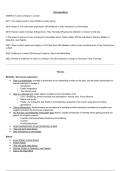
Fundamental Biology Concepts
- What is Biology?
- The scientific study of life.
Scientific Method
- Proper Components of the Scientific Method:
- Observation, Question, Hypothesis, Prediction, Experiment, Results, Conclusion.
Taxonomy
- Taxonomy is the:
- Naming and classifying of species.
Classification of Organisms
- Which Kingdom of Eukarya consists primarily of unicellular organisms?
- Protista.
Genetic Variation
- What accounts for the different breeds of domesticated dogs?
- Artificial selection.
Prokaryotic vs. Eukaryotic Cells
- Relative to prokaryotic cells, eukaryotic cells are usually:
- Larger and more complex.
Biological Adaptation
- What does adaptation mean in a biological context?
, - The accumulation of favorable variations in a population over time.
Types of Science
- Difference between Discovery Science and Hypothesis-Driven Science:
- Discovery Science: Describes natural structures and processes as accurately as possible through
careful observation and data analysis.
- Hypothesis-Driven Science: Involves observation and induction from discovery science that stimulate
the pursuit of natural structures and processes.
Hypothesis
- A Hypothesis is a:
- Tentative answer to a question.
Genetics
- What is a Gene?
- A unit of inheritance.
Atomic Structure
- The second electron shell of an atom can hold a maximum of:
- 8 electrons.
- All atoms of an element have the same number of:
- Protons.
pH and Acidity
- Relative to a pH of 6, a pH of 4 has a:
- 100 times higher H⁺ concentration.
- The lower the pH of a solution, the:
Fundamental Biology Concepts
- What is Biology?
- The scientific study of life.
Scientific Method
- Proper Components of the Scientific Method:
- Observation, Question, Hypothesis, Prediction, Experiment, Results, Conclusion.
Taxonomy
- Taxonomy is the:
- Naming and classifying of species.
Classification of Organisms
- Which Kingdom of Eukarya consists primarily of unicellular organisms?
- Protista.
Genetic Variation
- What accounts for the different breeds of domesticated dogs?
- Artificial selection.
Prokaryotic vs. Eukaryotic Cells
- Relative to prokaryotic cells, eukaryotic cells are usually:
- Larger and more complex.
Biological Adaptation
- What does adaptation mean in a biological context?
, - The accumulation of favorable variations in a population over time.
Types of Science
- Difference between Discovery Science and Hypothesis-Driven Science:
- Discovery Science: Describes natural structures and processes as accurately as possible through
careful observation and data analysis.
- Hypothesis-Driven Science: Involves observation and induction from discovery science that stimulate
the pursuit of natural structures and processes.
Hypothesis
- A Hypothesis is a:
- Tentative answer to a question.
Genetics
- What is a Gene?
- A unit of inheritance.
Atomic Structure
- The second electron shell of an atom can hold a maximum of:
- 8 electrons.
- All atoms of an element have the same number of:
- Protons.
pH and Acidity
- Relative to a pH of 6, a pH of 4 has a:
- 100 times higher H⁺ concentration.
- The lower the pH of a solution, the: