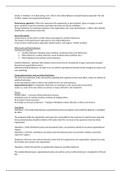
Jacobs, G. Belshak, F.D. & Den Hartog, D.N. (2014). (Un) ethical behavior and performance appraisal: The role
of affect, support and organizational justice.
Performance appraisal = Offers the superivsors the opportunity to give feedback, agree on targets or work
goals, establish a basis for promotion and salary decisions and discuss ambitions.
Strong implication for employees’position in the organization and career development -> Affects their attitude
(Satisfaction, commitment and trust).
Aim of this article:
Understand of certain factors enable ethical and supporess unethical behaviour.
The impact of the performance apparaisal on (un) ethical behaviour.
In the context of performance appraisals: Explore justice- and support- related variables.
Ethical and unethical behaviour
3 streams of research:
1. Unethical behavior (Stealing, lying, cheating, counterprocutive work behaviour).
2. Ethical behavior reaching minimum moral standards (Not unethical, but..)
3. Ethical behavior that exceeds moral minimums
Unethical behavior = Behavior that violates moral norms that are accepted by a larger community and goes
beyond local organizational norms.
Individual unethical behavior can lead to an (un) ethical organizational climate (Social contagion processes and
role modelling).
Organizational justice and (un) ethical behaviour
We think that employees’justice perceptions regarding their appraisal evoke stron affect, relates to enthical an
unethical behaviour.
Justice perceptions relate to ethical and unethical forms of work behaviour.
Organizational justice = if employees think they ar eworking in a fair and just job environment.
Justice is a value of its own: Next to economic or status intersest in fair treatment.
Theory
Positive Affect -> Increases ethical behaviour because:
Individuals want to maintain positive emotions by helping others.
PA increases moral awareness
PA includes an arousal component -> Energizes individual to direct attention at their environment.
Hypothesis
Hypothesis 1 The relationship between organizational justice perceptions and (un)ethical behavior is mediated
by affect.
The employee holds the organization and supervisor responsible for the outcome of a performance appraisal.
Ineraccctional jiustice should be linked to PSS rather than POS. So more to the supervisor than the whole
organization.
Hypothesis 2 Both distributive justice and procedural justice, are positively related to perceived organizational
support.
Hypothesis 3 All three: distributive, procedural and interactional justice are positively related to perceived
supervisor support.
Employees will show more ethical behaviour when they feel supported by the organization. Support increases
the loyalety and caring for the organization.
Hypothesis 4 Both POS and PSS are significantly related to (un)ethical behavior.
The relationship betweeen organizational justice perceptions and (un) ethical behavior is mediated by POS and
PSS.
of affect, support and organizational justice.
Performance appraisal = Offers the superivsors the opportunity to give feedback, agree on targets or work
goals, establish a basis for promotion and salary decisions and discuss ambitions.
Strong implication for employees’position in the organization and career development -> Affects their attitude
(Satisfaction, commitment and trust).
Aim of this article:
Understand of certain factors enable ethical and supporess unethical behaviour.
The impact of the performance apparaisal on (un) ethical behaviour.
In the context of performance appraisals: Explore justice- and support- related variables.
Ethical and unethical behaviour
3 streams of research:
1. Unethical behavior (Stealing, lying, cheating, counterprocutive work behaviour).
2. Ethical behavior reaching minimum moral standards (Not unethical, but..)
3. Ethical behavior that exceeds moral minimums
Unethical behavior = Behavior that violates moral norms that are accepted by a larger community and goes
beyond local organizational norms.
Individual unethical behavior can lead to an (un) ethical organizational climate (Social contagion processes and
role modelling).
Organizational justice and (un) ethical behaviour
We think that employees’justice perceptions regarding their appraisal evoke stron affect, relates to enthical an
unethical behaviour.
Justice perceptions relate to ethical and unethical forms of work behaviour.
Organizational justice = if employees think they ar eworking in a fair and just job environment.
Justice is a value of its own: Next to economic or status intersest in fair treatment.
Theory
Positive Affect -> Increases ethical behaviour because:
Individuals want to maintain positive emotions by helping others.
PA increases moral awareness
PA includes an arousal component -> Energizes individual to direct attention at their environment.
Hypothesis
Hypothesis 1 The relationship between organizational justice perceptions and (un)ethical behavior is mediated
by affect.
The employee holds the organization and supervisor responsible for the outcome of a performance appraisal.
Ineraccctional jiustice should be linked to PSS rather than POS. So more to the supervisor than the whole
organization.
Hypothesis 2 Both distributive justice and procedural justice, are positively related to perceived organizational
support.
Hypothesis 3 All three: distributive, procedural and interactional justice are positively related to perceived
supervisor support.
Employees will show more ethical behaviour when they feel supported by the organization. Support increases
the loyalety and caring for the organization.
Hypothesis 4 Both POS and PSS are significantly related to (un)ethical behavior.
The relationship betweeen organizational justice perceptions and (un) ethical behavior is mediated by POS and
PSS.