100% satisfaction guarantee Immediately available after payment Both online and in PDF No strings attached 4.6 TrustPilot
logo-home
Exam (elaborations)

EMT chapter 10 JBL quiz Questions With Answers Graded A+ Assured Success

Rating
-
Sold
-
Pages
2
Grade
A+
Uploaded on
27-08-2024
Written in
2024/2025

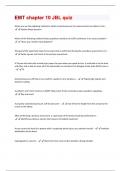
When you use the palpating method to obtain a blood pressure the measurement you obtain is the: - Systolic blood pressure Which of the following medical history questions would be of LEAST pertinence in an acute situation? - "Does your mother have diabetes?" The goal of the systematic head-to-toe exam that is performed during the secondary assessment is to: - locate injuries not found in the primary assessment. A 29-year-old male with a head injury opens his eyes when you speak to him, is confused as to the time and date, and is able to move all of his extremities on command. His Glasgow Coma Scale (GCS) score is: - 13 A blood pressure cuff that is too small for a patient's arm will give a: - Falsely high systolic and diastolic reading A patient's short term memory is MOST likely intact if they correctly answer questions regarding: - Day and event A properly sized blood pressure cuff should cover: - two thirds the length from the armpit to the crease in the elbow. After performing a primary assessment, a rapid exam of the body should be performed to: - identify less-obvious injuries that require immediate treatment. As you assess the head of a patient with a suspected spinal injury, your partner should: - maintain stabilization of the head. Capnography is used to: - determine how much carbon dioxide is being exhaled.Cyanosis of the skin is caused by: - decreased blood oxygen In the adult, bradycardia is defined as a pulse rate less than ____________ beats/min, and tachycardia is defined as a heart rate greater than __________ Beats/min - 60, 100 The goal of oxygenation for most patients is an oxygen saturation of: - 94%-99% Which of the following would the EMT likely NOT perform on a responsive patient with a headache and no apparent life-threatening conditions? - Systematic head-to-toe examination Treatment and transport priorities at the scene of a mass-casualty incident should be determined after: - all the patients have been triaged When performing a reassessment of your patient, you should first: - repeat the primary assessment Which of the following findings indicates that your patient has a patent airway? - ability to speak Which of the following is an example of a symptom? - headache In responsive patients who are older than 1 year of age, you should palpate the pulse at the __________ artery - radial The systematic head-to-toe assessment should be performed on: - patients with a significant MOI and unresponsive medical patients.

Show more Read less
Institution
EMT JBL
Module
EMT JBL


Whoops! We can’t load your doc right now. Try again or contact support.

Written for

Institution
EMT JBL
Module
EMT JBL

Document information

Uploaded on
August 27, 2024
Number of pages
2
Written in
2024/2025
Type
Exam (elaborations)
Contains
Questions & answers

Subjects

Content preview

EMT chapter 10 JBL quiz
When you use the palpating method to obtain a blood pressure the measurement you obtain is the: -
Systolic blood pressure


Which of the following medical history questions would be of LEAST pertinence in an acute situation? -
"Does your mother have diabetes?"


The goal of the systematic head-to-toe exam that is performed during the secondary assessment is to: -
locate injuries not found in the primary assessment.


A 29-year-old male with a head injury opens his eyes when you speak to him, is confused as to the time
and date, and is able to move all of his extremities on command. His Glasgow Coma Scale (GCS) score is:
- 13


A blood pressure cuff that is too small for a patient's arm will give a: - Falsely high systolic and
diastolic reading


A patient's short term memory is MOST likely intact if they correctly answer questions regarding: -
Day and event


A properly sized blood pressure cuff should cover: - two thirds the length from the armpit to the
crease in the elbow.


After performing a primary assessment, a rapid exam of the body should be performed to: -
identify less-obvious injuries that require immediate treatment.


As you assess the head of a patient with a suspected spinal injury, your partner should: - maintain
stabilization of the head.


Capnography is used to: - determine how much carbon dioxide is being exhaled.
£6.51
Get access to the full document:

100% satisfaction guarantee
Immediately available after payment
Both online and in PDF
No strings attached


Also available in package deal

Get to know the seller

Seller avatar
Reputation scores are based on the amount of documents a seller has sold for a fee and the reviews they have received for those documents. There are three levels: Bronze, Silver and Gold. The better the reputation, the more your can rely on the quality of the sellers work.
Brainarium Delaware State University
Follow You need to be logged in order to follow users or courses
Sold
1826
Member since
2 year
Number of followers
1043
Documents
22327
Last sold
5 hours ago

3.8

317 reviews

5
147
4
60
3
54
2
16
1
40

Recently viewed by you

Why students choose Stuvia

Created by fellow students, verified by reviews

Quality you can trust: written by students who passed their exams and reviewed by others who've used these revision notes.

Didn't get what you expected? Choose another document

No problem! You can straightaway pick a different document that better suits what you're after.

Pay as you like, start learning straight away

No subscription, no commitments. Pay the way you're used to via credit card and download your PDF document instantly.

Student with book image

“Bought, downloaded, and smashed it. It really can be that simple.”

Alisha Student

Frequently asked questions