MATERNAL CHILD FINAL EXAM CONCEPT GUIDE RASMUSSEN
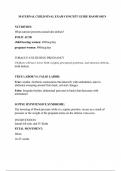
NUTRITION: What nutrient prevents neural tube defects? FOLIC ACID child bearing women: 400mcg/day pregnant women: 800mcg/day TOBACCO USE DURING PREGNANCY Children will have lower birth weights, perceptual problems, and attention deficits, birth defects TRUE LABOR VS. FALSE LABOR: True: regular, rhythmic contractions that intensify with ambulation, pain in abdomen sweeping around from back, cervical changes. False: Irregular rhythm, abdominal pain (not in back) that decreases with ambulation SUPINE HYPOTENSIVE SYNDROME: The lowering of blood pressure while in a supine position; occurs as a result of pressure or the weight of the pregnant uterus on the inferior vena cava. INTERVENTION: lateral left side, and IV fluids FETAL MOVEMENT: When 16-25 weeks KICK COUNTS: How to monitor during pregnancy Most babies move at least ten (10) times within two hours. Count your baby's movements once a day, at the same time each day NEAGLE'S RULE: ADD 9 MONTHS AND 7 DAYS PREECLAMPSIA: symptoms -high BP -proteinuria -vision changes -edema -Headache PREECLAMPSIA: Treatment antihypertensives IV magnesium sulfate (to prevent seizure) definitive is delivery of fetus MAGNESIUM SULFATE TOXICITY: C- cardiac dysrhythmia's O- Output less than 30mL R- Respirations less than 12/min A-Absent deep tendon reflexes (hyporeflexia*) L-LOC is decreased TREATMENT: 10 mL calcium gluconate GTPAL: 1. Gravidity number of pregnancies including present one 2. Term births (longer than 37 weeks) 3. Preterm births (before 37 weeks) 4. Abortions or miscarriages 5. Living children TOCOLYTICS: Used to stop preterm labor. -Terbutaline sulfate (Brethine) -ritodrine HCl (Yutopar) -nifedipine (Procardia) -magnesium sulfate STAGES OF LABOR: 1st: dilating stage 3 phases: -Latent (0-3cm) -Active (4-7cm) -Transitional (8-10cm w/ urge to push) 2nd stage: delivery 3rd: placental delivery 4th: recovery- primary goal to prevent hemorrhage from uterine atony, 1st void within 1 hour and then q2-3 hrs, Rhogam FETAL MOITORING ASSESSMENT: DECELERATION: Gradual or abrubt decrease in FHR lasting longer than 15 seconds but usually less than 2 minutes. EARLY DECELERATION: -slowing of FHR w/ start of contraction -due to compression of baby's head from contraction *no intervention necessary LATE DECELERATION: -slowing of FHR after contraction has started and prolonged return to baseline -due to uteroplacental insufficiency *place patient in side-lying position, administer IV fluids, d/c oxytocin, administer O2, palpate uterus for tachysystole, notify provider. VARIABLE DECELERATION: -transient, variable slowing FHR ("V", "W" on wave form) -due to umbilical cord compression -place patient in knee-chest position, trendelenburg, d/c oxytocin, administer O2 RUPTURE OF MEMBRANES: SROM spontaneous rupture of membrane: naturally occurring rupture of the fetal membranes during or after onset of labor, normal require NO intervention RUPTURE OF MEMBRANES: AROM AMNIOTOMY breaking the water of the amniotic sac intentionally during labor test amniotic fluid after for infection PLACENTA PREVIA: painless vaginal bleeding treatment: -tocolytics -IV fluids -blood transfusions C-SECTION REQUIRED PLACENTA ABRUPTION: 3rd trimester bleeding associated with severe abdominal pain GUSH OF BLOOD VBAC: vaginal birth after cesarean section candidates: 1-2 prior low transverse C-sections, no other problems LABOR PAIN MANAGEMENT: -epidural -butorphanol EPIDURAL: -eliminates sensation from umbilicus to thighs. Administer when mom is at least 4cm dilated -s/e: maternal hypotension, fetal bradycardia -nursing interventions: administer IV fluids, position mom on side, monitor maternal VS and FHR continually BUTORPHANOL: -narcotic opioid analgesic s/e for mom: Pain at the injection site Nausea and vomiting Drowsiness or sedation Dizziness Muscle weakness Itching Urinary retention s/e for baby: Slow breathing in the baby Sleepiness Poor feeding or breastfeeding Apnea
Written for
- Institution
- Rasmussen College
- Module
- Maternal Child
Document information
- Uploaded on
- September 20, 2024
- Number of pages
- 18
- Written in
- 2024/2025
- Type
- Exam (elaborations)
- Contains
- Questions & answers
Subjects
-
maternal child
-
maternal child final exam
-
maternal child final exam concept guide rasmussen

Also available in package deal