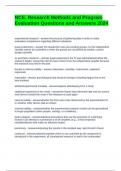
NCE. Research Methods and Program
Evaluation Questions and Answers 2024
experimental research - answer the process of gathering data in order to make
evaluative comparisons regarding different situations
quasi-experiment - answer the researcher uses pre-existing groups, so the independent
variable cannot be controlled or when the groups are not picked at random; cannot
assign causality
ex post facto research – answer quasi-experiment; the IV was administered before the
research began; researcher did not have control over the independent variable because
the research occurred in the past
threats to internal validity - answer maturation, mortality, instruments, statistical
regression
maturation - answer psychological and physical changes including fatigue due to the
time involved
attrition/experimental mortality - answersubjects withdrawing from a study
statistical regression to the mean - answerthe notion that extremely high and low scores
woul dmove toward the mean if the measure is used again
internal validity - answerwhether the DVs were truly influenced by the experimental IVs
or whether other factors had an impact
external validity - answerwhether the experimental research results can be generalized
to larger population (other people, settings, or conditions)
factor analysis - answerstatistical procedures that use the important or underlying
factors in an attempt to summarize a lot of variables (e.g., 3 most important
variables/factors that make an effective helper)
parsimony - answerinterpreting the results in the simplest way; aka Occam's Razor
confound - answerundesired variable which is not controlled by the researcher is
introduced in the experiment; all correlational research is said to be confounded
, APA Journal of Counseling - answerpublishes more counseling research articles than
any other periodical in the counseling field
variable - answera behavior or circumstance that can exist on at least 2 levels or
conditions; a factors that varies or is capable of change
independent variable - answerthe variable that the researcher manipulates
dependent variable - answerexpresses the outcome or the data
discrete variable - answere.g., brand of counseling
continuous variable - answere.g. height or weight
causal comparative design - answera true experiment except that groups were not
randomly assigned; can be analyzed with a test of significance (e.g., t test or ANOVA)
research ethics - answer1) subjects are informed of any risks; 2) negative after effects
are removed; 3) confidentiality of subjects must be maintained; 4) research report
results will be presented in an accurate format that is not misleading; 5) researcher will
only use techniques that s/he is trained in; 6) subjects are allowed to withdraw at any
time; (INCR-TW)
control group - answerdoes not receive the independent variable
experimental group - answerreceives the independent variable
minimum number of research participants - answertrue experiment: at least 30 people;
correlational research: 30 subjects per variable; surveys: at least 100 people
organismic variable - answerone the researcher cannot control yet exists, such as
height, weight or gender
R.A. Fisher - answerpioneered hypothesis testing
hypothesis - answera statement which can be tested regarding the relationship of the IV
& DV; a hunch or educated guess which can be tested using the experimental model
null hypothesis - answerasserts that the samples will not change (i.e. they will still be
the same) even after the experimental variable is applied; the control group & the
experimental group will not differ at the end of the experiment; the IV does not affect the
DV
meta-analysis - answera study that analyses the findings of numerous studies in order
to examine a hypothesis; originally used to overcome severe limitations of a small
sample size in one experiment; drawback is that a meta-analysis may be relying on
Evaluation Questions and Answers 2024
experimental research - answer the process of gathering data in order to make
evaluative comparisons regarding different situations
quasi-experiment - answer the researcher uses pre-existing groups, so the independent
variable cannot be controlled or when the groups are not picked at random; cannot
assign causality
ex post facto research – answer quasi-experiment; the IV was administered before the
research began; researcher did not have control over the independent variable because
the research occurred in the past
threats to internal validity - answer maturation, mortality, instruments, statistical
regression
maturation - answer psychological and physical changes including fatigue due to the
time involved
attrition/experimental mortality - answersubjects withdrawing from a study
statistical regression to the mean - answerthe notion that extremely high and low scores
woul dmove toward the mean if the measure is used again
internal validity - answerwhether the DVs were truly influenced by the experimental IVs
or whether other factors had an impact
external validity - answerwhether the experimental research results can be generalized
to larger population (other people, settings, or conditions)
factor analysis - answerstatistical procedures that use the important or underlying
factors in an attempt to summarize a lot of variables (e.g., 3 most important
variables/factors that make an effective helper)
parsimony - answerinterpreting the results in the simplest way; aka Occam's Razor
confound - answerundesired variable which is not controlled by the researcher is
introduced in the experiment; all correlational research is said to be confounded
, APA Journal of Counseling - answerpublishes more counseling research articles than
any other periodical in the counseling field
variable - answera behavior or circumstance that can exist on at least 2 levels or
conditions; a factors that varies or is capable of change
independent variable - answerthe variable that the researcher manipulates
dependent variable - answerexpresses the outcome or the data
discrete variable - answere.g., brand of counseling
continuous variable - answere.g. height or weight
causal comparative design - answera true experiment except that groups were not
randomly assigned; can be analyzed with a test of significance (e.g., t test or ANOVA)
research ethics - answer1) subjects are informed of any risks; 2) negative after effects
are removed; 3) confidentiality of subjects must be maintained; 4) research report
results will be presented in an accurate format that is not misleading; 5) researcher will
only use techniques that s/he is trained in; 6) subjects are allowed to withdraw at any
time; (INCR-TW)
control group - answerdoes not receive the independent variable
experimental group - answerreceives the independent variable
minimum number of research participants - answertrue experiment: at least 30 people;
correlational research: 30 subjects per variable; surveys: at least 100 people
organismic variable - answerone the researcher cannot control yet exists, such as
height, weight or gender
R.A. Fisher - answerpioneered hypothesis testing
hypothesis - answera statement which can be tested regarding the relationship of the IV
& DV; a hunch or educated guess which can be tested using the experimental model
null hypothesis - answerasserts that the samples will not change (i.e. they will still be
the same) even after the experimental variable is applied; the control group & the
experimental group will not differ at the end of the experiment; the IV does not affect the
DV
meta-analysis - answera study that analyses the findings of numerous studies in order
to examine a hypothesis; originally used to overcome severe limitations of a small
sample size in one experiment; drawback is that a meta-analysis may be relying on