CRLS 3100 Chapter 2
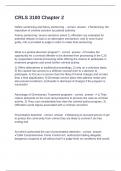
Define sentencing and felony sentencing. - correct answer ✔Sentencing: the
imposition of criminal sanction by judicial authority
Felony sentencing: severe sanctions where 1) offenders are evaluated for
potential release on bail or an alternative mechanism, and 2) once found
guilty, info is provided to judge in order to make final sentencing
What is a pretrial diversion program? - correct answer ✔Provides the
opportunity for a criminal offender to be diverted from processing in the CJS
by suspended criminal processing while offering the chance to participate in
treatment programs and avoid further criminal activity.
1) Offers alternatives to traditional proceedings, 2) only on a voluntary basis,
3) the caused has access to a defense counsel prior to a decision to
participate, 4) Occurs no sooner than the filing of formal charges and no later
than a final adjudication, 5) Develops service plans that address needs and
also prevent recidivism, 6) Results in dismissal of charges if the program is
successful
Advantage of Diversionary Treatment programs - correct answer ✔1) They
reduce demands on the court and prosectors to process the case as criminal
activity, 2) They cost considerably less than the criminal justice program, 3)
Offenders avoid stigma associated with a criminal conviction
Preventative detention - correct answer ✔Detaining an accused person in jail
to protect the community from crimes they are likely to commit if set free
ending trial
Act which authorized the use of preventative detention - correct answer
✔1984 Comprehensive Crime Control Act: authorized holding allegedly
dangerous suspects in jail without bail if a judge finds no conditions that would
, ensure that the defendant would appear at trial and at the same time ensure
the safety of the community.
United States vs. Salerno (1987) - correct answer ✔Upheld the ability of a
magistrate to confine an offender on a presumption that he or she was
dangerous.
Describe bail and identify some of the problems with it. - correct answer
✔Bail: the pledge of money or property in exchange for a promise to return for
further criminal processing.
Problems: 1) ability to "make bail" is not related to the risk of the offender or
the chance of successful professing, 2) The bail process discriminates against
the poor, 3) idea that "freedom can be bought for a price" is unfair and anti-
ethical.
Alternatives to bail - correct answer ✔1) Personal recognizance: Defendant
is released upon personal promise to appear in court (without bond), 2)
Unsecured bond: Defendant released on unsecured appearance bond that is
secured by only their signature, 3) percentage bond: The defendant is
required to execute an appearance bond in a specific amount with the clerk of
the court, in cash or other security as directed, 3) Surety bond: The defendant
is required to execute a pail bond by the deposit of cash or the posting of a
bail bond, 5) Collateral: The defendant is required to execute the bail bond by
posting property of a valve equal to or greater than the bail set by the judicial
officer, 6) Third-party custody: The court may place the person in the custody
of another person or organization.
Most (75%) of offenders were released at arraignment on either bay or
personal recognizance (ROR). - correct answer ✔
Define release on recognizance (ROR). - correct answer ✔Release from jail
based only on the defendants promise to appear for further court procedures.
Define sentencing and felony sentencing. - correct answer ✔Sentencing: the
imposition of criminal sanction by judicial authority
Felony sentencing: severe sanctions where 1) offenders are evaluated for
potential release on bail or an alternative mechanism, and 2) once found
guilty, info is provided to judge in order to make final sentencing
What is a pretrial diversion program? - correct answer ✔Provides the
opportunity for a criminal offender to be diverted from processing in the CJS
by suspended criminal processing while offering the chance to participate in
treatment programs and avoid further criminal activity.
1) Offers alternatives to traditional proceedings, 2) only on a voluntary basis,
3) the caused has access to a defense counsel prior to a decision to
participate, 4) Occurs no sooner than the filing of formal charges and no later
than a final adjudication, 5) Develops service plans that address needs and
also prevent recidivism, 6) Results in dismissal of charges if the program is
successful
Advantage of Diversionary Treatment programs - correct answer ✔1) They
reduce demands on the court and prosectors to process the case as criminal
activity, 2) They cost considerably less than the criminal justice program, 3)
Offenders avoid stigma associated with a criminal conviction
Preventative detention - correct answer ✔Detaining an accused person in jail
to protect the community from crimes they are likely to commit if set free
ending trial
Act which authorized the use of preventative detention - correct answer
✔1984 Comprehensive Crime Control Act: authorized holding allegedly
dangerous suspects in jail without bail if a judge finds no conditions that would
, ensure that the defendant would appear at trial and at the same time ensure
the safety of the community.
United States vs. Salerno (1987) - correct answer ✔Upheld the ability of a
magistrate to confine an offender on a presumption that he or she was
dangerous.
Describe bail and identify some of the problems with it. - correct answer
✔Bail: the pledge of money or property in exchange for a promise to return for
further criminal processing.
Problems: 1) ability to "make bail" is not related to the risk of the offender or
the chance of successful professing, 2) The bail process discriminates against
the poor, 3) idea that "freedom can be bought for a price" is unfair and anti-
ethical.
Alternatives to bail - correct answer ✔1) Personal recognizance: Defendant
is released upon personal promise to appear in court (without bond), 2)
Unsecured bond: Defendant released on unsecured appearance bond that is
secured by only their signature, 3) percentage bond: The defendant is
required to execute an appearance bond in a specific amount with the clerk of
the court, in cash or other security as directed, 3) Surety bond: The defendant
is required to execute a pail bond by the deposit of cash or the posting of a
bail bond, 5) Collateral: The defendant is required to execute the bail bond by
posting property of a valve equal to or greater than the bail set by the judicial
officer, 6) Third-party custody: The court may place the person in the custody
of another person or organization.
Most (75%) of offenders were released at arraignment on either bay or
personal recognizance (ROR). - correct answer ✔
Define release on recognizance (ROR). - correct answer ✔Release from jail
based only on the defendants promise to appear for further court procedures.