Sports Psych Test 1 –Questions with
A+ Rated Answers
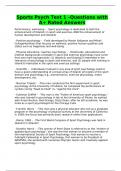
Performance; well-being - -Sport psychology is dedicated to both the
enhancement of (blank1) in sport and exercise, AND the enhancement of
human development and (blank2)
-Positive psychology - -Field developed by Martin Seligman and Mihali
Csiksgentmihalyi that focuses on wellness, positive human qualities and
states such as happiness and well-being
-Physical educators; coaches; psychology - -Historically, educational and
interest backgrounds of people in sport and exercise psychology have come
from two main backgrounds: (1) (blanks1) and (blanks2) interested in the
relevance of psychology to sport and exercise, and (2) people with training in
(blank3) interested in the sport and exercise settings
-Scientific - -Individuals involved in any area of sport psychology need to
have a good understanding of a broad array of (blank) principles of the sport
domain and psychology e.g., biomechanics, exercise physiology, motor
development, etc.
-Norman Triplett - -This man conducted the first experiment in sport
psychology at the University of Indiana; he compared the performance of
cyclists racing "head-to-head" vs. "against the clock"
-Coleman Griffith - -This man is the "Father of American sport psychology,"
who was trained in psychology in lab at the University of Illinois; he worked
with Knute Rockne, Red Grange, Dizzy Dean; after he left academia, he was
hired as a sport psychologist for the Chicago Cubs
-Franklin Henry - -This man was a physical educator who set up a graduate
program in the psychology of physical activity at the University of California
in 1938; the focus was primarily basic research rather than applications
-Rome; 1965 - -The First World Congress of Sport Psychology was held in
(blank1) in (blank2)
-Dorothy Harris - -This woman of Penn State is referred to as the "mother of
applied sport psychology"; she was the first woman to become a member of
the International Society of Sport Psychology, first woman to receive a
Fulbright Fellowship in Sport Psychology, first women to be President of
NASPSPA; she worked with numerous Olympic teams and creatively applied
sport psychology
, -Bruce Ogilvie and Thomas Tutko - -(Blank1) and (Blank2) wrote Problem
Athletes and How to Handle Them in 1966; the book applied principles of
clinical psychology to the sport setting
-Bryant Cratty - -(Blank) of UCLA wrote a very influential book, the
Psychology of Physical Activity, in 1967; the book was a thorough review of
motor learning
-American Alliance for Health, Physical Education, Recreation and Dance - -
What does AAHPERD stand for?
-North American Society for the Psychology of Sport and Physical Activity - -
What does NASPSPA stand for?
-Rainer Martens - -This man was one of the leader of NASPSPA when they
were formed as a special interest group within AAHPERD
-Sport science - -The majority of NASPSPA members have a background in
(blank) [physical education and kinesiology]
-Basic research - -NASPSPA was from the outset, and still is, primarily
concerned with (blank)
-1978-2000 - -This was a period of tremendous growth, especially in
applications of psychological principles to sport; in this period, the field
became more accepted and respected by the public
-1980 - -In this year, USOC (U.S. Olympic Committee) developed a Sport
Psychology Advisory Board
-1983; Rober Nideffer - -In this year, the USOC (U.S. Olympic Committee)
set up a commission of sport scientists, including (Blank 2), a prominent
sport psychologist, to study the preparation of our Olympic athletes and
make recommendations
-1984 - -In this year, for the first time, sport psychologists (11 of them
volunteered) were available to work with our Olympic athletes; the results
were very satisfactory; this gave a big push to sport psychology and greatly
enhanced the credibility of the profession
-1986; John Silva - -An especially important development occurred in (blank
year), when a splinter group of NASPSPA, under the leadership of (Blank 2),
set up AAASP (The Association for the Advancement of Applied sport
Psychology)
A+ Rated Answers
Performance; well-being - -Sport psychology is dedicated to both the
enhancement of (blank1) in sport and exercise, AND the enhancement of
human development and (blank2)
-Positive psychology - -Field developed by Martin Seligman and Mihali
Csiksgentmihalyi that focuses on wellness, positive human qualities and
states such as happiness and well-being
-Physical educators; coaches; psychology - -Historically, educational and
interest backgrounds of people in sport and exercise psychology have come
from two main backgrounds: (1) (blanks1) and (blanks2) interested in the
relevance of psychology to sport and exercise, and (2) people with training in
(blank3) interested in the sport and exercise settings
-Scientific - -Individuals involved in any area of sport psychology need to
have a good understanding of a broad array of (blank) principles of the sport
domain and psychology e.g., biomechanics, exercise physiology, motor
development, etc.
-Norman Triplett - -This man conducted the first experiment in sport
psychology at the University of Indiana; he compared the performance of
cyclists racing "head-to-head" vs. "against the clock"
-Coleman Griffith - -This man is the "Father of American sport psychology,"
who was trained in psychology in lab at the University of Illinois; he worked
with Knute Rockne, Red Grange, Dizzy Dean; after he left academia, he was
hired as a sport psychologist for the Chicago Cubs
-Franklin Henry - -This man was a physical educator who set up a graduate
program in the psychology of physical activity at the University of California
in 1938; the focus was primarily basic research rather than applications
-Rome; 1965 - -The First World Congress of Sport Psychology was held in
(blank1) in (blank2)
-Dorothy Harris - -This woman of Penn State is referred to as the "mother of
applied sport psychology"; she was the first woman to become a member of
the International Society of Sport Psychology, first woman to receive a
Fulbright Fellowship in Sport Psychology, first women to be President of
NASPSPA; she worked with numerous Olympic teams and creatively applied
sport psychology
, -Bruce Ogilvie and Thomas Tutko - -(Blank1) and (Blank2) wrote Problem
Athletes and How to Handle Them in 1966; the book applied principles of
clinical psychology to the sport setting
-Bryant Cratty - -(Blank) of UCLA wrote a very influential book, the
Psychology of Physical Activity, in 1967; the book was a thorough review of
motor learning
-American Alliance for Health, Physical Education, Recreation and Dance - -
What does AAHPERD stand for?
-North American Society for the Psychology of Sport and Physical Activity - -
What does NASPSPA stand for?
-Rainer Martens - -This man was one of the leader of NASPSPA when they
were formed as a special interest group within AAHPERD
-Sport science - -The majority of NASPSPA members have a background in
(blank) [physical education and kinesiology]
-Basic research - -NASPSPA was from the outset, and still is, primarily
concerned with (blank)
-1978-2000 - -This was a period of tremendous growth, especially in
applications of psychological principles to sport; in this period, the field
became more accepted and respected by the public
-1980 - -In this year, USOC (U.S. Olympic Committee) developed a Sport
Psychology Advisory Board
-1983; Rober Nideffer - -In this year, the USOC (U.S. Olympic Committee)
set up a commission of sport scientists, including (Blank 2), a prominent
sport psychologist, to study the preparation of our Olympic athletes and
make recommendations
-1984 - -In this year, for the first time, sport psychologists (11 of them
volunteered) were available to work with our Olympic athletes; the results
were very satisfactory; this gave a big push to sport psychology and greatly
enhanced the credibility of the profession
-1986; John Silva - -An especially important development occurred in (blank
year), when a splinter group of NASPSPA, under the leadership of (Blank 2),
set up AAASP (The Association for the Advancement of Applied sport
Psychology)