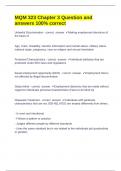
MQM 323 Chapter 3 Question and answers 100% correct
1 view 0 purchase
Module
MQM 323
Institution
MQM 323
MQM 323 Chapter 3 Question and answers 100% correct
Unlawful Discrimination - correct answer Making employment decisions of the basis of:
Age, Color, Disability, Genetic information and marital status, military status, national origin, pregnancy, race an religion and sexual orientation
...
MQM 323 Chapter 3 Question and
answers 100% correct
Unlawful Discrimination - correct answer ✔Making employment decisions of
the basis of:
Age, Color, Disability, Genetic information and marital status, military status,
national origin, pregnancy, race an religion and sexual orientation
Protected Characteristics - correct answer ✔Individual attributes that are
protected under EEO laws and regulations
Equal employment opportunity (EEO) - correct answer ✔Employment that is
not affected by illegal discrimination
Status-blind - correct answer ✔Employment decisions that are made without
regard to individuals personal characteristics (Have to be blind to)
Disparate Treatment - correct answer ✔Individuals with particular
characteristics that are not JOB RELATED are treated differently from others.
- Is overt and intentional
- Follows a pattern or practice
- Judges different people by different standards
- Uses the same standard but is not related to the individuals job (productivity
or gender)
, Disparate Impact - correct answer ✔When an employment practice that does
not APPEAR DISCRIMINATORY adversely affects individuals with a
particular characteristic.
- Individuals of a protected category are substantially underrepresented as a
result of employment decisions
Nondiscriminatory Decisions - correct answer ✔- Business Necessity Job
Relatedness
- Bona Fide Occupational Qualification (BFOQ)
- Burden of Proof
- Non retaliatory Practices
- correct answer ✔If you're making a decision or instituting a policy that is
something that will be used to make your business decisions - that particular
qualification must be business necessity or a job relatedness component.
EX: Requiring medical license to be a doctor. Hair dresser need to have a
license and passed state board exams. Due to a business necessity they
typically have this information on display.
BFOQ - correct answer ✔An opportunity for employers to say
that they have a legitimate reason for choosing someone who may be in
violation of equal employment laws.
The benefits of buying summaries with Stuvia:
Guaranteed quality through customer reviews
Stuvia customers have reviewed more than 700,000 summaries. This how you know that you are buying the best documents.
Quick and easy check-out
You can quickly pay through credit card for the summaries. There is no membership needed.
Focus on what matters
Your fellow students write the study notes themselves, which is why the documents are always reliable and up-to-date. This ensures you quickly get to the core!
Frequently asked questions
What do I get when I buy this document?
You get a PDF, available immediately after your purchase. The purchased document is accessible anytime, anywhere and indefinitely through your profile.
Satisfaction guarantee: how does it work?
Our satisfaction guarantee ensures that you always find a study document that suits you well. You fill out a form, and our customer service team takes care of the rest.
Who am I buying these notes from?
Stuvia is a marketplace, so you are not buying this document from us, but from seller Academia199. Stuvia facilitates payment to the seller.
Will I be stuck with a subscription?
No, you only buy these notes for £10.92. You're not tied to anything after your purchase.