3.2 Water
First review @September 13, 2023
Practise Q's Done
Structure of water
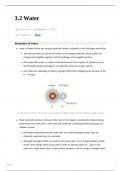
water is formed when one oxygen molecule bonds covalently to two hydrogen molecules
the electrons that are shared are closer to the oxygen molecule which makes the
oxygen atom slightly negative and the hydrogen atom slightly positive
this means that water us a polar molecule because it has regions of positivity (near
the hydrogen atoms) and regions of negativity (near the oxygen atoms)
any molecule containing a hydroxyl group (OH) will be slightly polar because of the
O—H bond
the electrons are closer to the oxygen atom, making it slightly negative and the hydrogen slightly positive
Polar molecules interact with each other due to the negative and positive regions being
attracted to each other, this is why ions and molecules containing hydroxyl groups are
soluble in water
the bonds formed between the molecules are called hydrogen bonds, they are
relatively weak and easy to overcome
although hydrogen bonds are weak to overcome, they occur in high numbers which
means more energy needs to be used in order to separate them all— this is why
water has a high latent heat of vaporisation (requires a lot of energy to change state)
3.2 Water 1
First review @September 13, 2023
Practise Q's Done
Structure of water
water is formed when one oxygen molecule bonds covalently to two hydrogen molecules
the electrons that are shared are closer to the oxygen molecule which makes the
oxygen atom slightly negative and the hydrogen atom slightly positive
this means that water us a polar molecule because it has regions of positivity (near
the hydrogen atoms) and regions of negativity (near the oxygen atoms)
any molecule containing a hydroxyl group (OH) will be slightly polar because of the
O—H bond
the electrons are closer to the oxygen atom, making it slightly negative and the hydrogen slightly positive
Polar molecules interact with each other due to the negative and positive regions being
attracted to each other, this is why ions and molecules containing hydroxyl groups are
soluble in water
the bonds formed between the molecules are called hydrogen bonds, they are
relatively weak and easy to overcome
although hydrogen bonds are weak to overcome, they occur in high numbers which
means more energy needs to be used in order to separate them all— this is why
water has a high latent heat of vaporisation (requires a lot of energy to change state)
3.2 Water 1