CRIMINAL: MCQ REVISION NOTES
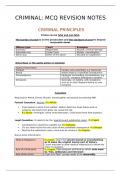
CRIMINAL PRINCIPLES
Crimes can be fatal and non-fatal.
The burden of proof is on the prosecution and the standard of proof is beyond
reasonable doubt.
Offence type Court Examples
Summary Magistrates Assault, criminal damage
Indictable-only Crown Court Murder, manslaughter
Either-way Either of the above Decided at magistrates
Actus Reus The guilty action or omission
Types of Actus Reus
Conduct Certain acts committed, e.g. blackmail
Result Action leads to a specified consequence
Circumstances Particular surrounding circumstances, e.g.
s1(1)TA: ‘property belonging to another’.
Omissions Generally, no liability, with exceptions
such as on duty lifeguard failing to save
someone
Causation
Required for Result Crimes: Murder, manslaughter and assault occasioning ABH.
Factual Causation- ‘But for’ (R v White)
D put poison in drink to kill mother. Mother died from heart failure and no
evidence she drank from glass. No causal link est.
R v Dyson: meningitis, threw child downstairs. Child would have died anyways.
Legal Causation- D needs to be the ‘operating and substantial cause’- R v Pagett.
Consequences caused by culpable act- R v Dalloway.
D’s act need not be the only cause of the prohibited consequence- R v Bengee
Must be the substantial cause, more than de minimus- R v Hughes.
Novus Actus Interveniens
Medical Negligence R v Smith: only if the second wound so overwhelming
as to make the original merely part of history.
Courts reluctant to allow medical malpractice to break the
chain of causation.
Acts of a third party R v Pagett: Used pregnant girlfriend as shield. Acts must
be ‘free, deliberate and informed’.
Acts of the victim Fright and flight- escape needs to be reasonably
, foreseeable by the reasonable person. R v Roberts-
needs to be so ‘daft’ no reasonable person would have
foreseen it.
Refusing medical treatment- Never breaks the chain R v
Dear
Suicide- R v Wallace: would break chain if injuries
have healed but D goes on to die by suicide.
Thin Skull rule D takes victim as they find them, R v Haywood: man
chased woman who died from abnormal thyroid condition.
He still killed her.
Natural Events Would only break the chain if ‘extraordinary’ and not
reasonably foreseeable. R v Girdler- common sense to
be used.
Omissions
Basic Rule: No liability for omissions as no general duty to act (R v Smith
Prosecution must prove:
Crime is capable of being committed by omission. Some offences can only be
committed by an act, e.g., manslaughter.
Accused under legal duty to act.
Duty was breached.
Breach caused actus reus.
Accused had required Mens rea.
(William))
Legal duty to act can arise from:
Statutory duty e.g., Road Traffic Act 1988- failure to provide
specimen of breath.
Special relationship Doctors/Patients, Parents/Children, Spouses
R v Gibbons and Proctor: child deliberately
starved to death.
Voluntary Assumption of R v Nicholls: person chooses to take care of
Responsibility someone ill, inform or infant, they assume
responsibility for them.
Breach of contractual duty R v Pittwood: failed to close gate which was part
of job.
Defendant creates dangerous R v Miller: If person inadvertently sets in motion
situation a chain of events and can prevent further
damage, inaction becomes an omission.
Legal duty to act R v Dytham: on duty police officer chose to
ignore man being violently kicked outside of club
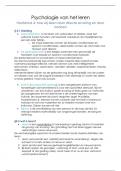
, Mens Rea- the ‘guilty mind’
Specific intent = Intent only
Basic intent = Intent or recklessness
Ulterior Intent = mens rea going beyond the actus reus
Intention
Direct- the aim or purpose of the act (R v Moloney)
Indirect/Oblique- defendant foes something manifestly dangerous, resulting in the
act. (R v Woolin) TEST
Objective limb the act committed was a virtual certainty as a result of the D’s
action.
Subjective limb Defendant appreciated that this was the case
Recklessness
R v G [2003]:
D is aware of the risk (Subjective)
In the circumstances, it was unreasonable to take that risk (Objective)
Negligence
A reasonable person would have foreseen the risk
Coincidence of the Actus Reus + Mens Rea
General Rule: The defendant must have the relevant mens rea for the offence
at the precise moment when the D commits the actus reus.
Continuing Act Theory: D forms mens rea at some point during the actus reus
continuing- Fagan v Metropolitan Police Commissioner: Fagan drove onto policeman’s
foot by accident, then refused to move it. Mens rea resulted after continuing act.
One Transaction Principle: A series of acts, making up one transaction- Thabo Meli
[1954]. D rolled body over cliff, thinking victim dead. Victim actually died of exposure,
did not matter as the series of acts formed one transaction.
CRIMINAL PRINCIPLES
Crimes can be fatal and non-fatal.
The burden of proof is on the prosecution and the standard of proof is beyond
reasonable doubt.
Offence type Court Examples
Summary Magistrates Assault, criminal damage
Indictable-only Crown Court Murder, manslaughter
Either-way Either of the above Decided at magistrates
Actus Reus The guilty action or omission
Types of Actus Reus
Conduct Certain acts committed, e.g. blackmail
Result Action leads to a specified consequence
Circumstances Particular surrounding circumstances, e.g.
s1(1)TA: ‘property belonging to another’.
Omissions Generally, no liability, with exceptions
such as on duty lifeguard failing to save
someone
Causation
Required for Result Crimes: Murder, manslaughter and assault occasioning ABH.
Factual Causation- ‘But for’ (R v White)
D put poison in drink to kill mother. Mother died from heart failure and no
evidence she drank from glass. No causal link est.
R v Dyson: meningitis, threw child downstairs. Child would have died anyways.
Legal Causation- D needs to be the ‘operating and substantial cause’- R v Pagett.
Consequences caused by culpable act- R v Dalloway.
D’s act need not be the only cause of the prohibited consequence- R v Bengee
Must be the substantial cause, more than de minimus- R v Hughes.
Novus Actus Interveniens
Medical Negligence R v Smith: only if the second wound so overwhelming
as to make the original merely part of history.
Courts reluctant to allow medical malpractice to break the
chain of causation.
Acts of a third party R v Pagett: Used pregnant girlfriend as shield. Acts must
be ‘free, deliberate and informed’.
Acts of the victim Fright and flight- escape needs to be reasonably
, foreseeable by the reasonable person. R v Roberts-
needs to be so ‘daft’ no reasonable person would have
foreseen it.
Refusing medical treatment- Never breaks the chain R v
Dear
Suicide- R v Wallace: would break chain if injuries
have healed but D goes on to die by suicide.
Thin Skull rule D takes victim as they find them, R v Haywood: man
chased woman who died from abnormal thyroid condition.
He still killed her.
Natural Events Would only break the chain if ‘extraordinary’ and not
reasonably foreseeable. R v Girdler- common sense to
be used.
Omissions
Basic Rule: No liability for omissions as no general duty to act (R v Smith
Prosecution must prove:
Crime is capable of being committed by omission. Some offences can only be
committed by an act, e.g., manslaughter.
Accused under legal duty to act.
Duty was breached.
Breach caused actus reus.
Accused had required Mens rea.
(William))
Legal duty to act can arise from:
Statutory duty e.g., Road Traffic Act 1988- failure to provide
specimen of breath.
Special relationship Doctors/Patients, Parents/Children, Spouses
R v Gibbons and Proctor: child deliberately
starved to death.
Voluntary Assumption of R v Nicholls: person chooses to take care of
Responsibility someone ill, inform or infant, they assume
responsibility for them.
Breach of contractual duty R v Pittwood: failed to close gate which was part
of job.
Defendant creates dangerous R v Miller: If person inadvertently sets in motion
situation a chain of events and can prevent further
damage, inaction becomes an omission.
Legal duty to act R v Dytham: on duty police officer chose to
ignore man being violently kicked outside of club
, Mens Rea- the ‘guilty mind’
Specific intent = Intent only
Basic intent = Intent or recklessness
Ulterior Intent = mens rea going beyond the actus reus
Intention
Direct- the aim or purpose of the act (R v Moloney)
Indirect/Oblique- defendant foes something manifestly dangerous, resulting in the
act. (R v Woolin) TEST
Objective limb the act committed was a virtual certainty as a result of the D’s
action.
Subjective limb Defendant appreciated that this was the case
Recklessness
R v G [2003]:
D is aware of the risk (Subjective)
In the circumstances, it was unreasonable to take that risk (Objective)
Negligence
A reasonable person would have foreseen the risk
Coincidence of the Actus Reus + Mens Rea
General Rule: The defendant must have the relevant mens rea for the offence
at the precise moment when the D commits the actus reus.
Continuing Act Theory: D forms mens rea at some point during the actus reus
continuing- Fagan v Metropolitan Police Commissioner: Fagan drove onto policeman’s
foot by accident, then refused to move it. Mens rea resulted after continuing act.
One Transaction Principle: A series of acts, making up one transaction- Thabo Meli
[1954]. D rolled body over cliff, thinking victim dead. Victim actually died of exposure,
did not matter as the series of acts formed one transaction.