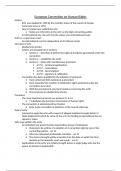
European Convention on Human Rights
History
- Echr was adapted in 1950 by the member states of the council of Europe
- Came into force in 1953
- Now 47 states have ratified the echr
o States are referred to in the echr as the high contracting parties
- In international law, the echr has the status of an international treaty
Ecthr is a supervisory court
- An international court & independent of all national courts
Structure of echr
- Divided into articles
- Articles are grouped into 3 sections
o Section 1 – describes & defines the rights & freedoms guaranteed under the
convention
o Section 2 – establishes the ecthr
o Section 3 – deals with miscellaneous provisions
Art 56 – territorial applications
Art 57 – reservations
Art 58 – denunciations
Art 59 – signature & ratification
- Convention has been amplified by the adoption of protocols
o Have concerned both substance & procedure
o Have expanded the number of substantive rights protected under the
convention &/or deal
o With the procedural & structural matters concerning the ecthr
o The protocols are divided into articles
Procedure
- The most important protocols are protocol 11 & 14
o 11 abolishes the European commission of human rights
- The convention is administered by 2 bodies
o Ecthr & the committee of ministers of the council of Europe
Role of ecthr
- Interpret & apply the echr with respect of alleged violations brought before it
- Make judgements which by virtue of the echr are binding in international law on
signatory states
Who may petition the ecthr
- An individual non-governmental organisation/ group of individuals
o Claiming to be victims of a violation of a convention right by one of the
contracting parties – art 34
o Who has exhausted all domestic remedies – art 35
o The claim is brought within 6 months from the date on which the final
decision in the domestic court was made – art 35
- Applications to the ecthr are initially brought before a single judge who has the
power to declare it inadmissible
History
- Echr was adapted in 1950 by the member states of the council of Europe
- Came into force in 1953
- Now 47 states have ratified the echr
o States are referred to in the echr as the high contracting parties
- In international law, the echr has the status of an international treaty
Ecthr is a supervisory court
- An international court & independent of all national courts
Structure of echr
- Divided into articles
- Articles are grouped into 3 sections
o Section 1 – describes & defines the rights & freedoms guaranteed under the
convention
o Section 2 – establishes the ecthr
o Section 3 – deals with miscellaneous provisions
Art 56 – territorial applications
Art 57 – reservations
Art 58 – denunciations
Art 59 – signature & ratification
- Convention has been amplified by the adoption of protocols
o Have concerned both substance & procedure
o Have expanded the number of substantive rights protected under the
convention &/or deal
o With the procedural & structural matters concerning the ecthr
o The protocols are divided into articles
Procedure
- The most important protocols are protocol 11 & 14
o 11 abolishes the European commission of human rights
- The convention is administered by 2 bodies
o Ecthr & the committee of ministers of the council of Europe
Role of ecthr
- Interpret & apply the echr with respect of alleged violations brought before it
- Make judgements which by virtue of the echr are binding in international law on
signatory states
Who may petition the ecthr
- An individual non-governmental organisation/ group of individuals
o Claiming to be victims of a violation of a convention right by one of the
contracting parties – art 34
o Who has exhausted all domestic remedies – art 35
o The claim is brought within 6 months from the date on which the final
decision in the domestic court was made – art 35
- Applications to the ecthr are initially brought before a single judge who has the
power to declare it inadmissible