Poem Analysis for Christina Rossetti’s The Thread of Life
Themes:
Life
Weakness
Delicacy
Heaven
Sublime
Summary:
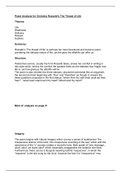
Rossetti’s “The thread of life” is perhaps her most devotional and decisive poem,
pondering the delicate nature of life, yet the glory the afterlife can offer us.
Structure:
Petrarchan sonnet, usually the form Rossetti takes, shows her comfort in writing in
this style which mimics the comfort the speaker feels as she debates how fragile how
life is, yet how glorious the afterlife will be.
The poem is also divided into three stanzas, structured somewhat like an argument,
the second and last beginning with “thus” and “therefore” as though to answer the
three questions proposed in the first stanza: “whom from thy self-chain shall set thee
free?”, “what heart shall touch thy heart? What hand thy hand?
More A* analysis on page 2!
Imagery:
The poem begins with natural imagery which convey a sense of isolationism “the
irresponsive silence of the land,/ the irresponsive sounding of the sea” which with the
assonance of the “o” sounds creates a mournful tone. Both speak of “one message...
aloof, aloof, we stand aloof” which essentially exaggerates the isolation she feels.
Furthermore, there can be a liturgical meaning behind “responsive”, in which the
“response” is the line sung by the choir, however the fact it is “irresponsive” may
Themes:
Life
Weakness
Delicacy
Heaven
Sublime
Summary:
Rossetti’s “The thread of life” is perhaps her most devotional and decisive poem,
pondering the delicate nature of life, yet the glory the afterlife can offer us.
Structure:
Petrarchan sonnet, usually the form Rossetti takes, shows her comfort in writing in
this style which mimics the comfort the speaker feels as she debates how fragile how
life is, yet how glorious the afterlife will be.
The poem is also divided into three stanzas, structured somewhat like an argument,
the second and last beginning with “thus” and “therefore” as though to answer the
three questions proposed in the first stanza: “whom from thy self-chain shall set thee
free?”, “what heart shall touch thy heart? What hand thy hand?
More A* analysis on page 2!
Imagery:
The poem begins with natural imagery which convey a sense of isolationism “the
irresponsive silence of the land,/ the irresponsive sounding of the sea” which with the
assonance of the “o” sounds creates a mournful tone. Both speak of “one message...
aloof, aloof, we stand aloof” which essentially exaggerates the isolation she feels.
Furthermore, there can be a liturgical meaning behind “responsive”, in which the
“response” is the line sung by the choir, however the fact it is “irresponsive” may