STAT1103
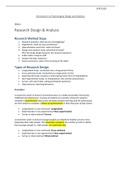
Introduction to Psychological Design and Statistics
Week 2
Research Design & Analysis
Research Method Steps
1. Research question: what are you investigating?
2. Hypotheses: what are your predictions?
3. Operationalise constructs: what and how?
4. Design and conduct study: what kind of study?
(Pick the study design based on the research question)
5. Collect data: measure stuff.
6. Analyse the data: Statistics!
7. Draw conclusions: what is the meaning of the data?
Types of Research Design
• Longitudinal study: conducted over a long period of time.
• Cross-sectional study: conducted at a single point in time.
• Experimental study: involves a control group and a form of manipulation.
• Non-experimental study: no manipulation, less control and precision.
• Survey: self-report data, asking participants questions.
• Observational: watching behaviour.
Examples:
A researcher wants to know if conscientiousness is a stable personality trait during
childhood and adolescence. A group of students at a primary school are asked to
complete a questionnaire about their attitudes towards learning, and the same group
are then asked to complete a follow-up questionnaire in their final year of high school.
• Longitudinal or cross-sectional? Longitudinal
• Experimental or non-experimental? Non-experimental
• Survey or observational? Survey
A researcher wants to know if younger people use telephone helpline services more
frequently than older people. The researcher compares the number of calls to Lifeline
from younger people vs. older people on a particular day.
• Longitudinal or cross-sectional? Cross-sectional
• Experimental or non-experimental? Non-experimental
• Survey or observational? Observational
, STAT1103
Criteria for Cause and Effect
1. Covariance rule there must be a relationship
1. Temporal cause must precede effect
precedence
rule
1. Internal validity excluding other potential causes of the effect
rule
Correlation does not imply causation!
• Lab experiments: high internal validity, allowing us to make strong casual conclusions.
• Field experiments: high external validity, allowing us to generalise to the real world.
Example:
A researcher measures mood for a group of people who have listened to happy music
for 30 minutes and for a second group who have listened to sad music for 30 minutes.
The happy music group was tested outdoors in the sunlight, and the sad music group
was tested in a dark room with no windows. Different mood scores were recorded for
the two groups.
Can the researcher conclude that there is a cause-and-effect (causal) relationship between
type of music and mood? Why or why not? No, because the researcher has not excluded
other potential causes (e.g., testing environment).
Methods of Acquiring Knowledge
• Intuition: gut feelings, emotions, instincts.
• Authority: accepting new ideas because an authority figure said so.
• Rationalism: logic and reasoning.
• Empiricism: observation and experience.
• The scientific method: collect, evaluate and measure data.
Key Features of Science
1. Systematic empiricism: systematically observing the natural world.
2. Empirical questions: about why the world is the way it is.
3. Public knowledge: conclusions, published to the public.
Three Goals of Science: to describe, to predict, to explain
Research
• Basic research: achieve a more accurate understanding of human behaviour.
• Applied research: addressing a problem.
• Empirically supported treatment: has been studied and shows to give greater improvement
than no treatment, placebo or alternative.
, STAT1103
Data & Variables
Data Definitions:
• Population: the wider group of interest.
• Sample: a selection of the population who data is collected from.
• Unit of observation: the level you are sampling, e.g. individual, school, organisation, country.
• Variable: the piece of information you collect.
Variable Definitions:
• Quantitative: numeric, from experiment or survey (age, weight, height)
• Qualitative: descriptive, from interview or survey (colour, car, suburb)
• Discrete: whole numbers (rank order: place, age)
• Continuous: data, decimal places (weight, temperature)
• Nominal: unordered, categorical (employment status, eye colour)
• Ordinal: ordered, categorical (grade, clothing size, place in race, age group)
• Interval: numerical scale (temperature, IQ score)
• Ratio: numeric, 0 = absence (number of siblings, study time, age in years, height, salary)
Variable Types
Independent & Dependant Variables
• Independent variable (IV): Predict, explain, cause change in the outcome, e.g. therapy.
• Dependant variable (DV): the outcome, e.g. level of anxiety after therapy.
Experimental: the IV can cause change in the DV.
Non-experimental: IV can be associated with or predict the DV.
Examples:
A researcher wants to know if students who engage in regular group study sessions feel
more motivated at the end of the semester than students who study individually.
• What is the IV? Study mode
• What is the DV? Motivation
A researcher wants to know if ice-cream shops sell more ice-creams on hotter days.
• What is the IV? Temperature
• What is the DV? Number of ice-creams sold
Extraneous & Confounding Variables
• Extraneous variable: not the IV or the DV.
• Confounding variable: extraneous variable that can explain the IV and the DV's relationship.
Example:
A researcher wants to know if daily exercise can help to regulate stress. Over a two-week
period, one group of participants attended daily spin classes, and a second group
were instructed not to do any intentional exercise. Participants were asked to rate their
stress levels at the beginning and at the end of the two-week period. Participants in the
, STAT1103
first group primarily followed a vegan diet, while those in the second group consumed a
diet high in meat products.
• What are some extraneous variables? Age, gender, occupation
• What is a potential confounding variable? Diet
Descriptive Statistics
• Mode: most frequently occurring score.
• Median: the mid point of the distribution (M or Med or x̃)
• Mean: the average (x̅ or μ "mu")
• Range: distance between highest and lowest score.
• Standard deviation: distance of score from mean (σ “sigma”)
• The interquartile range: the difference between the upper quartile and the lower quartile.
• Variance: standard deviation squared.
• Correlation Coefficient: strength and direction of two variables (ρ “rho”)
Inferential Statistics:
Allow researchers to draw conclusions about the population based on data.
Reading an Academic Paper
First Pass
• Read the abstract, section headings, introduction, conclusion, diagram descriptions.
• Highlight any unfamiliar words.
• Ask what is the point, what are the pain arguments, why is it important?
• Summarise in a sentence or two.
Second Pass
• Read the whole paper.
• Pay closer attention.
• Answer the questions I wrote down earlier.
Third Pass
• Reflect and analysis.
• Take notes.
• This pass should give me the basis for my summary.
Stata Code
Suppose we wanted to recode the Age variable into a three level categorical variable where:
• Ages less than 30 are coded as 0
• Ages from 31 - 60 are coded as 1
• Ages older than 60 are coded as 2
We just have to type: recode Age (min/30 = 0) (31/60 = 1) (61/max = 2), generate(Age_cat)
Create value labels for the categories: label define Agegrps 0 "<31" 1 "31-60" 2 ">60"
label values Age_cat Agegrps
Frequency table: tab1 variable
Introduction to Psychological Design and Statistics
Week 2
Research Design & Analysis
Research Method Steps
1. Research question: what are you investigating?
2. Hypotheses: what are your predictions?
3. Operationalise constructs: what and how?
4. Design and conduct study: what kind of study?
(Pick the study design based on the research question)
5. Collect data: measure stuff.
6. Analyse the data: Statistics!
7. Draw conclusions: what is the meaning of the data?
Types of Research Design
• Longitudinal study: conducted over a long period of time.
• Cross-sectional study: conducted at a single point in time.
• Experimental study: involves a control group and a form of manipulation.
• Non-experimental study: no manipulation, less control and precision.
• Survey: self-report data, asking participants questions.
• Observational: watching behaviour.
Examples:
A researcher wants to know if conscientiousness is a stable personality trait during
childhood and adolescence. A group of students at a primary school are asked to
complete a questionnaire about their attitudes towards learning, and the same group
are then asked to complete a follow-up questionnaire in their final year of high school.
• Longitudinal or cross-sectional? Longitudinal
• Experimental or non-experimental? Non-experimental
• Survey or observational? Survey
A researcher wants to know if younger people use telephone helpline services more
frequently than older people. The researcher compares the number of calls to Lifeline
from younger people vs. older people on a particular day.
• Longitudinal or cross-sectional? Cross-sectional
• Experimental or non-experimental? Non-experimental
• Survey or observational? Observational
, STAT1103
Criteria for Cause and Effect
1. Covariance rule there must be a relationship
1. Temporal cause must precede effect
precedence
rule
1. Internal validity excluding other potential causes of the effect
rule
Correlation does not imply causation!
• Lab experiments: high internal validity, allowing us to make strong casual conclusions.
• Field experiments: high external validity, allowing us to generalise to the real world.
Example:
A researcher measures mood for a group of people who have listened to happy music
for 30 minutes and for a second group who have listened to sad music for 30 minutes.
The happy music group was tested outdoors in the sunlight, and the sad music group
was tested in a dark room with no windows. Different mood scores were recorded for
the two groups.
Can the researcher conclude that there is a cause-and-effect (causal) relationship between
type of music and mood? Why or why not? No, because the researcher has not excluded
other potential causes (e.g., testing environment).
Methods of Acquiring Knowledge
• Intuition: gut feelings, emotions, instincts.
• Authority: accepting new ideas because an authority figure said so.
• Rationalism: logic and reasoning.
• Empiricism: observation and experience.
• The scientific method: collect, evaluate and measure data.
Key Features of Science
1. Systematic empiricism: systematically observing the natural world.
2. Empirical questions: about why the world is the way it is.
3. Public knowledge: conclusions, published to the public.
Three Goals of Science: to describe, to predict, to explain
Research
• Basic research: achieve a more accurate understanding of human behaviour.
• Applied research: addressing a problem.
• Empirically supported treatment: has been studied and shows to give greater improvement
than no treatment, placebo or alternative.
, STAT1103
Data & Variables
Data Definitions:
• Population: the wider group of interest.
• Sample: a selection of the population who data is collected from.
• Unit of observation: the level you are sampling, e.g. individual, school, organisation, country.
• Variable: the piece of information you collect.
Variable Definitions:
• Quantitative: numeric, from experiment or survey (age, weight, height)
• Qualitative: descriptive, from interview or survey (colour, car, suburb)
• Discrete: whole numbers (rank order: place, age)
• Continuous: data, decimal places (weight, temperature)
• Nominal: unordered, categorical (employment status, eye colour)
• Ordinal: ordered, categorical (grade, clothing size, place in race, age group)
• Interval: numerical scale (temperature, IQ score)
• Ratio: numeric, 0 = absence (number of siblings, study time, age in years, height, salary)
Variable Types
Independent & Dependant Variables
• Independent variable (IV): Predict, explain, cause change in the outcome, e.g. therapy.
• Dependant variable (DV): the outcome, e.g. level of anxiety after therapy.
Experimental: the IV can cause change in the DV.
Non-experimental: IV can be associated with or predict the DV.
Examples:
A researcher wants to know if students who engage in regular group study sessions feel
more motivated at the end of the semester than students who study individually.
• What is the IV? Study mode
• What is the DV? Motivation
A researcher wants to know if ice-cream shops sell more ice-creams on hotter days.
• What is the IV? Temperature
• What is the DV? Number of ice-creams sold
Extraneous & Confounding Variables
• Extraneous variable: not the IV or the DV.
• Confounding variable: extraneous variable that can explain the IV and the DV's relationship.
Example:
A researcher wants to know if daily exercise can help to regulate stress. Over a two-week
period, one group of participants attended daily spin classes, and a second group
were instructed not to do any intentional exercise. Participants were asked to rate their
stress levels at the beginning and at the end of the two-week period. Participants in the
, STAT1103
first group primarily followed a vegan diet, while those in the second group consumed a
diet high in meat products.
• What are some extraneous variables? Age, gender, occupation
• What is a potential confounding variable? Diet
Descriptive Statistics
• Mode: most frequently occurring score.
• Median: the mid point of the distribution (M or Med or x̃)
• Mean: the average (x̅ or μ "mu")
• Range: distance between highest and lowest score.
• Standard deviation: distance of score from mean (σ “sigma”)
• The interquartile range: the difference between the upper quartile and the lower quartile.
• Variance: standard deviation squared.
• Correlation Coefficient: strength and direction of two variables (ρ “rho”)
Inferential Statistics:
Allow researchers to draw conclusions about the population based on data.
Reading an Academic Paper
First Pass
• Read the abstract, section headings, introduction, conclusion, diagram descriptions.
• Highlight any unfamiliar words.
• Ask what is the point, what are the pain arguments, why is it important?
• Summarise in a sentence or two.
Second Pass
• Read the whole paper.
• Pay closer attention.
• Answer the questions I wrote down earlier.
Third Pass
• Reflect and analysis.
• Take notes.
• This pass should give me the basis for my summary.
Stata Code
Suppose we wanted to recode the Age variable into a three level categorical variable where:
• Ages less than 30 are coded as 0
• Ages from 31 - 60 are coded as 1
• Ages older than 60 are coded as 2
We just have to type: recode Age (min/30 = 0) (31/60 = 1) (61/max = 2), generate(Age_cat)
Create value labels for the categories: label define Agegrps 0 "<31" 1 "31-60" 2 ">60"
label values Age_cat Agegrps
Frequency table: tab1 variable