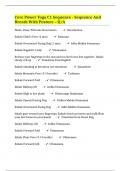
Research and Program Evaluation CPCE Questions and Answers 2023
Research and Program Evaluation CPCE Questions and Answers 2023Reliable If an experiment can be replicated. Parsimony (Occaim's Razor) The finding should be explained and interprited in the simplest and most economic way Experiment The most common type of research. The researcher has control over all relevant variables. Usually conducted in Labs or high control settings. Confounding When undesirable variable enter the experiment. Independent variable (IV) The variable that the experimenter manipulates Dependent variable (DV) The result, the data, the scores, some form of human response. Control Group Group of people who don't receive any form of the IV or experimental variable Experimental Group Group of people who do receive the IV or experimental variable. Random Sampling Every member of the population has an equal probability of being selected for the study and the selection of one member of the population has no effect on the selection of an other member. Random assignment Subjects are randomly assigned to the experimental and control groups. True Experiment Every member has an equal chance of selection AND are randomly assigned to groups. Rare in most studies. Quasi Experiment Any research that fails to use random assignment or lacks a control group. All intact group studies. Stratified Sampling People are selected from sub-groups. Proportional Stratified Sampling The data reflects the pattern that occurs naturally. i.e. the population you are working with is 1/2 black and 1/2 white. Your study would have 1/2 black 1/2 white Cluster Sampling A naturally existing group is selected. i.e. an experiment wanted to show the side effect of a certain drug on substance abusers in treatment users so the experimenter contacts substance abuse programs and selects people from those. "n"th Sampling The experimenter picks every "10"th person or every "2"nd person from a population and that is how your groups are generated. Systematic sampling v. Random sampling Research shows the finding are comparable. Representativeness of the sample More important to the study than the procedure used to select the population. Probability samples Random sampling, Stratified sampling, Cluster sampling, "n"th sampling. Non-probability samples Subjects are not selected based on probability. (Judgement sampling, convenience sampling, quota sampling) Judgement Sampling Uses the judgement of the experimenter to choose subjects that are thought to be representative of the population Convenience Sampling An intact existing group is used with no random sampling Quota Sample The subjects have pre-specified characteristics so that your sample will mimic the same type of characteristics that you assume actually exist in the general population being studied. Hypothesis The idea or question the researcher wants to answer. Null Hypothesis The absence of a relationship between the IV and the DV. No significant difference. The modern form of describing a hypothesis. The hypothesis is written in the present tense without the word significant and without any mention of measurement. You might have sub-hypotheses. A null hypothesis might include interaction hypotheses. Test of significance Determines what the difference is between the control group and the experimental group. Operate on the principle of probability (p). Significate findings p<.05 Only a 5% chance that the difference in the groups occurred by chance. Confidence or Alpha level The level of significance. Alpha Error Reject Null when it is actually true Beta Error Accept Null when it is false The probability of a type 1 error The level of significance. If your p value is .05, then .05 is the probability of making a type one error. Internal validity Does the experiment demonstrate that the DV changes were caused by the IV, does the treatment make a difference. External validity Can the findings of this study be generalized to the general population. Internal threats to validity Instrumentation, Maturation, Statistical regression, Attrition. Instrumentation Threat When instrument or measurement methods or observers opinion changes impact the experiment Maturation Time impacts the results (a person maturing during the study, especially true of developmental studies of children) Statistical regression When extreme scores regress to the mean when a test is re-taken. Attrition or experimenter mortality When the group does not look the same in the beginning as it did in the end because people dropped out or died. Usually during a longitudinal study. Reactive effect People perform better due to being observed Good Study A study cannot have good external validity if it does not have good internal validity. Good internal validity will not guarantee good external validity. t-Test Test a hypothesis between two normally distributed samples. Appropriate use studies using 30 subjects or more. Correlate t-Test There is a measurement for a pre and a post test Independent sample no pre and post test, only 1 test Anova used to compare more than two sets of data. Analyses variance. Results of an anova shown using an f value. Manova used when there is more than one dependent variable Ancova used to adjust groups so that when a variable might correlate with the DV will not throw off the study. Correlational research Does a relationship between two variables exist and if so what is the magnitude and the direction of the relationship. Correlational coefficient can go from -1.00, 0, +1.00 Perfect correlations -1.00 and +1.00 correlations (very rare). The high the number the higher the correlation. .78<-.99 Negative correlation (inverse relationships) 1 variable goes up while one variable goes down. The greater the population of foxes in a area, the lesser the population of rabbits in the area Positive correlation 1 variable goes up the other variable goes up. 1 variable goes down, the other variable goes down Correlation does not imply cause and effect Just because the fox population went up and the rabbit population goes down, does not mean the rabbit population goes down because the fox population went up. Measures of central tendency mean, median, mode Mode most frequent, will always be at the high point of the distribution Bimodal curve There are two modes
Written for
- Institution
- CPCE
- Course
- CPCE
Document information
- Uploaded on
- July 21, 2023
- Number of pages
- 4
- Written in
- 2022/2023
- Type
- Exam (elaborations)
- Contains
- Questions & answers
Subjects
-
research and program evaluation cpce questions and
-
reliable if an experiment can be replicated
-
random sampling every member of the population has
-
cluster sampling a naturally existing group is sel
-
ju

Also available in package deal