Med-Surg Evolve Cardiovascular Questions
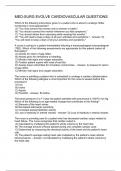
Which of the following instructions given to a patient who is about to undergo Holter monitoring is most appropriate? A) "You may remove the monitor only to shower or bathe." B) "You should connect the monitor whenever you feel symptoms." C) "You should refrain from exercising while wearing this monitor." D) "You will need to keep a diary of all your activities and symptoms." - Answer- D) "You will need to keep a diary of all your activities and symptoms." A nurse is caring for a patient immediately following a transesophageal echocardiogram (TEE). Which of the following assessments are appropriate for this patient (select all that apply)? A) Assess for return of gag reflex. B) Assess groin for hematoma or bleeding. C) Monitor vital signs and oxygen saturation. D) Position patient supine with head of bed flat. E) Assess lower extremities for circulatory compromise. - Answer- A) Assess for return of gag reflex. C) Monitor vital signs and oxygen saturation. The nurse is admitting a patient who is scheduled to undergo a cardiac catheterization. Which of the following allergies is most important for the nurse to assess before this procedure? A) Iron B) Iodine C) Aspirin D) Penicillin - Answer- B) Iodine The blood pressure of a 71-year-old patient admitted with pneumonia is 160/70 mm Hg. Which of the following is an age-related change that contributes to this finding? A) Stenosis of the heart valves B) Decreased adrenergic sensitivity C) Increased parasympathetic activity D) Loss of elasticity in arterial vessels - Answer- D) Loss of elasticity in arterial vessels The nurse is providing care for a patient who has decreased cardiac output related to heart failure. The nurse recognizes that cardiac output is A) Calculated by multiplying the patient's stroke volume by the heart rate. B) The average amount of blood ejected during one complete cardiac cycle. C) Determined by measuring the electrical activity of the heart and the patient's heart rate. D) The patient's average resting heart rate multiplied by the patient's mean arterial blood pressure. - Answer- A) Calculated by multiplying the patient's stroke volume by the heart rate. Which of the following cardiovascular effects of aging should the nurse anticipate when providing care for older adults (select all that apply)? A
Written for
- Institution
- Med-Surg
- Course
- Med-Surg
Document information
- Uploaded on
- November 7, 2023
- Number of pages
- 13
- Written in
- 2023/2024
- Type
- Exam (elaborations)
- Contains
- Questions & answers
Subjects
-
med surg evolve cardiovascular questions
-
which of the following instructions given to a pat
-
a nurse is caring for a patient immediately follow
-
the nurse is admitting a patient who is scheduled

Also available in package deal