NACE CIP 1 Exam
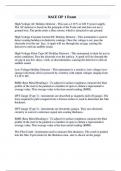
High-Voltage AC Holiday Detector - This uses a 110 V or 220 V power supply. The AC detector is based on the principle of the Tesla coil and does not use a ground wire. The probe emits a blue corona, which is attracted to any ground. High-Voltage Constant Current DC Holiday Detector - This instrument is used to detect coating holidays in dielectric coatings. Once the voltage is set, pass the electrode over the sur- face. A spark will arc through the air gap, causing the detector to emit an audible sound. High-Voltage Pulse-Type DC Holiday Detector - This instrument is ideal for use in moist conditions. Pass the electrode over the surface. A spark will arc through the air gap at any hol- idays, voids, or discontinuities, causing the detector to emit an audible sound. Low-Voltage Holiday Detector - This instrument is a sensitive, low-voltage (wetsponge) electronic device powered by a battery with output voltages ranging from 5-120 V DC. BMR (Base Metal Readings) - To adjust for surface roughness, measure the blast profile of the steel to be painted at a number of spots to obtain a representative average value. This average value is the base metal reading (BMR). DFT Gauge (Type 1) - instruments are described as magnetic pull-off gauges. The force required to pull a magnet from a ferrous surface is used to determine the film thickness. DFT Gauge (Type 2) - instruments are electronic gauges. They use electronic circuitry to convert a reference signal into coating thickness. BMR (Base Metal Readings) - To adjust for surface roughness, measure the blast profile of the steel to be painted at a number of spots to obtain a representative average value. This average value is the base metal reading (BMR). Wet Film Comb - Instrument used to measure film thickness. The comb is pushed into the film. Upon removal, the thickness mea- sure is shown on the gauge.Chlorides - are the salts of hydrochloric acid HCl. The chloride ion forms when the element chlorine picks up one electron to form the anion Cl− (a negatively-charged ion). Nitrates - Nitrates are salts of nitric acid with an ion composed of one nitrogen and three oxy- gen atoms (NO−3). Soluble Salts - These are non-visible and require testing to determine their presence. Although they are termed "soluble" they really are not very soluble at all. Sulfates - are the salts of sulfuric acid; the IUPAC-recommended spelling is sulfate; the British English spelling is sulphate. Acidic Cleaners - Cleaners that remove soil by chemical attack; they dissolve the reaction products. They are usually composed of fairly strong acids, such as phosphoric acid (H3PO4), with small quantities of surfactants, water-miscible solvents, and organic wetting and emulsi- fying agents. Alkaline Cleaners - Cleaners that saponify most oils and greases, and their surfaceactive components wash away other contaminants. These cleaners may also saponify certain coating vehicles. Ceramic Grit - Relatively expensive abrasives that are justified by their special properties. Their particles retain sharp cutting edges, and are especially effective on hard-base materials which may resist effective blasting by chilled cast iron grit. Crushed Slag - Relatively cheap abrasives that are formed from metallurgical processes or combustion. Copper-, nickel-, coal-, and aluminum-slag are common. Detergents - Cleaners that are composed of buffering salts, dispersants, soaps, and inhibitors. They function by wetting, emulsifying, dispersing, and solubilizing the contaminants, which can be washed away using water (usually hot) or steam.
Written for
- Institution
- Nace CIP2
- Course
- Nace CIP2
Document information
- Uploaded on
- November 21, 2023
- Number of pages
- 9
- Written in
- 2023/2024
- Type
- Exam (elaborations)
- Contains
- Questions & answers
Subjects

Also available in package deal