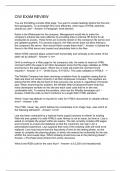
HESI Milestone 2 Exam Study Guide Graded A 2024
What's the Broca's Area control? - Speech located in a convolution adjoining the middle cerebral artery. for control of the combinations of muscular movements needed to speak each word. What are the Chemo Side Effects? - Nausea Vomiting Myelosuppression SIADH Cardiac Toxicity sterility. Chemotherapy-induced neurotoxicity Chemo Brain Fatigue What is Expressive Aphasia? - Inability to express oneself What's the first step of a pt is Dx with Meningitis? - Broad Spectrum Antibiotics What are the sx of - (may not seek health care until he or she experiences blurred vision or "halos") Blurred vision Halos difficulty focusing difficulty adjusting eyes in low lighting loss of peripheral vision aching or discomfort around the eyes headache. What Assessments should an RN conduct for Guillain Barre syndrome? - monitored for life-threatening complications (respiratory failure, cardiac dysrhythmias, VTE [including DVT or PE]) assess the patient's and family's ability to cope Maintain respiratory function Enhancing physical mobility Promote adequate nutrition Improving communication Decreasing fear and anxiety Managing potential complications How does Multiple Sclerosis relate to Urinary Retention? - A neurogenic bladder results in urinary retention or leakage. The patient may describe a sensation of bladder fullness or incomplete bladder emptying. The pharmacological treatment of urinary retention is administration of a cholinergic agonist Traction & Assessment (Blueprint- Fractured Femer Dim Pulses) - After skin traction is applied, the nurse assesses circulation of the foot within 15 to 30 minutes and then every 1 to 2 hours. Circulatory assessment consists of: Peripheral pulses, color, capillary refill, and temperature of the fingers or toes. Manifestations of deep vein thrombosis (DVT), which include unilateral calf tenderness, warmth, redness, and swelling. How is Compartment Syndrome diagnosed - 6 P's pain poikilothermia pallor paresthesia pulselessness paralysis Describe a Normal Sinus Rhythm - begins in the SA node · rate: 60 to 100 bpm · rhythm: Regular · QRS shape and duration: Usually normal, but may be regularly abnormal · P wave: Normal and consistent shape; always in front of the QRS · PR interval: Consistent interval between 0.12 and 0.20 seconds · P:QRS ratio: 1:1 What should an rn teach a pt who is undergoing a Valve Replacement? - VS are assessed every 5 to 15 minutes / PRN After the patient has recovered from anesthesia and sedation, is hemodynamically stable without IV medications, and has stable physical assessment parameters, he or she usually is transferred to a telemetry unit, typically within 24 to 72 hours of surgery. educates the patient about anticoagulant therapy, explaining the need for frequent follow-up appointments and blood laboratory studies. What teaching should a nurse conduct to a mother who was just diagnosed w Engorgement? - sandwich technique :grasp her breast by making a "C" with her thumb and index finger. The thumb stabilizes the top of the breast while the remaining four fingers support her breast from below. Massage or pumping the breast may soften and extend the nipple for easier infant latch-on. What should a nurse do if her patient Refuses RhoGam? - Consider culture Nurses need to respect whatever the mother's decision is.
Written for
- Institution
- HESI Milestone 2.
- Course
- HESI Milestone 2.
Document information
- Uploaded on
- January 17, 2024
- Number of pages
- 14
- Written in
- 2023/2024
- Type
- Exam (elaborations)
- Contains
- Questions & answers
Subjects
- hesi milestone 2 exam
- hesi milestone 2
- hesi
-
hesi milestone 2 exam study guide graded a 2024