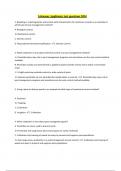
Arkansas Applicator test questions 2024
Arkansas Applicator test questions 2024 1. Breeding or selecting plants and animals with characteristics for resistance to pests is an example of which type of pest management method? A. Biological control. B. Mechanical control. C. Genetic control. D. Physical/environmental modification. C. Genetic Control 3. Which statement is true about chemical control as a pest management method? A. Pesticides play a key role in pest management programs and sometimes are the only control method available. B. Pesticides include any material that is applied to plants and the soil but not to water or harvested crops. C. A highly selective pesticide controls a wide variety of pests. D. Systemic pesticides are not absorbed by treated plants or animals. A. Pesticides play a key role in pest management programs and sometimes are the only control method available. 2. Using a plow to destroy weeds is an example of which type of mechanical control method? A. Exclusion. B. Trapping. C. Cultivation. D. Irrigation. C. Cultivation 4. Which statement is true about pest management goals? A. Pesticides are never used to prevent pests. B. Preventive and suppressive pest control goals are rarely combined. C. Cultivation and mowing of weeds are ways to prevent and suppress pest populations. D. Over large areas, eradication is a practical approach to pest control. C. Cultivation and mowing of weeds are ways to prevent and suppress pest populations. 5. Which term describes the pest population density that causes losses equal to the cost of control measures? A. Economic threshold. B. Economic injury level. C. Action threshold. D. Pest threshold. C. Economic Threshold 6. Which would decrease the likelihood of pesticide resistance? A. Increasing label dosages. B. Using pesticides from the same class of chemicals. C. Applying the pesticide over a wide area. D. Using pesticides with multiple sites of toxicity in an organism. D. Using pesticides with multiple sites of toxicity in an organism. 7. Which federal law requires employers to provide agricultural workers and pesticide handlers with protections against possible harm from pesticides? A. Federal Insecticide, Fungicide, and Rodenticide Act (FIFRA). B. Federal Food, Drug, and Cosmetic Act (FFDCA). C. Food Quality Protection Act (FQPA). D. Worker Protection Standard (WPS). D. Worker Protection Standard (WPS). 8. What are the two main classifications of pesticides under FIFRA? A. Organic and inorganic. B. General-use and unclassified use. C. Regulated and unregulated. D. Unclassified use and restricted-use. D 9. What is a tolerance as set by the EPA? A. The maximum amount of pesticide residue that may legally remain on or in a commodity at the time of harvest or slaughter. B. The maximum amount of pesticide residue that workers may be exposed to during the course of an average workday. C. The minimum amount of pesticide residue that may remain on a crop during the growing season. D. The minimum amount of pesticide residue that may be consumed by a 150-pound person on a yearly basis. A. The maximum amount of pesticide residue that may legally remain on or in a commodity at the time of harvest or slaughter. 10. Which of the following sections under FIFRA could be used to allow the use of an unregistered pesticide to control an "emergency" pest problem? A. Section 3. B. Section 18. C. Section 24 (c). D. Section 25 (b). B. Section 18. 11. The name "VIP No Pest 75WP" on a pesticide label indicates: A. The chemical name and 75 percent inert ingredients formulated as a wettable powder. B. The brand name and 25 percent active ingredients, formulated as a wettable powder. C. The brand name and 75 percent active ingredients, formulated as a wettable powder. D. The chemical name and 25 percent active ingredients, formulated as a wettable powder. C. The brand name and 75 percent active ingredients, formulated as a wettable powder. 12. Which signal word appears on a label with a skull and crossbones symbol? A. DANGER—POISON. B. DANGER. C. WARNING. D. CAUTION. A. DANGER-POISON 13. Which statement is true about protective clothing and equipment statements?
Written for
- Institution
- Arkansas Applicator
- Course
- Arkansas Applicator
Document information
- Uploaded on
- March 23, 2024
- Number of pages
- 12
- Written in
- 2023/2024
- Type
- Exam (elaborations)
- Contains
- Questions & answers
Subjects
-
arkansas applicator test questions 2024

Also available in package deal