CCRN Practice Questions with 100% Correct Answers
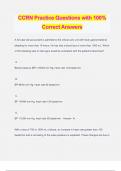
CCRN Practice Questions with 100% Correct Answers A 52-year-old accountant is admitted to the critical care unit with frank gastrointestinal bleeding for more than 18 hours. He has had a blood loss of more than 1000 mL. Which of the following sets of vital signs would be consistent with the patient's blood loss? A. Blood pressure (BP) 100/84 mm Hg, heart rate 124 beats/min B. BP 86/40 mm Hg, heart rate 92 beats/min C. BP 124/66 mm Hg, heart rate 124 beats/min D. BP 112/60 mm Hg, heart rate 92 beats/min - Answer- A! With a loss of 750 to 1500 mL of blood, an increase in heart rate greater than 100 beats/min and a narrowing of the pulse pressure is expected. These changes are due to sympathetic nervous system innervation. Option a shows a narrow pulse pressure and tachycardia. Which is the most critical concern during the acute phase of care for a patient with an intestinal obstruction? A. Aspiration B. Hyperkalemia C. Hypovolemia D. Metabolic alkalosis - Answer- C - hypovolemia In intestinal obstruction, hypovolemia is the result of vomiting and sequestration of fluids in the lumen of the intestine. Intravascular volume decreases which can cause hypovolemic shock. Aspiration is a potential risk if the patient is vomiting. Hypokalemia and metabolic acidosis occur as a result of trapping of fluid within the lumen of the intestine. A patient is brought to the hospital after inadvertent consumption of shellfish. He says he knew he was allergic to shellfish but did not know that the casserole that he was eating had shellfish in it. His face is edematous and his tongue is swollen. His voice is hoarse and he has inspiratory stridor. His medical history includes a myocardial infarction last year, and he has been taking metoprolol (Lopressor) since that time. Symptoms of anaphylaxis would have occurred how long after exposure to the antigen? A. 5 to 20 minutes B. 20 to 60 minutes C. 48 hours D. 3 days - Answer- A Symptoms of anaphylaxis occur within 5 to 20 minutes. These immediate hypersensitivity reactions are life threatening. Later reactions, including cytotoxic hypersensitivity, cause urticaria but rarely are life threatening. Which of the following would not occur during a stressful situation? A. Hypersalivation B. Hyperventilation C. Increased muscle tension D. Palpitations - Answer- A Oral and gastrointestinal secretions are reduced with sympathetic nervous system stimulation. A patient arrives with multisystem trauma after falling out of a second-floor window. She is lethargic and has peripheral cyanosis. Her vital signs are blood pressure 80/60 mm Hg, heart rate 145 beats/min, and respiratory rate 40 breaths/min. Which class of hemorrhagic shock is she in? A. I B. II C. III D. IV - Answer- D. IV
Written for
- Institution
- CCRN
- Course
- CCRN
Document information
- Uploaded on
- March 27, 2024
- Number of pages
- 158
- Written in
- 2023/2024
- Type
- Exam (elaborations)
- Contains
- Questions & answers
Subjects
-
ccrn practice questions with 100 correct answers

Also available in package deal