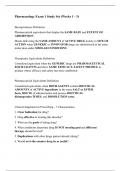
Pharmacology Exam 1 Study Set (Weeks 1 - 3)
Bioequivalence Definition Pharmaceutical equivalents that display the SAME RATE and EXTENT OF ABSORPTION Means delivering the SAME AMOUNT of ACTIVE DRUG moiety to SITE OF ACTION when GENERIC or INNOVATOR drugs are administered at the same molar dose under SIMILAR CONDITIONS Therapeutic Equivalents Definition Considered equivalent when the GENERIC drugs are PHARMACEUTICAL EQUILVALENTS and show SAME EFFICACY, SAFETY PROFILE as product whose efficacy and safety has been established Pharmaceutical Equivalents Definition Considered equivalents when BOTH AGENTS contain IDENTICAL AMOUNTS of ACTIVE ingredients in the same SALT or ESTER form, ROUTE of administration and possess IDENTICAL disintegration TIMES, and DISSOLUTION rates. Clinical Judgement in Prescribing - 7 Characteristics 1. Clear Indication for drug? 2. Drug effective in treating this disorder? 3. What are the goals of taking drug? 4. What conditions determine drug IS NOT meeting goal and different therapy should be tried? 5. Duplications with other drugs patient already taking? 6. Would over-the-counter drug be as useful?7. What about cost? Pre-Clinical - Drug Development Phases: Studies in lab (performed on cells, isolated tissues/organs, animals) Designed to provide basic safety, bioavailability, pharmacokinetic, and initial efficacy data Development of suitable formulation for clinical use Reproductive toxicology Long-term carcinogenic testing Phase I - Drug Development Phases: Healthy people - Volunteers: used to establish: 1. Biological effects 2. Safe Doses and tolerability 3. Pharmacokinetics 4. Pharmacodynamic effect (B/P, HR, ECG) Phase I Drug Development - How Stopped 1. Trial stopped if half-life too short or too long 2. Trial stopped with significant ECG changes, severe adverse effects 3. Trials START with sub-pharmacological doses that are escalated following multiple doses (if safe) 4. Pre-clinical data available 5. Costs: $500,000-1.5M / drug tested Phase II - Drug Development Phases: 1. Used to treat disease in a SMALL NUMBER of patients.2. Establish the ability to IMPROVE patient outcomes Test Efficacy and Safety Phase IIa: Drug limited to single/maximal tolerated dose level. 10-100 patients Phase IIb: Follows proof of concept (Phase IIa) - Several dose levels are tested on target population (dose ranging studies) How Progresses to Phase III - Drug Development Depends on: 1. Drug efficacy relative to competitors 2. Safety profile 3. Probability of technical success and regulatory success 4. Remaining patent life of drug 5. Costs to produce 6. Market share 7 Price 8. Reimbursement Phase III -Drug Development Phases: Minimum of TWO trials; several thousand patients 1. Compare new med to standard therapy 2. Larger number of patients studied in POPULATIONS across the country 3. New drugs have to AS GOOD or BETTER Confirms clinical dose, frequency, and timing of administration Designed to test the hypothesis of efficacy Adverse Effects are collected to assess benefit-risk potential Phase IV - After Market Drug Development 1. Data submitted to regulatory agencies 2. New drug application takes ~15 months to review3. Process is expedited for oncology and HIV 4. Begins with post-marketing or safety surveillance trials 5. Harmful effects are discovered that can lead to the withdrawal of the drug Surveillance - FDA continues to monitor (broader population use) American Physiological Society 1. Translational research = transfers knowledge new/improved methods of preventing, diagnosing, or treating disease. Creates hypothesis 2. Biomarkers = quantitative measures of biological effect; provide links between mechanisms of action and clinical effectiveness 3. Measure changes in biomarkers in both preclinical models and the clinical indicative of the activity of potentially new drug for treating indication Orphan Drug Status 1. Pharmaceuticals to treat rare disease 2. Fast track application (orphan drug act) 3. Disease should affect 200,000 people 4. Market exclusivity for 7 years 5. Direct guidance from FDA on design of clinical plan 6. Cost of developing not covered by expected sales Drug Responses Graded Definition and Rationale for Grading 1. Biological effects that can be measured CONTINUALLY up to MAXIMUM responding capacity of the biological system 2. Most drug responses are [xx] (e.g. changes in B/P after drug given) 3. When [xx], responses are EASIER to MANAGE clinically
Written for
Document information
- Uploaded on
- June 6, 2024
- Number of pages
- 72
- Written in
- 2023/2024
- Type
- Exam (elaborations)
- Contains
- Questions & answers
Subjects
- nurs 615
- pharmacology exam 1
-
pharmacology exam 1 study set weeks 1 3

Also available in package deal