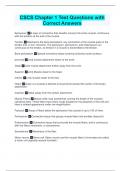
CSCS Chapter 1 Test Questions with Correct Answers
Epimysium A layer of connective that sheaths (covers) the entire muscle, continuous with the tendons at the end of the muscle. Tendon Attached to the bone periosteum; any contraction of the muscle pulls on the tendon and, in turn, the bone. The epimysium, perimysium, and endomysium run continuous to the tendon, so tension in a muscle is transmitted to the tendon. Bone periosteum Special connective tissue covering all bones (outer surface.) proximal Limb muscle attachment closer to the trunk. Distal Limb muscle attachment further away from the trunk. Superior Limb Muscle closer to the head. Inferior Limb muscle closer to the feet. Origin Origin of a muscle is defined at its proximal (toward the center of the body) attachment. Insertion Distal (away from the center) attachment. Muscle Fibers Muscle cells; long (sometimes running the length of the muscle,) cylindrical cells. These fibers have many nuclei situated on the periphery of the cell and have a striated appearance under low magnification. Fasciculi Group of fibers below the epimysium that consist of up to 150 of them. Perimysium Connective tissue that groups muscle fibers into bundles (fasciculi.) Endomysium Connective tissue that surrounds the muscle fibers, and is continuous with the fibers membrane, or sarcolemma. Sarcolemma Membrane of the fiber. Motor neuron Nerve cell. Motor neuron and the muscle fibers it innervates are called a motor unit (typically several hundred.)
Written for
- Institution
- CSCS
- Course
- CSCS
Document information
- Uploaded on
- June 8, 2024
- Number of pages
- 8
- Written in
- 2023/2024
- Type
- Exam (elaborations)
- Contains
- Questions & answers
Subjects
-
cscs chapter 1 test questions with correct answers
-
epimysium a layer of connective that sheaths cov
-
tendon attached to the bone periosteum any contr

Also available in package deal