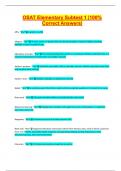
OSAT Elementary Subtest 1 |100%
Correct Answers|
Affix *Ans*✨a prefix or suffix
Allegory *Ans*✨A story, poem, or picture that can be interpreted to reveal a hidden meaning,
typically a moral or political one.
Alphabetic principle *Ans*✨The understanding that words are composed of letters and that there is a
relationship between printed letters and spoken sounds.
Author's purpose *Ans*✨Entertain, persuade, inform, describe, narrate. Authors may have more than
one purpose when writing.
Author's tone *Ans*✨Author's attitude as reflected in the text
Ballad *Ans*✨A narrative poem (that tells a story) and has song-like qualities or is meant to be sung.
Base word *Ans*✨The word to which affixes are attached (aka root word)
Behavioral learning *Ans*✨People learn socially or through some sort of stimulation or repetition
(learning is external)
Biography *Ans*✨A written account of another person's life.
Book club *Ans*✨Organized literature instruction within three literacy units, each of which could last
from 3 to 8 weeks. promotes reader response, incorporating reading, writing responses to text,
discussion groups, and community share.
Character *Ans*✨A fictional personality created by an author
, Characteristics of good readers: *Ans*✨-Think about the information they will read in the text,
formulate questions they predict will be answered in the text, and confirm those predictions from the
information in the text.
-When faced with unfamiliar words, they attempt to pronounce them using analogies to familiar words.
-Before reading, good readers establish a purpose for reading, select possible text structure, choose a
reading strategy, and make predictions about what will be in the reading.
-Continually test and confirm their predictions as they read, go back when something does not make
sense, and make new predictions
Children's literature *Ans*✨Written and/or drawn texts that whether they are intended for published
for, or read by children, are considered children's text. Most common forms: Traditional literature,
folktales/fairy tales, fables, myths, legends, tall tales, modern fantasy, science fiction, modern realistic
fiction, historical fiction, biography, and informational books.
Cognitive approach to language development *Ans*✨Children acquire knowledge of linguistic
structures after they have acquired the cognitive structures necessary to process language.
Cognitive learning *Ans*✨Learning takes place in the mind and the mind processes ideas through
brain mapping and connections with other material and experiences (learning is internal)
Common irregular sight words *Ans*✨Words that are irregular enough not to be considered sight
words that can be easily memorized and cannot be easily decoded because they have irregular spellings
(ex. design and thought)
Contextual redefinition *Ans*✨An activity in which the teacher selects a few words to teach;
challenge students to come up with a definition; then use a context rich sentence with one of the
unknown words then have students come up with the meaning of the unknown word; students must
justify their meaning by referencing the context clues in the sentence.
Description *Ans*✨Piece of writing whose purpose is to make an experience available through one of
the five senses.
Correct Answers|
Affix *Ans*✨a prefix or suffix
Allegory *Ans*✨A story, poem, or picture that can be interpreted to reveal a hidden meaning,
typically a moral or political one.
Alphabetic principle *Ans*✨The understanding that words are composed of letters and that there is a
relationship between printed letters and spoken sounds.
Author's purpose *Ans*✨Entertain, persuade, inform, describe, narrate. Authors may have more than
one purpose when writing.
Author's tone *Ans*✨Author's attitude as reflected in the text
Ballad *Ans*✨A narrative poem (that tells a story) and has song-like qualities or is meant to be sung.
Base word *Ans*✨The word to which affixes are attached (aka root word)
Behavioral learning *Ans*✨People learn socially or through some sort of stimulation or repetition
(learning is external)
Biography *Ans*✨A written account of another person's life.
Book club *Ans*✨Organized literature instruction within three literacy units, each of which could last
from 3 to 8 weeks. promotes reader response, incorporating reading, writing responses to text,
discussion groups, and community share.
Character *Ans*✨A fictional personality created by an author
, Characteristics of good readers: *Ans*✨-Think about the information they will read in the text,
formulate questions they predict will be answered in the text, and confirm those predictions from the
information in the text.
-When faced with unfamiliar words, they attempt to pronounce them using analogies to familiar words.
-Before reading, good readers establish a purpose for reading, select possible text structure, choose a
reading strategy, and make predictions about what will be in the reading.
-Continually test and confirm their predictions as they read, go back when something does not make
sense, and make new predictions
Children's literature *Ans*✨Written and/or drawn texts that whether they are intended for published
for, or read by children, are considered children's text. Most common forms: Traditional literature,
folktales/fairy tales, fables, myths, legends, tall tales, modern fantasy, science fiction, modern realistic
fiction, historical fiction, biography, and informational books.
Cognitive approach to language development *Ans*✨Children acquire knowledge of linguistic
structures after they have acquired the cognitive structures necessary to process language.
Cognitive learning *Ans*✨Learning takes place in the mind and the mind processes ideas through
brain mapping and connections with other material and experiences (learning is internal)
Common irregular sight words *Ans*✨Words that are irregular enough not to be considered sight
words that can be easily memorized and cannot be easily decoded because they have irregular spellings
(ex. design and thought)
Contextual redefinition *Ans*✨An activity in which the teacher selects a few words to teach;
challenge students to come up with a definition; then use a context rich sentence with one of the
unknown words then have students come up with the meaning of the unknown word; students must
justify their meaning by referencing the context clues in the sentence.
Description *Ans*✨Piece of writing whose purpose is to make an experience available through one of
the five senses.