PSYC 242 EXAM 3 LATEST UPDATED
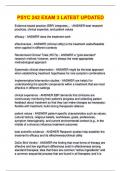
Evidence-based practice (EBP) integrates... - ANSWER best research
practices, clinical expertise, and patient values
efficacy - ANSWER does the treatment work
effectiveness - ANSWER (clinical utility) is the treatment useful/feasible
when applied in different contexts
Randomized Clinical Trials (RCTs) - ANSWER a "gold-standard"
research method; however, aren't always the most appropriate
methodological approach
Systematic clinical observation - ANSWER might be the best approach
when establishing treatment hypotheses for rare symptom combinations
Implementation/intervention studies - ANSWER are helpful for
understanding the specific components within a treatment that are most
effective in different settings
clinical experience - ANSWER EBP demands that clinicians are
continuously monitoring their patient's progress and collecting patient
feedback about treatment so that they can make changes as necessary;
flexible with treatment; build strong therapeutic alliance
patient values - ANSWER patient-specific characteristics such as values,
cultural factors, religious beliefs, worldviews, goals, preferences,
symptom heterogeneity, and current environmental context (e.g., in the
middle of a divorce) influence treatment outcomes
best scientific evidence - ANSWER Research studies help establish the
treatment's efficacy and its effectiveness/clinical utility
DoDo Bird Verdict - ANSWER the finding that most forms of therapy are
effective and few significant differences exist in effectiveness among
standard therapies; idea that there are common "active ingredients" and
a common sequential process that are found in all therapies; and it is
, these common active ingredients that explain the effectiveness of
treatment
Client Factors Impacting Treatment - ANSWER Demographics,
Psychological Functioning, Treatment Responsiveness, Personality
Therapeutic Process Factors Impacting Treatment - ANSWER Alliance,
Match with Client, Confront Problems, Mastery
CBT - ANSWER integrates components of Behavioral therapy and
Cognitive therapy with the assumption that thoughts and behaviors and
emotions are inextricably connected.
The clinician is the "______" who is providing psychoeducation
("training") to the client ("player").
The clinician ("_____") assigns homework ("practice") - ANSWER coach
Classical conditioning - ANSWER outlines how behaviors become
associated with certain stimuli/triggers
Operant conditioning - ANSWER states that one's behavior is
determined by the consequences associated with that behavior (e.g.,
positive reinforcement, punishment, etc).
The goal of behavioral therapy is to - ANSWER increase
desirable/adaptive behaviors and to decrease maladaptive behaviors by
either 1) extinguishing conditioned relationships through exposure or
2) changing the consequences associated with those behaviors.
Exposure - ANSWER Associated with classical conditioning
End pairing between anxiety and stimulus
Habituate anxiety
Increase self-efficacy
Systematic desensitization - ANSWER Type of exposure that relies on
anxiety hierarchy where you rate how anxious a stimulus makes you feel
The more exposure, the more habituated anxiety becomes
Evidence-based practice (EBP) integrates... - ANSWER best research
practices, clinical expertise, and patient values
efficacy - ANSWER does the treatment work
effectiveness - ANSWER (clinical utility) is the treatment useful/feasible
when applied in different contexts
Randomized Clinical Trials (RCTs) - ANSWER a "gold-standard"
research method; however, aren't always the most appropriate
methodological approach
Systematic clinical observation - ANSWER might be the best approach
when establishing treatment hypotheses for rare symptom combinations
Implementation/intervention studies - ANSWER are helpful for
understanding the specific components within a treatment that are most
effective in different settings
clinical experience - ANSWER EBP demands that clinicians are
continuously monitoring their patient's progress and collecting patient
feedback about treatment so that they can make changes as necessary;
flexible with treatment; build strong therapeutic alliance
patient values - ANSWER patient-specific characteristics such as values,
cultural factors, religious beliefs, worldviews, goals, preferences,
symptom heterogeneity, and current environmental context (e.g., in the
middle of a divorce) influence treatment outcomes
best scientific evidence - ANSWER Research studies help establish the
treatment's efficacy and its effectiveness/clinical utility
DoDo Bird Verdict - ANSWER the finding that most forms of therapy are
effective and few significant differences exist in effectiveness among
standard therapies; idea that there are common "active ingredients" and
a common sequential process that are found in all therapies; and it is
, these common active ingredients that explain the effectiveness of
treatment
Client Factors Impacting Treatment - ANSWER Demographics,
Psychological Functioning, Treatment Responsiveness, Personality
Therapeutic Process Factors Impacting Treatment - ANSWER Alliance,
Match with Client, Confront Problems, Mastery
CBT - ANSWER integrates components of Behavioral therapy and
Cognitive therapy with the assumption that thoughts and behaviors and
emotions are inextricably connected.
The clinician is the "______" who is providing psychoeducation
("training") to the client ("player").
The clinician ("_____") assigns homework ("practice") - ANSWER coach
Classical conditioning - ANSWER outlines how behaviors become
associated with certain stimuli/triggers
Operant conditioning - ANSWER states that one's behavior is
determined by the consequences associated with that behavior (e.g.,
positive reinforcement, punishment, etc).
The goal of behavioral therapy is to - ANSWER increase
desirable/adaptive behaviors and to decrease maladaptive behaviors by
either 1) extinguishing conditioned relationships through exposure or
2) changing the consequences associated with those behaviors.
Exposure - ANSWER Associated with classical conditioning
End pairing between anxiety and stimulus
Habituate anxiety
Increase self-efficacy
Systematic desensitization - ANSWER Type of exposure that relies on
anxiety hierarchy where you rate how anxious a stimulus makes you feel
The more exposure, the more habituated anxiety becomes