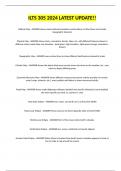
ILTS 305 2024 LATEST UPDATE!!
Political Map - ANSWER shows state/national boundaries and locations of cities (does not include
topographic features)
Physical Map - ANSWER shows rivers, mountains, forests, lakes, etc. with different features shown in
different colors (water-blue, low elevation - dark green, high elevation - light green/orange, mountains -
brown)
Topographic Map - ANSWER uses contour lines to show different land features instead of colors
Climatic Map - ANSWER shows info about what areas receive more rain/snow or dry weather, etc.; uses
colors to depict differing areas
Economic/Resource Map - ANSWER shows different resources/economic activity prevalent in certain
areas (crops, minerals, etc.); uses symbols and letters to show resources/activity
Road Map - ANSWER shows roads/highways/railways; detailed and used for directions (more detailed
the more specific you look, ie: country vs. city)
Total Solar Eclipse - ANSWER Sun, moon, and earth are in a direct line (SME)
Total Lunar Eclipse - ANSWER Moon and sun on direct opposite sides of earth (MSE)
Partial Lunar Eclipse - ANSWER Part of the moon enters Earth's shadow
Partial Solar Eclipse - ANSWER Sun, moon, and Earth not exactly aligned
Annular Solar Eclipse - ANSWER When Moon is farthest from Earth (moon's shadow appears in front of
Sun to make a ring around the moon)
, Simple Circuit Flow Model - ANSWER positively charged electrons -> light bulb -> negatively charged
electrons along a conductor
Chloroplasts - ANSWER contains chlorophyll for photosynthesis, helps plant absorb light energy from the
sun and transform it into carbon dioxide and water into glucose
Chromoplasts - ANSWER provide color for plants and flowers
Central Vacuole - ANSWER Stores water and helps cell wall from bursting
Golgi apparatus - ANSWER A system of membranes that modifies and packages proteins for export by
the cell
Ribosomes - ANSWER Contain RNA, where protein synthesis occurs
Mitochondria - ANSWER Provide energy by breaking down carbs
Lysosome - ANSWER Dispose of waste from cells
Neap tide - ANSWER the tide with the least difference between consecutive low and high tides (sun and
moon at right angle)
Spring tide - ANSWER The tide with the greatest difference between consecutive low and high tides
(moon, earth, and sun in straight line)
Area of a rectangular prism - ANSWER A=2(wl+hl+hw)
Volume of rectangular prism - ANSWER V=lwh
Political Map - ANSWER shows state/national boundaries and locations of cities (does not include
topographic features)
Physical Map - ANSWER shows rivers, mountains, forests, lakes, etc. with different features shown in
different colors (water-blue, low elevation - dark green, high elevation - light green/orange, mountains -
brown)
Topographic Map - ANSWER uses contour lines to show different land features instead of colors
Climatic Map - ANSWER shows info about what areas receive more rain/snow or dry weather, etc.; uses
colors to depict differing areas
Economic/Resource Map - ANSWER shows different resources/economic activity prevalent in certain
areas (crops, minerals, etc.); uses symbols and letters to show resources/activity
Road Map - ANSWER shows roads/highways/railways; detailed and used for directions (more detailed
the more specific you look, ie: country vs. city)
Total Solar Eclipse - ANSWER Sun, moon, and earth are in a direct line (SME)
Total Lunar Eclipse - ANSWER Moon and sun on direct opposite sides of earth (MSE)
Partial Lunar Eclipse - ANSWER Part of the moon enters Earth's shadow
Partial Solar Eclipse - ANSWER Sun, moon, and Earth not exactly aligned
Annular Solar Eclipse - ANSWER When Moon is farthest from Earth (moon's shadow appears in front of
Sun to make a ring around the moon)
, Simple Circuit Flow Model - ANSWER positively charged electrons -> light bulb -> negatively charged
electrons along a conductor
Chloroplasts - ANSWER contains chlorophyll for photosynthesis, helps plant absorb light energy from the
sun and transform it into carbon dioxide and water into glucose
Chromoplasts - ANSWER provide color for plants and flowers
Central Vacuole - ANSWER Stores water and helps cell wall from bursting
Golgi apparatus - ANSWER A system of membranes that modifies and packages proteins for export by
the cell
Ribosomes - ANSWER Contain RNA, where protein synthesis occurs
Mitochondria - ANSWER Provide energy by breaking down carbs
Lysosome - ANSWER Dispose of waste from cells
Neap tide - ANSWER the tide with the least difference between consecutive low and high tides (sun and
moon at right angle)
Spring tide - ANSWER The tide with the greatest difference between consecutive low and high tides
(moon, earth, and sun in straight line)
Area of a rectangular prism - ANSWER A=2(wl+hl+hw)
Volume of rectangular prism - ANSWER V=lwh