Garantie de satisfaction à 100% Disponible immédiatement après paiement En ligne et en PDF Tu n'es attaché à rien 4,6 TrustPilot
logo-home
Examen

ICH4801 Assignment 3 (ANSWERS) 2024 - DISTINCTION GUARANTEED

Note
-
Vendu
-
Pages
27
Grade
A+
Publié le
10-06-2024
Écrit en
2023/2024

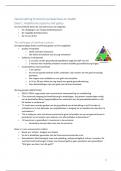
Well-structured ICH4801 Assignment 3 (ANSWERS) 2024 - DISTINCTION GUARANTEED. (DETAILED ANSWERS - DISTINCTION GUARANTEED!)..... Question 1 [40 marks] Questions 1(a) (20 marks) and 1(b) (20 marks) – compulsory 1(a) Comparative education (chapter 8 of the prescribed book) 1. Define “comparative education”. (4) 2. Discuss any four phases of the historical evolution of the field of comparative and international education. (8) ICH4801/101/02024 27 3. Discuss four areas that show the value and the purpose of comparative education and its contribution to education as a whole. (8) [20] AND 1(b) Tanzania (chapters 7 and 10 of the prescribed book) “… [I]f education in Tanzania and, indeed, in other parts of Africa is to mean anything, it must aim at equipping children with the knowledge, skills and attitudes for tackling … societal problems.” (Ndunguru 1976:75) 1. What is your understanding of education for self-reliance? (2) 2. What is generally understood by the concept “Ujamaa”? (2) 3. In a few sentences, explain the aim of education for self-reliance. (8) 4. What were the challenges of education for self-reliance? (8) [20] Question 2 Answer 2.1 or 2.2. 2.1 South Africa (chapter 14 of the prescribed book) “Recent calls for a decolonised curriculum from movements such as #FeesMustFall in South Africa have amplified and refuelled a quest to reassess and develop a curriculum that is relevant to the problems of countries in the Global South. More specifically, these calls are for a decolonised curriculum for these countries. In South Africa, the calls for a decolonised curriculum must be interpreted within broader contextual debates for the internationalisation of the curriculum, and rebuttal of its regressive racial, economic and political status. The arguments for a decolonised curriculum need to take this broader context into consideration. Seroto, J, Davids, MN & Wolhuter, C (eds). (2020). a) Account for the recent calls for a decolonised curriculum by movements such as #FeesMustFall in South Africa. (10) b) Explain the successes and the failures of #FeesMustFall. (5) [15] OR 2.2 India (chapter 9 of the prescribed book) a) Explain the development of formal education in India. (2) b) The aims and purposes of education are determined by the socio-political context. There can also be a divergence between the purposes of education propagated by a 28 government and those demanded by people at large. Indicate the aims and purposes of education in India. (8) c) What were the challenges of formal education in India? (5) Question 3 (chapters 11 and 12 of the prescribed book) Answer 3.1 or 3.2. 3.1 Turkey a) Formal education in Turkey was provided through two channels. Mention the two channels and briefly describe the differences between them. (4) b) What was the purpose of centralising the education system in Turkey? (2) c) With reference to the Basic Law of National Education, what are the objectives of education in Turkey? (5) d) Formal education in Turkey comprises pre-primary education, primary education, secondary education and higher education. Pre-primary education and higher education levels are optional, while primary and secondary education levels are mandatory for all citizens. In the past 20 years, there have been three major changes to mandatory education levels, especially in primary education. Before 1997, primary education was a period of eight years, with five years of elementary and three years of middle school education separately, and only the first five years were mandatory. In 1997, however, these two stages were combined and a period of eight years of primary school was made mandatory (see chapter 11 of the prescribed book). Were all Turkish people happy about this arrangement? Provide reasons for your answer. (4) [15] OR 3.2 Chile Education in Chile: on the path to inclusion? “Among the people who occupied Chile prior to Spanish colonisation, education was carried out within the extended family, in the ‘learning by doing mode’. Emphasis was on learning to understand and communicate with others, nature and the divinity. There were no schools as such.” (Seroto, Davids & Wolhuter 2020 – refer to chapter 12) a) Indicate how the education that was carried out within the extended family in Chile was affected by the arrival of Spanish colonisers. (4) b) How did the colonisers respond to family petitions? (2) c) What were the aims/objectives of education before the return of democracy in 1990? (5) ICH4801/101/02024 29 d) What were the aims/objectives of education after the return of democracy in Chile? (4) [15] Question 4 (chapter 14 of the prescribed book) Answer 4.1 or 4.2. 4.1 “The medium of teaching and learning has always been a key issue for educational institutions across the world, especially in those nations that were colonised.” (Seroto, Davids & Wolhuter 2020). a) Explain how colonisation has affected the issue of the language of teaching in previously colonised nations. (5) b) Explain the thinking of Wa Thiong’o concerning the issue of the language. (10) [15] OR 4.2 There are authors who claim that the issue of mother tongue is confusing, especially for those who are adopted. Critically discuss mother tongue as a medium of teaching and learning in a multicultural/multilingual society. Use your country as an example. (15) Question 5 (chapter 15 of the prescribed book) Answer 5.1 or 5.2. 5.1 Answer the following questions: a) “In the context of South Africa, the Higher Education Act (No 101 of 1997) governs higher education institutions.” (Seroto, Davids & Wolhuter 2020). Indicate four important stipulations in this Act. (4) b) Account for the development of higher education during apartheid. Refer to the policies and the legislation that guided educational segregation. (6) c) After the apartheid era, the higher education system had to undergo fundamental changes to transform South Africa into a non-racial democracy. To expedite the transformation of higher education in the post-apartheid period, three important initiatives were adopted (see chapter 15 of the prescribed book). Discuss two of these initiatives. (5) [15] 30 OR 5.2 Answer the following questions: a) Policies played an important role in the development of higher education in South Africa after 1994. Indicate any five important policies that led to the reform of higher education (refer to chapter 15 of the prescribed book). (5) b) Highlight current views on the decolonisation of South African higher education, with specific reference to: (10) - the concept of colonisation and Battiste’s views on indigenous students - the #FeesMustFall campaign - the Africanisation of the curriculum

Montrer plus Lire moins
Établissement
Cours

Aperçu du contenu

ICH4801
Assignment 3 2024
Unique Number: 322793
Due Date: 22 July 2024

SECTION A: COMPULSORY SECTION

QUESTION 1

Questions 1(a)

1.
Comparative education is a detailed study of educational systems to determine how people's
values and beliefs affect their educational system and provide a suitable education.

Comparative education is a comparative study of educational theories and practices in various
countries.
DISCLAIMER Comparative
& TERMS OF USE education attempts to use cross-national data to test propositions about
1. Educational Aid: These study notes are designed to serve as educational aids and should not be considered as a
substitute for individual research, critical thinking, or professional guidance. Students are encouraged to
conduct their own extensive research and consult with their instructors or academic advisors for specific
assignment requirements.
2. Personal Responsibility: While every effort has been made to ensure the accuracy and reliability of the
information provided in these study notes, the seller cannot guarantee the completeness or correctness of all
the content. It is the responsibility of the buyer to verify the accuracy of the information and use their own
judgment when applying it to their assignments.
3. Academic Integrity: It is crucial for students to uphold academic integrity and adhere to their institution's
policies and guidelines regarding plagiarism, citation, and referencing. These study notes should be used as a
tool for learning and inspiration, but any direct reproduction of the content without proper acknowledgment and
citation may constitute academic misconduct.
4. Limited Liability: The seller of these study notes shall not be held liable for any direct or indirect damages,
losses, or consequences arising from the use of the notes. This includes, but is not limited to, poor grades,
academic penalties, or any other negative outcomes resulting from the application or misuse of the information
provided.
]

Livre connecté

École, étude et sujet

Établissement
Cours

Infos sur le Document

Publié le
10 juin 2024
Nombre de pages
27
Écrit en
2023/2024
Type
Examen
Contient
Questions et réponses

Sujets

€3,89
Accéder à l'intégralité du document:

Garantie de satisfaction à 100%
Disponible immédiatement après paiement
En ligne et en PDF
Tu n'es attaché à rien

Faites connaissance avec le vendeur

Seller avatar
Les scores de réputation sont basés sur le nombre de documents qu'un vendeur a vendus contre paiement ainsi que sur les avis qu'il a reçu pour ces documents. Il y a trois niveaux: Bronze, Argent et Or. Plus la réputation est bonne, plus vous pouvez faire confiance sur la qualité du travail des vendeurs.
Edge
S'abonner Vous devez être connecté afin de suivre les étudiants ou les cours
Vendu
10049
Membre depuis
2 année
Nombre de followers
4253
Documents
3016
Dernière vente
1 heure de cela

4,2

1256 revues

5
712
4
248
3
190
2
31
1
75

Documents populaires

Récemment consulté par vous

Pourquoi les étudiants choisissent Stuvia

Créé par d'autres étudiants, vérifié par les avis

Une qualité sur laquelle compter : rédigé par des étudiants qui ont réussi et évalué par d'autres qui ont utilisé ce document.

Le document ne convient pas ? Choisis un autre document

Aucun souci ! Tu peux sélectionner directement un autre document qui correspond mieux à ce que tu cherches.

Paye comme tu veux, apprends aussitôt

Aucun abonnement, aucun engagement. Paye selon tes habitudes par carte de crédit et télécharge ton document PDF instantanément.

Student with book image

“Acheté, téléchargé et réussi. C'est aussi simple que ça.”

Alisha Student

Foire aux questions