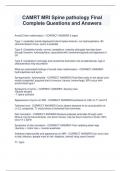
CAMRT MRI Spine pathology Final Complete Questions and Answers
4 vues 0 fois vendu
Cours
CAMRT MRI
Établissement
CAMRT MRI
CAMRT MRI Spine pathology Final
Complete Questions and Answers
Arnold Chiari malformation - CORRECT ANSWER-3 types
Type 1: cerebellar tonsils displaced 5-6mm below foramen, mo hydrocephalus, 4th
ventricle doesnt move, syrinx is possible
Type 2: Cerebellar tonsils, vermis, cerebellum, medulla...
CAMRT MRI Spine pathology Final
Complete Questions and Answers
Arnold Chiari malformation - CORRECT ANSWER-3 types
Type 1: cerebellar tonsils displaced 5-6mm below foramen, mo hydrocephalus, 4th
ventricle doesnt move, syrinx is possible
Type 2: Cerebellar tonsils, vermis, cerebellum, medulla oblongata herniate down
through foramen, hydrocephalus, associated with myelomeningocele and agenesis of
CC
Type 3: Cerebellum meninges and sometimes brainstem into encephalocele, type 2
characteristics may be present
What are associated findings of arnold chiari malformation - CORRECT ANSWER-
hydrocephalus and syrinx
Syringomyelia / hydromyelia - CORRECT ANSWER-Fluid filled cavity in the spinal cord,
mostly congenital, acquired due to tumours, trauma, hemorrhage. 90% occur with
arnold chiari type 1
Sympyoms of syrinx - CORRECT ANSWER--Sensory loss
-Muscle atrophy
- T spine scoliosis
Appearance of syrinx on MRI - CORRECT ANSWER-Isointense to CSF on T1 and T2
Tethered cord - CORRECT ANSWER-Conus doesnt descend to its usual position at
L1/L2, congenital. T1 would show a thickened filum terminale
Disc herniation - CORRECT ANSWER-Nucleus pulposes protrudes through outer
fibrous ring (annulus fibrosis), can pinch nerves, may be due to trauma or strain. 90%
occur in L spine
Symptoms of disc herniation - CORRECT ANSWER--Pain radiating down legs
-Sensory + motor loss + muscle weakness
Vertebral osteomyelitis and appearance on MRI - CORRECT ANSWER-Can occur due
to disc infection, people most at risk: diabetics, steroid/ drug users (heroin)
T1- hypo
Les avantages d'acheter des résumés chez Stuvia:
Qualité garantie par les avis des clients
Les clients de Stuvia ont évalués plus de 700 000 résumés. C'est comme ça que vous savez que vous achetez les meilleurs documents.
L’achat facile et rapide
Vous pouvez payer rapidement avec iDeal, carte de crédit ou Stuvia-crédit pour les résumés. Il n'y a pas d'adhésion nécessaire.
Focus sur l’essentiel
Vos camarades écrivent eux-mêmes les notes d’étude, c’est pourquoi les documents sont toujours fiables et à jour. Cela garantit que vous arrivez rapidement au coeur du matériel.
Foire aux questions
Qu'est-ce que j'obtiens en achetant ce document ?
Vous obtenez un PDF, disponible immédiatement après votre achat. Le document acheté est accessible à tout moment, n'importe où et indéfiniment via votre profil.
Garantie de remboursement : comment ça marche ?
Notre garantie de satisfaction garantit que vous trouverez toujours un document d'étude qui vous convient. Vous remplissez un formulaire et notre équipe du service client s'occupe du reste.
Auprès de qui est-ce que j'achète ce résumé ?
Stuvia est une place de marché. Alors, vous n'achetez donc pas ce document chez nous, mais auprès du vendeur TIFFACADEMICS. Stuvia facilite les paiements au vendeur.
Est-ce que j'aurai un abonnement?
Non, vous n'achetez ce résumé que pour €12,96. Vous n'êtes lié à rien après votre achat.