ALLES IS AFKOMSTIG VAN HET BOEK VAN JOEP CORNELISSEN
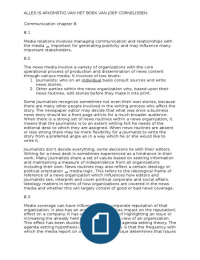
Communication chapter 8
8.1
Media relations involves managing communication and relationships with
the media important for generating publicity and may influence many
important stakeholders.
8.2
The news media involve a variety of organizations with the core
operational process of production and dissemination of news content
through various media. It involves of two levels:
1. Journalists: who on an individual basis consult sources and write
news stories.
2. Other parties within the news organization who, based upon their
news routines, edit stories before they make it into print.
Some journalists recognize sometimes not even their own stories, because
there are many other people involved in the writing process who affect the
story. The newspaper editor may decide that what was once a business
news story should be a front page article for a much broader audience.
When there is a strong set of news routines within a news organization, it
means that the journalists is to an extent writing fort he needs of the
editorial desk to which they are assigned. When news routines are absent
or less strong there may be more flexibility for a journalist to write the
story from a preferred angle an in a way which he or she would like to
write it.
Journalists don’t decide everything; some decisions lie with their editors.
Writing for a news desk is sometimes experienced as a hindrance in their
work. Many journalists share a set of values based on seeking information
and maintaining a measure of independence from all organizations
including their own. News routines may also reflect a certain ideology or
political orientation media logic. This refers to the ideological frame of
reference of a news organization which influences how editors and
journalists see, interpret and cover political corporate and social affairs.
Ideology matters in terms of how organizations are covered in the news
media and whether this will largely consist of good or bad news coverage.
8.3
Media coverage can have influence on the corporate reputation of that
organization. It also has an amplifying (news has impact on the reputation)
effect on a company. It has an impact in terms of highlighting an issue or
increasing the already held positive or negative view of an organization.
This effect has been studied through the lens of agenda setting theory. The
agenda setting hypothesis underlying the theory is that the frequency with
which the media report on a public or political issue determines that issues
, ALLES IS AFKOMSTIG VAN HET BOEK VAN JOEP CORNELISSEN
salience in the minds of the general public. Agenda setting tells people
what to think about. The news media thus set the public agenda.
Agenda setting theory distinguishes two levels of agenda setting:
1. Organization: Objects of news coverage. Focus is on the salience of a
particular organization and the degree to which it readily comes to
mind when a particular topic is being discussed. Deals with salience
of objects.
2. Focuses on the concept of framing by suggesting that the news
media can also influence how people think about a topic by selecting
and placing emphasis on certain attributes or associations or ignore
others. What to say and think about a topic.
The greater the salience issue associated with a company in media
coverage, the better the reputation of the company that is seen to own
that issue.
Corporate reputation is formed through multiple interactions of individuals
with an organization. Not only or even primarily through media coverage.
The status and visibility associated with a strong corporate reputation may
also mean that organizations may get away scot free when negative news
is reported. Second level suggests that news coverage not only reports
facts and neutral observations, but also feelings through its stance and
tone on the issue. Media not only convey information, they actually make
and represent reputational assessments to their audiences the higher the
level of media favourability the higher the level of an organizations
performance.
Corporate communication practitioners are crucial to the formation of the
media agenda. This process is described as agenda building which
involves discussions and debates among multiple groups, including
journalists and communication practitioners is not uni-directional. New
coverage is often the result of interactions between them with each side
impacting one another throughout the process. The news media often rely
upon large and well known corporations for information subsidies, and
there is evidence to support the claim that only companies with significant
corporate reputations wether good or bad are used as information sources.
8.4
The relationship between communication practitioners and journalists has
often been described as adversarial. Communication practitioners realize
that journalists have their own agenda and may frame news about the
company in line their news routines and the ideology of the news
organization that they work for. Journalists and communication
practitioners are interdependent: journalists need and often use
information provided by communication practitioners, and equally,
practitioners and the companies that they work for often need the media
as a conduit to generate coverage on the company and to reach important
stakeholders. Two separate but related process: first is to solicit interest in
Communication chapter 8
8.1
Media relations involves managing communication and relationships with
the media important for generating publicity and may influence many
important stakeholders.
8.2
The news media involve a variety of organizations with the core
operational process of production and dissemination of news content
through various media. It involves of two levels:
1. Journalists: who on an individual basis consult sources and write
news stories.
2. Other parties within the news organization who, based upon their
news routines, edit stories before they make it into print.
Some journalists recognize sometimes not even their own stories, because
there are many other people involved in the writing process who affect the
story. The newspaper editor may decide that what was once a business
news story should be a front page article for a much broader audience.
When there is a strong set of news routines within a news organization, it
means that the journalists is to an extent writing fort he needs of the
editorial desk to which they are assigned. When news routines are absent
or less strong there may be more flexibility for a journalist to write the
story from a preferred angle an in a way which he or she would like to
write it.
Journalists don’t decide everything; some decisions lie with their editors.
Writing for a news desk is sometimes experienced as a hindrance in their
work. Many journalists share a set of values based on seeking information
and maintaining a measure of independence from all organizations
including their own. News routines may also reflect a certain ideology or
political orientation media logic. This refers to the ideological frame of
reference of a news organization which influences how editors and
journalists see, interpret and cover political corporate and social affairs.
Ideology matters in terms of how organizations are covered in the news
media and whether this will largely consist of good or bad news coverage.
8.3
Media coverage can have influence on the corporate reputation of that
organization. It also has an amplifying (news has impact on the reputation)
effect on a company. It has an impact in terms of highlighting an issue or
increasing the already held positive or negative view of an organization.
This effect has been studied through the lens of agenda setting theory. The
agenda setting hypothesis underlying the theory is that the frequency with
which the media report on a public or political issue determines that issues
, ALLES IS AFKOMSTIG VAN HET BOEK VAN JOEP CORNELISSEN
salience in the minds of the general public. Agenda setting tells people
what to think about. The news media thus set the public agenda.
Agenda setting theory distinguishes two levels of agenda setting:
1. Organization: Objects of news coverage. Focus is on the salience of a
particular organization and the degree to which it readily comes to
mind when a particular topic is being discussed. Deals with salience
of objects.
2. Focuses on the concept of framing by suggesting that the news
media can also influence how people think about a topic by selecting
and placing emphasis on certain attributes or associations or ignore
others. What to say and think about a topic.
The greater the salience issue associated with a company in media
coverage, the better the reputation of the company that is seen to own
that issue.
Corporate reputation is formed through multiple interactions of individuals
with an organization. Not only or even primarily through media coverage.
The status and visibility associated with a strong corporate reputation may
also mean that organizations may get away scot free when negative news
is reported. Second level suggests that news coverage not only reports
facts and neutral observations, but also feelings through its stance and
tone on the issue. Media not only convey information, they actually make
and represent reputational assessments to their audiences the higher the
level of media favourability the higher the level of an organizations
performance.
Corporate communication practitioners are crucial to the formation of the
media agenda. This process is described as agenda building which
involves discussions and debates among multiple groups, including
journalists and communication practitioners is not uni-directional. New
coverage is often the result of interactions between them with each side
impacting one another throughout the process. The news media often rely
upon large and well known corporations for information subsidies, and
there is evidence to support the claim that only companies with significant
corporate reputations wether good or bad are used as information sources.
8.4
The relationship between communication practitioners and journalists has
often been described as adversarial. Communication practitioners realize
that journalists have their own agenda and may frame news about the
company in line their news routines and the ideology of the news
organization that they work for. Journalists and communication
practitioners are interdependent: journalists need and often use
information provided by communication practitioners, and equally,
practitioners and the companies that they work for often need the media
as a conduit to generate coverage on the company and to reach important
stakeholders. Two separate but related process: first is to solicit interest in