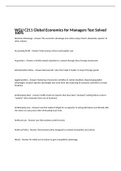
WGU C211 Global Economics for Managers Test Solved 100%
Absolute Advantage - Answer The economic advantage one nation enjoys that is absolutely superior to other nations. Accounting Profit - Answer Total revenue minus total explicit cost Acquisition - Answer a wholly owned subsidiary is created through direct foreign investment. Administrative Policy - Answer Bureaucratic rules that make it harder to import foreign goods. Agglomeration - Answer Clustering of economic activities in certain locations. Beyond geographic advantages, location-specific advantages also arise from the clustering of economic activities in certain locations. Antidumping Duty - Answer Tariffs levied on imports that have been "dumped" (selling below costs to "unfairly" drive domestic firms out of business). Antidumping Law - Answer Law that makes it illegal for an exporter to sell goods below cost abroad with the intent to raise prices after eliminating local rivals. Antitrust Law - Answer Law that outlaws cartels (trusts). Antitrust Policy - Answer Government policy designed to combat monopolies and cartels. Attack - Answer An initial set of actions to gain competitive advantage. Automatic Stabilizers - Answer changes in fiscal policy that stimulate aggregate demand when the economy goes into a recession without policymakers having to take any deliberate action Average fixed cost - Answer Fixed cost divided by the quantity of output AFC = FC/Q Average Revenue - Answer total revenue divided by the quantity sold Average total cost - Answer Total cost divided by the quantity of output *ATC = TC / Q* Average variable cost - Answer Variable cost divided by the quantity of output AVC = VC/Q Balance of payments - Answer a country's international transaction statement. Balance of Trade - Answer The aggregation of importing and exporting that leads to the country-level trade surplus or deficit. Bandwagon effect - Answer the result of investors moving as a herd in the same direction at the same time. ٭ Bank Capital - Answer the resources a bank's owners have put into the institution Bargaining Power - Answer Ability to extract favorable outcome from negotiations due to one party's strengths. Base of the Pyramid - Answer Economies where people make less than $2,000 per capita per year. Beijing Consensus - Answer A view that questions Washington Consensus' belief in the superiority of private ownership over state ownership in economic policy making, which is often associated with the position held by the Chinese government. Bid rate - Answer the price offered to buy a currency. Blue Ocean Strategy - Answer Strategy that focuses on developing new markets ("blue ocean") and avoids attacking core markets defended by rivals, which is likely to result in a bloody price war or a "red ocean." Bounded Rationality - Answer The necessity of making rational decisions in the absence of complete information. Bretton Woods system - Answer a system in which all currencies were pegged at a fixed rate to the U.S. dollar. BRIC - Answer Brazil, Russia, India, and China. Budget Constraint - Answer the limit on the consumption bundles that a consumer can afford *B*uild-*o*perate-*t*ransfer (BOT) agreement - Answer a *non-equity* mode of entry used to build a longer-term presence. Capacity to Punish - Answer Sufficient resources possessed by a price leader to deter and combat defection. Capital flight - Answer a phenomenon in which a large number of individuals and companies exchange domestic currencies for a foreign currency. ٭ Capital Requirement - Answer a government regulation specifying a minimum amount of bank capital Cartel (trust) - Answer An output- and price-fixing entity involving multiple competitors. Central Bank - Answer an institution designed to oversee the banking system and regulate the quantity of money in the economy Civil Law - Answer A legal tradition that uses *comprehensive statutes and codes* as a primary means to form legal judgments. It is "the *oldest*, the most influential, and the *most widely distributed* around the world." ٭ Classical Trade Theories - Answer The major theories of international trade that were advanced before the 20th century, which consist of (1) mercantilism, (2) absolute advantage, and (3) comparative advantage. (static) ٭ Clean (or free) float - Answer a pure market solution to determine exchange rates. ٭ Cognitive Pillar - Answer The internalized (or taken-for granted) *values and beliefs* that guide individual and firm behavior. ٭ Collusion - Answer Collective attempts between competing firms to reduce competition. An agreement among firms in a market about quantities to produce or prices to charge Collusive Price Setting - Answer Price setting by monopolists or collusion parties at a level higher than the competitive level. Co-marketing - Answer refers to efforts among a number of firms to jointly market their products and services. Command Economy - Answer An economy that is characterized by *government ownership and control* of factors of production. All factors of production should be government-owned or state-owned, and all supply, demand, and pricing are planned by the government. ٭ Commodity Wealth - Answer money that takes the form of a commodity with intrinsic value Common Law - Answer A legal tradition that is shaped by *precedents and traditions* from previous judicial decisions. ٭ Comparative Advantage - Answer Relative (not absolute) advantage in one economic activity that one nation enjoys in comparison with other nations. (*produce at a lower relative opportunity cost*) ٭ Competition Policy - Answer Government policy governing the rules of the game in competition. Competitive Dynamics - Answer Actions and responses undertaken by competing firms. Competitive Markets - Answer a market with many buyers and sellers trading identical products so that each buyer and seller is a price taker ٭ Competitor Analysis - Answer The process of anticipating rivals' actions in order to both revise a firm's plan and prepare to deal with rivals' response. Concentration Ratio - Answer The percentage of total industry sales accounted for by the top four, eight, or twenty firms. Constant Returns to Scale - Answer The property whereby long-run average total cost stays the same as the quantity of output changes Consumer Surplus - Answer the amount a buyer is willing to pay for a good minus the amount the buyer actually pays for it (the *area under the demand curve and above the price*.) Consumption - Answer spending by households on goods and services, with the exception of purchases of new housing ٭ Contender - Answer Strategy that centers on a firm engaging in *rapid learning and then expanding* overseas. ٭ Copyright - Answer Exclusive legal right of *authors and publishers* to publish and disseminate their work. Cost - Answer the value of everything a seller must give up to produce a good Counterattack - Answer A set of actions in response to attack. Country-of-origin effect - Answer The positive or negative perception of firms and products from a certain country. Cross-market Retaliation - Answer Retaliatory attacks on a competitor's other markets if this competitor attacks a firm's original market. Crowding-Out Effect - Answer the offset in aggregate demand that results when expansionary fiscal policy raises the interest rate and thereby reduces investment spending Cultural distance - Answer the difference between two cultures along some identifiable dimensions. Currency - Answer the paper bills and coins in the hands of the public Currency board - Answer a monetary authority that issues notes and coins convertible into a key foreign currency at a fixed exchange rate. Currency hedging - Answer a transaction that protects traders and investors from exposure to the fluctuations of the spot rate. ٭ Currency risks - Answer the fluctuations of the foreign exchange market. Currency swap - Answer a foreign exchange transaction in which one currency is converted into another in Time 1, with an agreement to revert it back to the original currency at a specific Time 2 in the future. Dead Weight Cost (also called Dead Weight Loss) - Answer Net losses that occur in an economy as a result of tariffs. Defender - Answer Strategy that centers on *local assets* in areas in which MNEs are weak. ٭ Demand Deposits - Answer balances in bank accounts that depositors can access on demand by writing a check Democracy - Answer A political system in which citizens elect representatives to govern the country on their behalf. Demonstration Effect - Answer The reaction of local firms to rise to the challenge demonstrated by MNEs through learning and imitation. Diminishing Marginal Product - Answer The property whereby the marginal product of an input declines as the quantity of the input increases Direct export - Answer represents the most basic mode of entry, which capitalizes on economies of scale in production concentrated in the home country and affording better control over distribution. Dirty (or managed) float - Answer the common practice of determining exchange rates through selective government intervention. ٭ Discount Rate - Answer the interest rate on the loans that the Fed makes to banks ٭ Diseconomies of Scale - Answer The property whereby long-run average total cost rises as the quantity of output increases Dissemination Risk - Answer The risk associated with unauthorized diffusion of firm-specific know-how. Dodger - Answer Strategy that centers on *cooperating* through *joint ventures* with MNEs and *sell-offs* to MNEs. ٭ Dominant Strategy - Answer a strategy that is best for a player in a game *regardless of the strategies chosen by the other players* Downstream Vertical FDI - Answer A type of vertical FDI in which a firm engages in a downstream stage of the value chain in a host country. Dumping - Answer An exporter selling goods below cost. Economic Profit - Answer Total revenue minus total cost, including both explicit and implicit costs Economic System - Answer Rules of the game on how a country is governed economically. Economies of Scale - Answer The property whereby long-run average total cost falls as the quantity of output increases Efficiency - Answer the property of a resource allocation of maximizing the total surplus received by all members of society Efficiency seeking - Answer firms often single out the most efficient locations featuring a combination of scale economies and low-cost factors. Efficient Scale - Answer The quantity of output that minimizes average total cost Emerging Economies - Answer A term that has gradually replaced the term "developing countries" since the 1990s. Emerging Markets - Answer A term that is often used interchangeably with "emerging economies." Equality - Answer the property of distributing economic prosperity uniformly among the members of society Equity mode - Answer a mode of entry (JVs and wholly owned subsidiaries) that is indicative of relatively larger, harder to reverse commitments. ٭ Expatriate manager (expat) - Answer A manager who works abroad, or "expat" for short. Explicit Collusion - Answer Firms directly negotiate output and pricing and divide markets. Explicit Costs - Answer Input costs that require an outlay of money by the firm Export (X) - Answer Selling abroad. Expropriation - Answer Government's confiscation of foreign assets. Extender - Answer Strategy that centers on *leveraging homegrown competencies* abroad. ٭ Factor Endowment - Answer The extent to which different countries possess various factors of production such as labor, land, and technology. Factor Endowment Theory (or Herchscher-Ohlin theory) - Answer A theory that suggests that nations will develop comparative advantages based on their locally abundant factors. FDI Flow - Answer The amount of FDI moving in a given period (usually a year) in a certain direction. FDI Inflow - Answer Inbound FDI moving into a country in a year. FDI Outflow - Answer Outbound FDI moving out of a country in a year. FDI Stock - Answer Total accumulation of inbound FDI in a country or outbound FDI from a country across a given period (usually several years). Federal Funds Rate - Answer the interest rate at which banks make overnight loans to one another Fiat Money - Answer money without intrinsic value that is used as money because of government decree First-mover advantage - Answer Advantage that first movers enjoy and do not share with late entrants. ٭ Fiscal Policy - Answer the setting of the level of government spending and taxation by government policymakers ٭ Fixed costs - Answer Costs that do not vary with the quantity of output produced (FC) Fixed rate policy - Answer fixing the exchange rate of a currency relative to other currencies. ٭ Floating (or flexible) exchange rate policy - Answer the willingness of a government to let the *demand and supply* conditions determine exchange rates. ٭ *F*oreign *D*irect *I*nvestment (FDI) - Answer Investment in, controlling, and managing value-added activities in other countries. Foreign exchange market - Answer a market where individuals, firms, governments, and banks buy and sell foreign currencies. ٭ Foreign exchange rate - Answer the price of one currency in terms of another. Foreign Portfolio Investment (FPI) - Answer Investment in a portfolio of foreign securities such as stocks and bonds. Formal Institutions - Answer Institutions represented by *laws, regulations, and rules*. ٭ Forward discount - Answer when the forward rate of one currency relative to another currency is higher than the spot rate. Forward premium - Answer when the forward rate of one currency relative to another currency is lower than the spot rate. Forward transaction - Answer a foreign exchange transaction in which participants buy and sell currencies now for future delivery, typically in 30, 90, or 180 days, after the date of the transaction. Fractional Reserve Banking - Answer a banking system in which banks hold only a fraction of deposits as reserves Free Market View - Answer A political view that suggests that FDI unrestricted by government intervention is the best. Free Trade - Answer The idea that free market forces should determine how much to trade with little or no government intervention. Game Theory - Answer A theory that studies the interactions between two parties that compete and/or cooperate with each other. ( the study of how people behave in strategic situations) GDP Deflator - Answer a measure of the price level calculated as the ratio of nominal GDP to real GDP times 100 Giffen Good - Answer a good for which an increase in the price raises the quantity demanded Global Business - Answer Business around the globe. Globalization - Answer The close integration of countries and peoples of the world. Gold standard - Answer a system in which the value of most major currencies was maintained by fixing their prices in terms of gold, which served as the Common denominator. Government Purchases - Answer spending on goods and services by local, state, and federal governments ٭ Greenfield operation - Answer a wholly owned subsidiary is created by building new factories and offices from scratch. Gross Domestic Product (GDP) - Answer The sum of value added by resident firms, households, and governments operating in an economy. The market value of all *final* goods and services *produced within a country* in a given period of time ٭ Gross National Income - Answer GDP plus income from *non-resident* sources *abroad*. GNI is the term used by the World Bank and other international organizations to supersede the term GNP. Gross National Product (GNP) - Answer GDP plus income from *non-resident sources abroad*. ٭ Group of 20 ("The G-20") - Answer The group of 19 major countries plus the European Union (EU) whose leaders meet on a biannual basis to solve global economic problems. Horizontal FDI - Answer A type of FDI in which a firm duplicates its home country-based activities at the same value chain stage in a host country. Implicit Costs - Answer Input costs that do not require an outlay of money by the firm Import (M) - Answer Buying from abroad. Import Quota - Answer Restriction on the quantity of imports (goods bought from abroad). Import Tariff - Answer A tax imposed on imports. Income Effect - Answer the change in consumption that results when a price change moves the consumer to a higher or lower indifference curve Indifference Curve - Answer a curve that shows consumption bundles that give the consumer the same level of satisfaction ٭ Indirect export - Answer a strategy of exporting through domestically based export intermediaries. Infant Industry Argument - Answer The argument that if domestic firms are as young as "infants," in the absence of government intervention, they stand no chances of surviving and will be crushed by mature foreign rivals. Inferior Good - Answer a good for which an increase in income reduces the quantity demanded Informal Institutions - Answer Institutions represented by *cultures, ethics, and norms*. ٭ Innovation seeking - Answer firms target countries and regions renowned for generating world-class innovations. Institutional distance - Answer the extent of similarity or dissimilarity between the regulatory, normative, and cognitive institutions of two countries. Institutional Framework - Answer Formal and informal institutions governing individual and firm behavior. Institutional Transitions - Answer Fundamental and comprehensive changes introduced to the formal and informal rules of the game that affect firms as players. Institution-based View - Answer A leading perspective in global business that suggests that the success and failure of firms are enabled and constrained by institutions. Institutions - Answer Formal and informal rules of the game. Intellectual Property - Answer Intangible property that is the result of intellectual activity. Intellectual Property Rights - Answer Rights associated with the ownership of intellectual property. Internalization - Answer The replacement of cross-border markets (such as exporting and importing) with one firm (the MNE) locating and operating in two or more countries. International Business - Answer (1) A business (or firm) that engages in international (crossborder) economic activities and/or (2) the action of doing business abroad. International Monetary Fund (IMF) - Answer an international organization of 185 member countries that was established to promote international monetary cooperation, exchange stability, and orderly exchange arrangements; to foster economic growth and high levels of employment; and to provide temporary financial assistance to countries to help ease balance of payments adjustment. International Premium - Answer A significant pay raise when working overseas. Intrafirm Trade - Answer International transactions between two subsidiaries in two countries controlled by the same MNE. Investment - Answer spending on capital equipment, inventories, and structures, including household purchases of new housing ٭ Joint venture - Answer a new corporate entity given birth and jointly owned by two or more parent companies. Knowledge Spillover - Answer Knowledge diffused from one firm to others among closely located firms. Late-mover advantages - Answer include free ride on first mover investments, resolution of technical and market uncertainty, and exploit first mover difficulties. ٭ Legal System - Answer The rules of the game on how a country's laws are enacted and enforced. Leverage - Answer the use of borrowed money to supplement existing funds for purposes of investment Liability of Foreignness - Answer The inherent disadvantage that foreign firms experience in host countries because of their non-native status. Licensing/franchising - Answer an agreement in which the licensor/franchisor sells the rights to intellectual property such as patents and know-how to the licensee/franchisee for a royalty fee. Liquidity - Answer the ease with which an asset can be converted into the economy's medium of exchange LLL advantages - Answer A firm's quest of *linkage* (L) advantages, *leverage* (L) advantages, and *learning* (L) advantages. These advantages are typically associated with multinationals from emerging economies. Local Content Requirement - Answer A requirement stipulating that a certain proportion of the value of the goods made in one country must originate from that country. Location - Answer Advantages enjoyed by firms operating in a certain location. Location-specific advantages - Answer favorable locations in certain countries may give firms operating there an advantage. Macroeconomics - Answer the study of economy-wide phenomena, including inflation, unemployment, and economic growth Management Control Rights - Answer The rights to appoint key managers and establish control mechanisms. Marginal cost - Answer The increase in total cost that arises from an extra unit of production MC=
Geschreven voor
- Instelling
- WGU C211
- Vak
- WGU C211
Documentinformatie
- Geüpload op
- 26 april 2023
- Aantal pagina's
- 79
- Geschreven in
- 2022/2023
- Type
- Tentamen (uitwerkingen)
- Bevat
- Vragen en antwoorden
Onderwerpen
-
wgu c211
-
wgu c211 global economics for managers test solved 100
-
absolute advantage the economic advantage one nation enjoys that is absolutely superior to other nations
-
accounting profit total reven

Ook beschikbaar in voordeelbundel